Trying to choose between CELPIPIELTS can feel overwhelming, especially when your immigration, citizenship, study, or career plans depend on getting the right score.
The good news: both tests measure the same core skills (Listening, Reading, Writing, Speaking) but they test them in different ways, use different scoring systems, and are accepted in different places
This guide breaks it down clearly, so you can choose the test that matches your goal and your strengths.

CELPIP vs IELTS: Quick Answer—Which Test Should You Take?
-
Choose CELPIP if you're focused on Canada, prefer Canadian English, and want a fully computer-based test done in one sitting.
-
Choose IELTS if you want global recognition, may need an academic version for university, or prefer a live speaking interview.
What Are CELPIP and IELTS?
CELPIP (Canadian English Focus)
The CELPIP (Canadian English Language Proficiency Index Program) is designed around everyday Canadian English and real-life situations you'd face in Canada: at work, in the community, and in daily life. The CELPIP test is an English language proficiency test accepted by Immigration, Refugees and Citizenship Canada (IRCC) for immigration and citizenship purposes, and the CELPIP exam is built to measure English language proficiency in Canadian contexts.
It offers two common versions in the CELPIP test format:
-
CELPIP–General (Listening, Reading, Writing, Speaking)
-
CELPIP–General LS (Listening, Speaking only)
To find out more about CELPIP, read our guide on what is CELPIP
IELTS (International English Test)
The IELTS (International English Language Testing System) is an IELTS exam used to measure English language proficiency.
It typically comes in the two IELTS tests that IELTS offers: an academic option and a general training version.
-
IELTS General Training (often used for migration/work)
-
IELTS Academic (commonly used for university/college admissions)
The IELTS exam is accepted by over 12,000 organizations worldwide and is commonly used across English-speaking countries for study, work, and immigration purposes among major IELTS tests.
Acceptance: Where Each Test Works Best
Acceptance should be your first filter, because the “best” test is the one your program or institution actually accepts.
For Canadian Immigration (Express Entry / PR)
- Many applicants use CELPIP–General or IELTS General Training, depending on availability and personal preference, and both CELPIP and IELTS are accepted by Immigration, Refugees and Citizenship Canada for immigration purposes. For Canadian immigration applications, the IELTS option used is the IELTS General Training test.
For Canadian Citizenship
- Many applicants choose CELPIP–General LS (Listening + Speaking only), since citizenship requirements often focus on those skills. It is also accepted for Canadian citizenship through Immigration, Refugees and Citizenship Canada, sometimes referred to in older usage as citizenship Canada.
For Study (Universities & Colleges)
-
IELTS Academic is commonly requested by schools internationally, so it can also suit an international student applying to universities outside Canada.
-
CELPIP is generally more Canada-focused, so it may be less useful if your study destination isn't Canada.
For Work and Professional Licensing
Both may be accepted for professional registration, depending on the organization. The key rule:
Always confirm the exact test version required (e.g., “IELTS Academic” vs “IELTS General Training”).
Format: How CELPIP and IELTS Feel on Test Day
CELPIP Format
-
Fully computer-delivered and one of the computer based tests preferred by candidates who like typing and on-screen navigation
-
Typically completed in one sitting
-
Main test sections measure language skills across listening, reading, writing, and speaking skills
-
The celpip speaking test is recorded into a microphone based on on-screen prompts, and some tasks ask you to discuss abstract ideas
-
The celpip listening test features Canadian accents and requires you to answer multiple choice questions
-
The reading section uses multiple choice answers in its format
IELTS Format
-
Available in a different exam format by location, and test centres may offer either a paper based test or computer delivery
-
Speaking is a live interview with an examiner
-
Speaking may be scheduled on a different time/day than the other sections, since ielts splits the speaking interview from the other sections more often than CELPIP
CELPIP vs IELTS: Side-by-Side Comparison
The key differences between the two tests mostly come down to test type, delivery, and scoring system.
| Feature | CELPIP | IELTS |
|---|---|---|
| Primary Focus | Canada (Canadian English + everyday scenarios) | Global (international contexts + accents) |
| Test Versions | General, General LS | General Training, Academic |
| Delivery | Computer-only | Computer or paper (varies by location) |
| Speaking Test | Recorded responses | Live interview with examiner |
| Scores | 1–12 per skill under its scoring system | 0–9 band per skill under its scoring system (often with half bands) |
| Results Speed | Typically 2–4 business days | Often 1–5 days (computer) or 13 days (paper) |
Tip: If you need results fast, both tests can be quick, especially in computer-delivered formats.
Section-by-Section Differences (Listening, Reading, Writing, Speaking)
Listening
What's similar: Both evaluate comprehension through conversations, monologues, and real-life situations.
Key difference:
-
CELPIP tends to use more Canadian/North American contexts and accents.
-
IELTS often includes a wider range of global English accents.
Best for you if:
-
You prefer one accent style and practical situations → CELPIP
-
You want to train for real-world accent variety → IELTS
Reading
Both tests assess your ability to:
-
find details quickly
-
understand main ideas
-
make inferences
Key difference:
-
IELTS reading content varies significantly between Academic and General Training
-
CELPIP tasks often feel more like real documents (emails, diagrams, everyday informational texts)
Best for you if:
-
You like practical reading tasks → CELPIP
-
You need university-level academic reading → IELTS Academic
Writing
Writing is where many test-takers feel the biggest difference, but the writing test on both exams includes two tasks completed in 60 minutes. If you choose CELPIP, strong task performance depends on using effective CELPIP writing strategies for Tasks 1 and 2 that match the scoring criteria.
CELPIP (General) Writing often includes:
-
writing an email
-
responding to a survey question (opinion + reasons)
IELTS Writing depends on version:
-
General Training: letter + essay-style response
-
Academic: diagram/report task + academic essay
Best for you if:
-
You're strong at practical writing (emails, opinions, everyday tone) → CELPIP
-
You're comfortable writing structured essays (especially academic-style) → IELTS
Speaking
This can be the deciding factor.
CELPIP Speaking
-
timed prompts on a computer
-
your responses are recorded
-
you must manage the timer closely
IELTS Speaking
-
live interview
-
feels like a guided conversation
-
examiner can encourage you to keep going
Best for you if:
-
You perform better alone and prefer structured prompts → CELPIP
-
You speak more naturally with a person and like conversational flow → IELTS
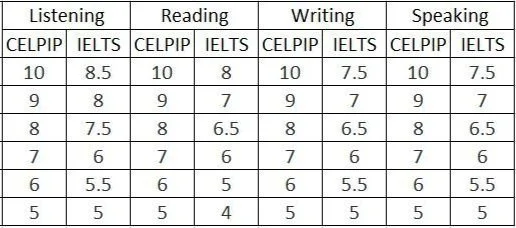
Scoring: CELPIP Levels vs IELTS Bands
CELPIP Scoring
-
Each skill is scored from 1 to 12, and CELPIP scores do not use band scores
-
Scores align closely with the Canadian Language Benchmark used in immigration contexts
-
A score of 7 to 8 is generally considered good for many purposes
-
Scores are valid for two years after the test date
IELTS Scoring
-
Each skill is scored from 0 to 9, and the ielts score is averaged across four sections, often reported with half bands
-
Final score is an average (often reported with half bands)
-
Scores are valid for two years after completion
Why CLB Matters (For Canada)
For Canadian immigration and citizenship purposes, what often matters most is your CLB-equivalent level, not the test name.
That's why many applicants aim for higher benchmark targets (commonly CLB 9+) to maximize points where applicable. Higher language results can also improve your comprehensive ranking system points in Express Entry.
Is CELPIP Easier Than IELTS?
There’s no single easier one test—the answer depends on personal preferences and test taking preferences, because “easier” comes down to how you test best
CELPIP may feel easier if you:
-
prefer Canadian contexts
-
like multiple-choice style
-
are comfortable speaking to a computer
-
want a single sitting with a structured timer
IELTS may feel easier if you:
-
prefer a live speaking conversation
-
like having different test format options (paper/computer)
-
feel confident with essay-style writing
-
want a test with broad global recognition
The better choice is the test that test aligns with your strengths and comfort level.
How to Choose the Right Test
Choose CELPIP if you want:
-
A Canada-focused test with Canadian English
-
Fully computer-delivered testing
-
One sitting, one schedule
-
Practical writing tasks (email + survey response)
Choose IELTS if you want:
-
Wide global acceptance
-
An academic option for university
-
A live speaking interview
-
Paper or computer options (depending on your location)
FAQs
Is CELPIP accepted for Canadian PR?
Yes, many Canadian immigration pathways accept CELPIP (usually the General version).
Is IELTS accepted for Canadian immigration?
Yes, Canada commonly accepts IELTS General Training for immigration pathways.
Which is better for citizenship: CELPIP or IELTS?
Both IELTS and CELPIP can work, depending on what versions are accepted for your situation. Many applicants prefer CELPIP–General LS because it focuses only on Listening and Speaking.
Which test gives faster results?
Both can be fast. CELPIP results are often available in 2–4 business days, and IELTS results can be 1–5 days for computer-based formats (paper-based is typically slower).
Which speaking test is easier?
Not “easier”, just different:
-
CELPIP rewards tight structure and timing
-
IELTS rewards natural conversation, fluency, and range
Final Verdict
If your future is focused on Canada, and you want a fully computer-based test with practical tasks, CELPIP can be an excellent fit.
If you want the most internationally portable option, or you need an academic test for study-IELTS is often the better choice, and it is managed by the British Council and other official partners, which adds to its global recognition among english proficiency tests.
Either way, the smartest choice is the test that:
-
your program accepts as a language proficiency test, and
-
you can score highest on across your english language skills consistently.
Ready to prepare with targeted practice and instant feedback? Explore our AI-powered prep platform to train smarter for CELPIP, and comparing sample tests can also help you choose. If you're focused on CELPIP specifically, you can also ace the CELPIP with structured AI-powered practice that mirrors the real exam.