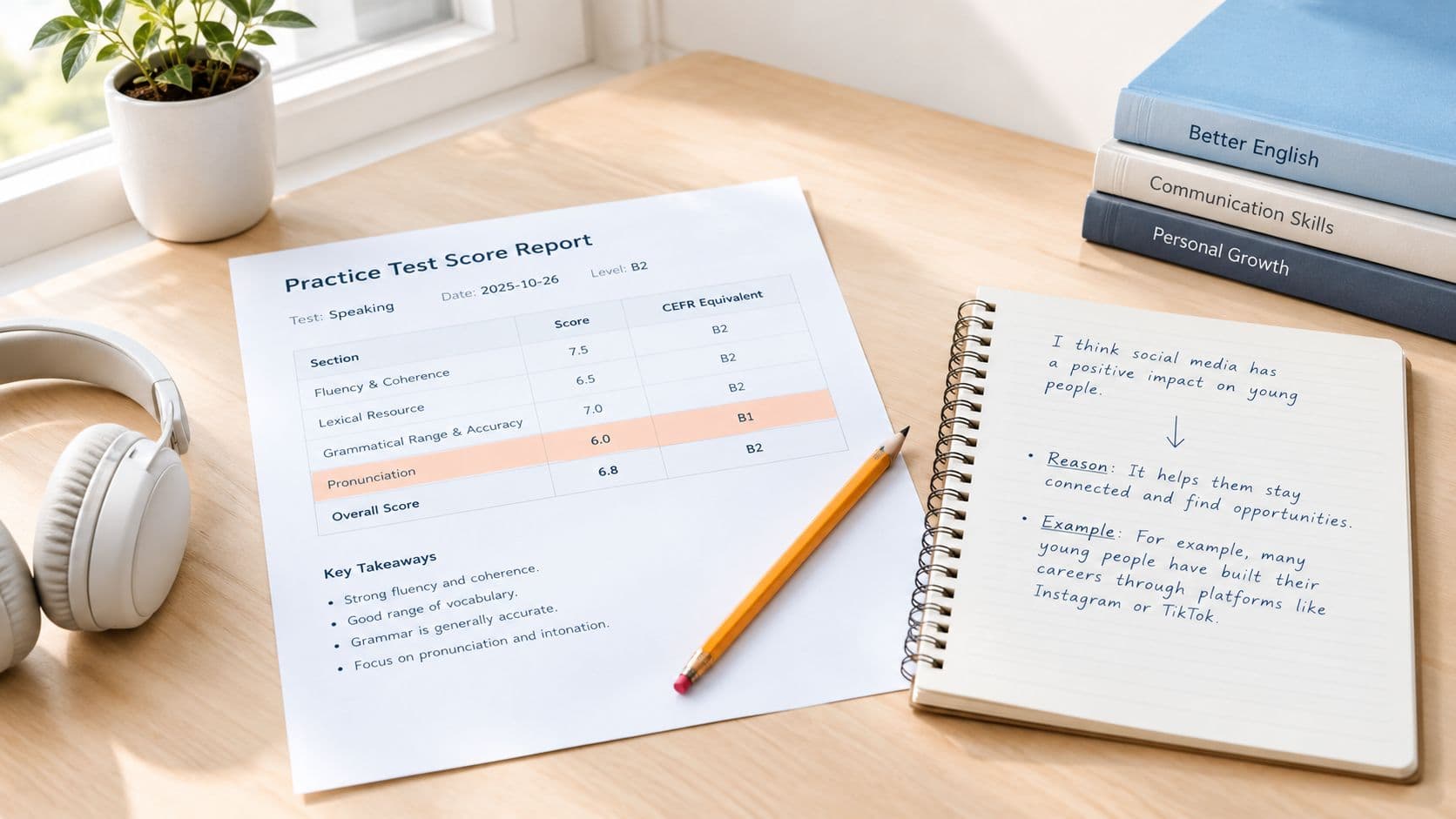
75% of surveyed workers in the United States and United Kingdom reported spending up to two hours per day on tasks or meetings they considered unimportant to their role, according to Timewatch's 2024 survey of 382 people. That reframes the problem: managing time effectively isn't always about finding more hours. It's about choosing what deserves the hours you have.
For a busy CELPIP candidate, a calendar full of study appointments can still produce little useful practice. You might watch lessons every evening yet never finish a response under exam conditions. A stronger approach treats each study week as a set of timed rehearsals, judged by completed answers, revisions, and pacing rather than hours logged.
A Six-Step Weekly Plan for Study Time
Stop adding study hours and plan the time you really have. Your starting point is a normal working week, including meals, travel, family responsibilities, and enough rest to concentrate.
-
List your real available time. Look at your calendar before choosing study tasks. Exclude periods when you're technically free but usually exhausted or responsible for someone else. A reliable short opening is more useful than an ambitious appointment you repeatedly cancel.
-
Rank tasks by exam impact and urgency. Start with the component that's preventing you from reaching your target. Then identify the specific problem within it. If your Speaking answers lack reasons, recording and reviewing advice responses deserves priority over collecting more vocabulary lists.
-
Reserve fixed blocks for your priorities. Give each appointment a start, finish, and location. Tell anyone who shares that space when you'll need quiet. Prepare the prompt, headphones, and recording tool beforehand so setup doesn't consume the session.
-
Turn each block into a measurable output. Replace an intention to study Writing with a finished deliverable: a timed email, revised for grammar and tone, then resubmitted. Define completion before you begin. Otherwise, browsing examples can feel like progress without producing anything you can assess.
-
Add contingency time. Keep a buffer block each day rather than allocating every available minute. Use it for an interrupted task or unfinished review. If nothing needs recovering, leave it free instead of automatically adding more work.
-
Review results and adjust capacity. Compare what you planned with what you completed at week's end. If recordings took longer because you replayed them carefully, that's useful information. Reduce the next week's workload rather than pretending the extra work will somehow fit.
A meta-analysis of 158 studies found moderate relationships between time management and academic achievement, job performance, and wellbeing, not a universal productivity multiplier; a 2024 review of working time and productivity also describes how performance can decline when working hours become excessive. In practice, a tired three-hour session after midnight may accomplish less than a focused hour at a dependable evening time.
Match the task to the opening
Use this sample schedule as a menu, not a requirement to study during every opening. The lengths below are suggested planning allowances, not official exam limits.
Weekly time slots and the work each one suits
| Daily slot | Usable length | Best use |
|---|---|---|
| Commute or transit | 20–40 minutes | Listening drills and vocabulary review |
| Lunch break | 20–30 minutes | One Speaking prompt, recorded and replayed |
| Evening after dinner | 40–60 minutes | A 27-minute Writing Task 1 email rehearsal, followed by revision |
| Weekend morning | Section timer plus a separate review block | Full timed practice section and review |
| Busy day with no slot | 10–15 minutes | Rewrite one weak sentence or sample answer |
A commute suits listening because you don't need a quiet recording space, although you should only study when travelling safely as a passenger. A lunch break suits a short Speaking rehearsal if you can find somewhere private. Don't sacrifice your whole meal break to fit it in.
The evening Writing allowance is a practice scenario: reserve part for the timed email and the rest for correcting it. A weekend opening suits an uninterrupted section, with review scheduled separately so you don't rush through feedback. Use our CELPIP test guide to identify the task formats you need to rehearse.
Practical rule: A study block isn't complete just because the timer stopped. It's complete when you've produced the answer and captured the next correction.
Our study plan feature lets you enter the minutes available each day so the weekly blocks match your real schedule. Fill in your own version of the table now, replacing the sample openings with appointments you can protect and writing an output beside each one.
Turning Study Goals Into If-Then Rules
A to-do list tells you what needs doing. An implementation intention also tells you what will trigger the action, so you don't have to negotiate with yourself when the moment arrives.
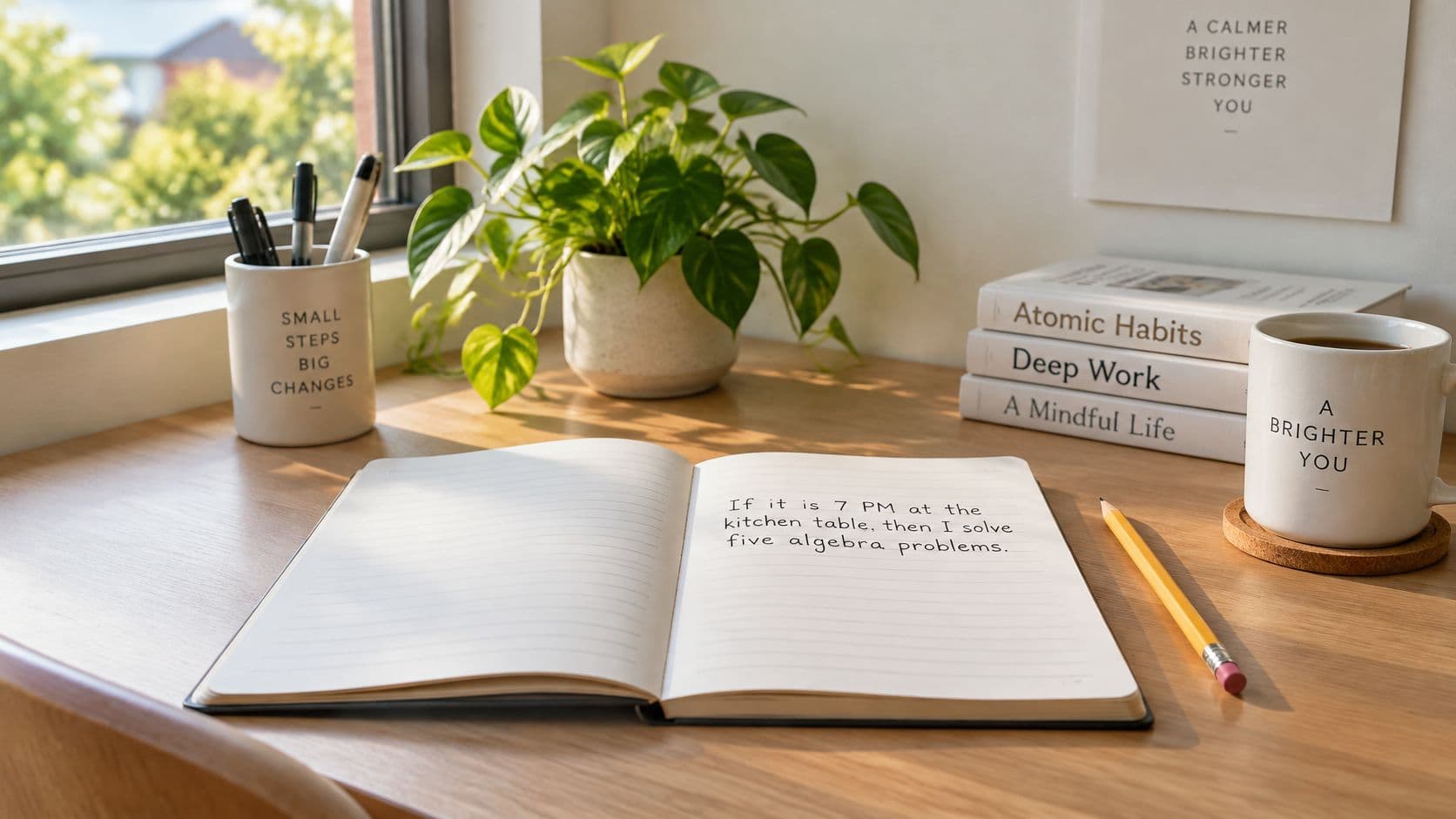
Keep the rule somewhere visible in your workspace.
A meta-analysis covering 94 independent studies found a medium-to-large improvement in goal achievement from implementation intentions, with an effect size of d = 0.65. That makes a concrete starting rule a better-supported strategy than relying on motivation alone.
Work through an evening example
Start with an observable outcome, such as a recorded answer you can replay. Identify the time and place available, connect a recognizable trigger to the action, then record whether you followed through. If you repeatedly miss the session, change the trigger rather than just promising to try harder.
For example: If it is 7:00 p.m. after dinner, then I will complete one 25-minute study block. This is a starting appointment, not a claim that this duration is ideal for everyone.
| Weak version | Actionable version |
|---|---|
| Improve Speaking | If I finish dinner and sit at my desk, then I record two Task 1 answers and replay one. |
| Study more | If I put my dinner plate away, then I open the prompt already saved on my laptop. |
| Catch up tomorrow | If I miss the evening block, then I do a 10-minute vocabulary review before 9 p.m. |
The stronger versions remove decisions about when to begin and what counts as done. The recovery rule also prevents a missed appointment from becoming an abandoned week.
Use this video alongside your written rule, then return to the task you've chosen.
Keep the rules manageable
Vague intentions fail because you can't reliably recognize when you've fulfilled them. Too many simultaneous rules create a different problem: you spend your energy remembering the system.
Start with one or two active rules per week. Keep additional skill rules written down until the basic routine feels dependable.
Log these measures:
-
Completion rate: Completed study appointments divided by planned appointments.
-
Planned versus real minutes: The difference between your estimate and the time the work required.
-
Submitted practice responses: Answers submitted, not prompts opened or lessons watched.
These measures distinguish a scheduling problem from a practice problem. If you attend sessions but submit little, narrow the task rather than adding another appointment.
How Long You Really Get to Prepare Each Speaking Task
Preparation time is where CELPIP Speaking answers most often fall apart. You can understand the question clearly and still spend the whole countdown hunting for the perfect opening line, so recording starts before you have organized anything else.
Most tasks allow only 30 seconds of preparation, according to the official CELPIP Speaking Pro Study Pack, which lists the task-specific preparation windows below.
Preparation and recording windows for the eight CELPIP Speaking tasks
| Speaking task | Timing |
|---|---|
| 1. Giving Advice | 30 seconds preparation, 90 seconds recording |
| 2. Talking about a Personal Experience | 30 seconds preparation |
| 3. Describing a Scene | 30 seconds preparation |
| 4. Making Predictions | 30 seconds preparation |
| 5. Comparing and Persuading | 60 seconds preparation per part across two parts, 90 seconds recording |
| 6. Dealing with a Difficult Situation | 60 seconds preparation |
| 7. Expressing Opinions | 30 seconds preparation, 90 seconds recording |
| 8. Describing an Unusual Situation | 30 seconds preparation |
Where the table shows a preparation window only, the recording limit appears on the official CELPIP test-format page and in the instructions shown with each task. Check both before you set your rehearsal timer.
Prepare ideas rather than sentences
CELPIP's Speaking Pro Target 9 Study Pack identifies the preparation actions as understanding the prompt, brainstorming ideas, and organizing what to say. Follow that order instead of drafting your opening word for word.
Start with the listener and the task: who are you speaking to, and what does the prompt ask you to produce? Then choose your content. Last, put the ideas in an order you can follow while talking. Thirty seconds is enough for that sequence; it is not enough for composing sentences in your head.
For Giving Advice, Celprep's Task 1 guide uses this answer frame:
-
Greeting and problem summary: Address the person and acknowledge the situation briefly.
-
Advice with reasons: Give two or three suggestions and explain why each would help.
-
Conclusion with a recommendation: End with a clear next step.
The guide also flags giving only one piece of advice as a common mistake. Plan at least two clear suggestions during preparation so you have enough relevant content without having to invent another direction while recording.
Write cue words you can speak from, not sentences you'll struggle to read aloud.
The frame belongs to an advice task, not every Speaking prompt. For a personal experience, prepare an event and its sequence instead; the CELPIP Speaking Task 2 guide explains how that task differs from giving advice.
Reduce preparation time gradually
If the actual preparation window leaves you frozen, start with extra planning time. Produce a coherent answer first, then shorten the allowance step by step until you can do the same thinking inside the exam window.
A shorter timer is a signal to carry fewer ideas, not to speak faster. Cut the suggestion you cannot support and keep the structure simple.
For each session, pick one task, display a visible preparation timer, and record within that task's speaking limit. Then judge the rehearsal by the recording it produced: did your planned ideas appear in a clear order, and did you reach a conclusion before time ran out? One finished answer against the clock tells you more than an hour of untimed drafting.
Timed Mocks and How to Fix Pacing Mistakes
Untimed practice lets you pause, restart, and polish before committing to an answer. A timed mock removes those options: you must plan within a fixed countdown and finish before a hard stopping point.
The official CELPIP General overview participant package shows preparation and speaking intervals with a progress bar indicating the remaining time. That visible deadline changes the exercise from preparing a possible answer to delivering one under constraints.
Read the first result as a diagnosis
A common reaction to a first mock is to stress about the score. Try to keep that response brief: every practice is a step forward when you use it to choose a specific correction.
Amandeep describes the experience in a Google review:
“The mock tests are very well designed and closely match the real exam format, which helped me improve.”
Treat that as an individual user's experience, not a promised result. Your useful question is narrower: what happened immediately before you lost control of the timing?
Pacing symptoms, likely causes and fixes
| Symptom | Likely cause | Fix |
|---|---|---|
| Run out of time mid-response in Speaking | Too many ideas gathered during preparation | Plan two suggestions and one reason each before recording |
| Blank during the 30-second preparation | Prompt read but ideas not sorted | Run the three moves: understand, brainstorm, organize |
| Writing email runs past the time limit | Drafting before outlining | Spend the first three minutes outlining greeting, purpose and closing |
| Timing slips week after week | No record of planned versus actual minutes | Log planned and actual minutes after each timed session |
These are starting diagnoses, not automatic explanations. If your Speaking response stops before the conclusion, listen for repeated points as well as excess ideas. You may need to remove repetition rather than cut useful detail.
Change a single variable
Choose the row that best matches your result and test its fix at the next sitting. Keep the other conditions steady enough to judge whether the change helped.
For a Writing rehearsal, for example, spend the first three minutes outlining the email before drafting under a visible timer. Include the purpose, required content, and closing in that outline so you don't discover a missing point while proofreading.
The full Writing section takes about 53 minutes across both tasks. Rehearsing the complete sitting builds stamina alongside accuracy, while individual email practice lets you isolate an outlining or revision problem.
Use our timed mock practice guide to prepare the sitting, then reserve a separate review appointment. Record the component to fix, the change you'll test, and the outcome you'll look for next time. Don't turn a disappointing result into an unplanned evening of extra exercises.
Commit to Your Weekly Plan Before the Next Mock
Choose a plan you can carry through an ordinary week, not just a quiet one. Make these commitments before adding more material to your study list.
-
Choose your weekly slot pattern. Use only minutes you can protect, and attach a finished output to each appointment.
-
Write three skill-specific if-then rules plus a recovery rule. Keep the full set as your weekly plan, but activate only the rules your available slots can support. Give each priority skill a clear starting cue.
-
Book the first uninterrupted timed mock. Reserve a short review block afterward so the result leads to a practical change rather than repeated score-checking.
Check whether the plan fits
After two weeks, check completion rate, planned versus actual minutes, and submitted practice responses. If completion stays below plan, shrink the workload rather than adding hours.
Keep the review short enough to finish in one sitting. Decide what to retain, what to reduce, and what to practise next.
The goal is a study plan you can repeat every week, not a perfect week.
Celprep offers timed practice and feedback to help you turn protected study slots into completed responses; signing up takes 30 seconds and gives instant access to practice exercises. The free plan includes 1 exercise per task type across Writing, Reading, Listening, and Speaking, 3 starter templates, one vocabulary bundle per section, and 3 submissions per day; the Weekly plan costs $14.99 per week and includes 7 days of unlimited practice. Visit Celprep to choose practice that fits your available time and begin your next scheduled rehearsal.