If you score an impressive 11 in Listening and Reading on Canada's flagship English exam, does that strong result pull up a 7 in Writing when your immigration file is assessed? Most test takers assume their strong English abilities will balance out a weaker afternoon on one section, the way a high midterm lifts a mediocre quiz in university.
On the Canadian English Language Proficiency Index Program (CELPIP), that assumption can cost you valuable immigration points and months of extra preparation. Think of your score profile like a chain rather than a grade-point average. Each of the four language skills acts as its own link, converting into points separately, so a single weak link leaves its own gap regardless of how strong the rest of your English is. At the same time, pushing an already strong skill past CELPIP 10 adds zero extra points in the Express Entry first-official-language grid.
Understanding how this exam is built, scored, and mapped to Canadian standards saves you from pouring study hours into the wrong skill. Here is how the test works from the ground up, step by step.
What CELPIP Measures and Who Needs It
The Canadian English Language Proficiency Index Program is a computer-delivered English exam that tests Listening, Reading, Writing, and Speaking and reports a separate CELPIP level for each skill rather than combining them into one overall grade. According to the official CELPIP CLB results guide, results are reported individually for each component on a scale aligned with Canadian Language Benchmark levels 3 through 12, so a strong overall impression can't automatically compensate for a weaker individual ability.
Candidates usually arrive at CELPIP with a concrete deadline in front of them: a permanent residence profile, a Canadian citizenship application, a professional licensing cutoff, or a college admission requirement. The scale of demand is substantial. In 2024, Canada admitted 134,980 people through Express Entry, including principal applicants and accompanying spouses and dependants, according to the IRCC 2025 Annual Report to Parliament on Immigration.
Who Takes the Exam and Which Version Applies
Immigration, Refugees and Citizenship Canada (IRCC) designates CELPIP-General for permanent residence applications because it measures all four skills. For Canadian citizenship applications, IRCC accepts the shorter CELPIP-General LS test, which assesses Listening and Speaking only.
Beyond immigration and citizenship, four main groups rely on CELPIP scores:
- Permanent residence applicants: Skilled workers and tradespeople submitting language proof for federal or provincial immigration streams.
- Citizenship candidates: Permanent residents demonstrating spoken and listening English fluency for citizenship eligibility.
- Licensing and registration applicants: Regulated professionals, such as healthcare workers or real estate licensees, meeting a provincial regulator's English standard.
- Students and workers: Individuals pursuing a work permit, vocational training, or an academic program that recognizes CELPIP credentials.
One quick clarification before you start gathering study materials: CELPIP is a registered trademark of Paragon Testing Enterprises. We at Celprep operate as an independent preparation resource designed for people applying for permanent residency, a work permit, or Canadian citizenship, rather than the official test provider.
Your Three-Question Starting Checklist
Before you open a practice test, write down your answers to three questions so you don't prepare for the wrong benchmark:
- Which purpose am I testing for? Pin down the exact program, regulator, or institution receiving your score report.
- Which version does that purpose require? Confirm whether you need the four-skill CELPIP-General exam or the two-skill CELPIP-General LS exam.
- Which level do I need in each skill? Record the target number separately for Listening, Reading, Writing, and Speaking instead of aiming for a vague average.
CELPIP Test Structure at a Glance
CELPIP-General runs in one computer-based sitting and moves through Listening, Reading, Writing, and Speaking in sequence. The official CELPIP test format and scoring overview describes a test built around the Canadian Language Benchmarks from CELPIP Level 1 to Level 12, with CELPIP 10 aligned to CLB 10 and CELPIP 12 aligned to CLB 12. Read the structure like a chain: each skill forms its own link, and a weak link costs points in that skill rather than disappearing into an average.
| Component | What you do | Approximate time | Score reported |
|---|---|---|---|
| Listening | Answer questions about conversations, announcements and discussions | About 47 minutes | Separate CELPIP level |
| Reading | Read correspondence, diagrams and viewpoints, then answer questions | About 60 minutes | Separate CELPIP level |
| Writing | Write two responses: an email and a survey response (150 to 200 words each) | About 27 and 26 minutes | Separate CELPIP level |
| Speaking | Eight spoken tasks answered to on-screen prompts, including advice, experience and prediction | About 20 minutes | Separate CELPIP level |
Use those times as practice boundaries. A student who rehearses Reading with unlimited time may understand every passage yet still lose marks when the clock turns careful reading into slow reading. The same problem appears in Writing, where a response can be accurate but incomplete if the ending never gets typed.
How Receptive Skills Test Daily Comprehension
Listening and Reading are receptive skills, meaning you process English produced by others and select answers rather than creating original text or speech. In Listening, you follow everyday Canadian audio scenarios, including workplace conversations, public announcements, and group discussions, then answer multiple-choice questions. Each recording is heard once, so attention works like a spotlight. If it slips, the answer may vanish before you can check it.
Reading shifts that same practical focus onto the screen. You work through everyday emails, informational diagrams, and short passages presenting competing viewpoints, then answer questions tied to details and implied tone. Strong readers still stumble here when they treat passages like novels instead of information sources to scan. A better approach is to read the question first, locate the relevant lines, then check whether the wording matches the writer's purpose.
Why Productive Skills Feel Harder Under Time Pressure
Writing and Speaking ask you to build original English from scratch while a clock counts down on screen. Writing has two distinct tasks: an email of 150 to 200 words in about 27 minutes, followed by a survey response of 150 to 200 words in about 26 minutes. You need to plan ideas, match the required tone, type cleanly, and edit before the screen locks.
Speaking compresses eight separate spoken prompts into about 20 minutes. You respond aloud into a headset microphone across everyday scenarios such as giving advice to a friend, describing a past experience, or making predictions from an image. Short answers can feel natural in conversation, but the test rewards clear structure, relevant detail, and steady delivery.
Practical reality check: Reading English emails all day at work does not automatically train your brain to organize a 60-second spoken answer or draft a tight 175-word survey response under a countdown timer.
That distinction shapes preparation. Receptive skills reward focused comprehension and scanning speed, while productive skills demand fast planning and clear delivery under strict timing. Before buying books or drilling vocabulary lists, locate the weakest link. If Writing or Speaking sits below your target, that gap needs its own work because the four skills convert to Express Entry points separately, and once a score reaches CELPIP 10, higher CELPIP levels add no first-official-language points in the Express Entry grid.
How CELPIP Levels Convert to CLB and Express Entry Points
Every CELPIP component score converts one-to-one into Canada's Canadian Language Benchmarks (CLB), the national standard IRCC uses to compare different approved English tests. Under the IRCC Express Entry language test guidelines, CELPIP 7 corresponds to CLB 7, CELPIP 8 to CLB 8, CELPIP 9 to CLB 9, and CELPIP 10 or higher to CLB 10 or above in each tested ability.
Here is a visual breakdown of how each band steps up across the conversion chain from CELPIP level to CLB equivalent to Express Entry points.

Under IRCC's Express Entry first-official-language grid, each of the four abilities earns its own point total rather than sharing a pooled score.
| CELPIP level | CLB equivalent | Express Entry points per ability |
|---|---|---|
| 7 | CLB 7 | 4 |
| 8 | CLB 8 | 5 |
| 9 | CLB 9 | 6 |
| 10 | CLB 10 | 6 |
| 11 | CLB 11 | 6 |
| 12 | CLB 12 | 6 |
| All four abilities combined | Not applicable | 24 points maximum |
Why Your Weakest Skill Costs Its Own Points
Look closely at the arithmetic in that table. Four abilities earning 6 points each produce the maximum 24 points in the first-official-language grid. Because IRCC converts each skill independently, a high score in Reading can't lend a single point to Writing.
Say an Express Entry candidate earns Listening 9, Reading 8, Writing 7, and Speaking 9. Here is how IRCC scores that report:
- Listening 9 (CLB 9): 6 points
- Reading 8 (CLB 8): 5 points
- Writing 7 (CLB 7): 4 points
- Speaking 9 (CLB 9): 6 points
That adds up to 21 out of 24 points. Even though the candidate looks strong overall with two 9s, Writing alone costs 2 points and Reading costs 1 point. You can plug your own practice or official component scores into our CELPIP score calculator to see exactly how many points each skill is adding or leaving behind.
Understanding the Points Ceiling at Level 10
Notice what happens at the top of the table. Official score reports match CELPIP 11 to CLB 11 and CELPIP 12 to CLB 12, yet the Express Entry first-official-language grid awards the exact same 6 points per ability for CLB 9, CLB 10, CLB 11, and CLB 12.
Improving a Listening score from 10 to 12 feels gratifying, yet it adds zero first-official-language points in that grid while a Writing 7 continues to cost you 2 points.
Candidates frequently confuse general English pride with smart score strategy. Once a skill clears your required ceiling, every extra hour spent polishing it steals study time from the weaker link that lowers your total.
For a quick walkthrough of how these conversions play out on an actual score report, watch this short breakdown.
Which Version and Score Each Purpose Requires
A single CELPIP score report can be more than enough for one organization and completely short for another. Comparing your exact goal against the required test version prevents the costly mistake of booking the wrong sitting or training for the wrong ceiling.
| Purpose | Test version | Skills or levels checked |
|---|---|---|
| Permanent residence through Express Entry | CELPIP-General | All four components, each mapped to CLB |
| Canadian citizenship | CELPIP-General LS | Listening and Speaking only |
| Australia DHA superior English | CELPIP-General | CELPIP 10 in Listening, Reading and Speaking; CELPIP 12 in Writing |
| Professional licensing or registration | Confirm with the regulator | Check the regulator's published level for each skill |
| Educational or vocational admission | Confirm with the institution | Check the institution's published requirement |
When Institutions Demand Uneven Skill Thresholds
External frameworks don't always ask for the same level across all four skills. As shown in the CELPIP official overview and score equivalencies, the score table extends through CELPIP Level 12 (equivalent to CLB 12 and labeled "expert proficiency" in high-stakes social, educational, or workplace contexts), and the listed Australia DHA superior-English benchmark requires CELPIP 10 in Listening, Reading, and Speaking alongside CELPIP 12 in Writing.
Think about what that means for a candidate preparing for that specific benchmark. Earning 11 in Listening, Reading, and Speaking won't rescue a 10 in Writing, because Writing carries its own higher bar. Even within Canadian immigration, different streams set distinct minimum CLB floors across the four components, which you can review in our Express Entry language test guide before finalizing your study targets.
How to Verify Unpublished Licensing and School Cutoffs
Notice the last two rows of the table ask you to confirm directly with the regulator or institution. Treat those cells as mandatory verification steps rather than blanks to guess at. Nursing colleges, engineering associations, real estate boards, and vocational schools set their own per-skill thresholds and update them on their own schedules.
Visit the official admissions or registration page for your specific body and copy four separate items into your notebook: the exact test version accepted, the minimum level for Listening, the minimum for Reading, and the minimums for Writing and Speaking. Check whether all four scores must come from a single test sitting, since many regulators don't allow combining results from two different test dates.
How to Prepare Each Skill in the Right Order
Randomly watching grammar videos or taking untimed quizzes rarely moves a stuck CELPIP score. According to the official CELPIP test results documentation, scoring is criterion-referenced and performance-level based, meaning the jump from Level 9 ("effective proficiency") to Level 10 ("highly effective proficiency" in high-stakes contexts) reflects crossing a defined performance band rather than squeezing in a few extra vocabulary words.
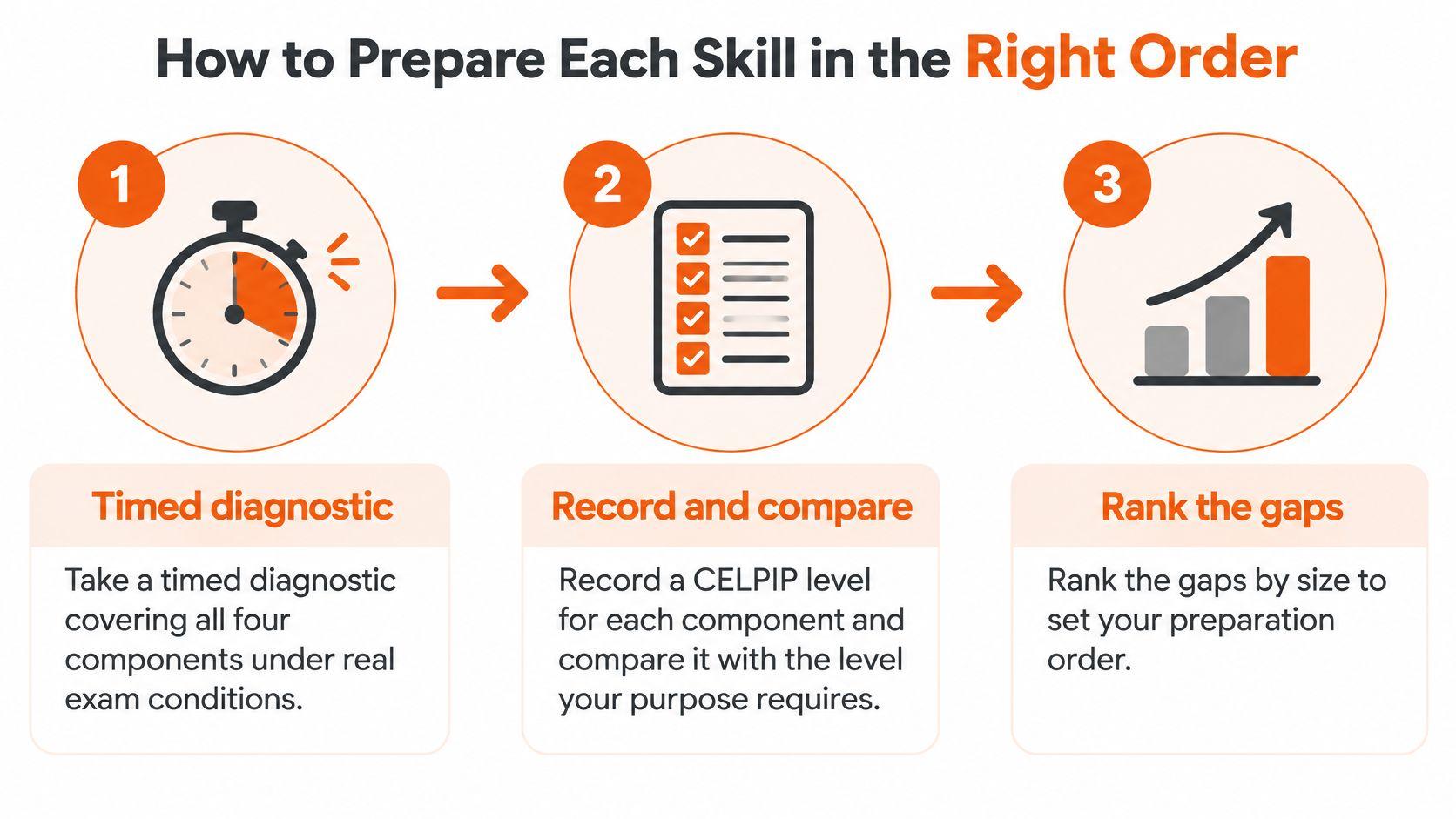
A chain works like your CELPIP result here: each of the four skills converts to Express Entry points on its own, so one weak component costs its own gap no matter how strong the other three are. And because scores above CELPIP 10 add no further first-official-language points, polishing a skill you have already pushed past that ceiling yields nothing while a weaker component keeps your total below target. Start your preparation with a clear sequence so every study hour targets the biggest point gap first.
Follow these six steps in order:
- Take a timed diagnostic covering all four components under real exam conditions. Sit down without pausing the clock, without checking a dictionary, and without replaying audio. This gives you an honest baseline instead of an inflated estimate built on relaxed practice.
- Record a CELPIP level for each component and compare it with your purpose's requirement. Put your diagnostic score beside your target for Listening, Reading, Writing, and Speaking so the exact gap in each skill sits in plain view. Seeing four separate numbers stops you from treating "English" as one blurry problem.
- Rank the gaps and start with the weakest component blocking your threshold. Crossing the performance boundary in your lowest skill creates the fastest real gain, since each band you cross in that skill adds points you cannot earn any other way.
- Practice every task inside its exam clock. Write each email and survey response within the time the actual Writing section allows, and deliver spoken answers inside the strict Speaking preparation and recording windows. Preserving real time limits trains your brain to make fast decisions when the clock ticks down.
- Audit every attempt against five observable scoring constructs. Grade your own Writing and Speaking samples on task completion, organization and coherence, vocabulary control, grammatical accuracy, and intelligibility. Tightening one weak construct, such as clearer paragraph transitions or fewer subject-verb slips, can push a borderline response into the next level even while your general English evolves gradually.
- Retest the targeted skill after two to three weeks, then move to full mock exams. Re-running a timed diagnostic on your priority skill shows whether your drills moved the needle before you add full-length endurance tests. Once all four components sit within reach of your target, full mocks build the stamina required for one continuous sitting.
Why Untimed Editing Hides Real Readiness
One trap catches thoughtful, careful learners again and again: spending the better part of an hour crafting a spotless practice email and assuming they are ready for test day. Untimed editing measures what you can polish at leisure, not what you can produce when the timer hits zero. The exam grades the version you finish under pressure, rough edges included.
Exam condition rule: If you never finish a Writing response without extra minutes or a spellcheck pause, you haven't practiced the actual task the exam grades.
The same applies to passive study. Watching English shows or reading news articles builds broad familiarity, yet it won't train you to organize your thoughts aloud within the short preparation window the Speaking section allows. Keep active, timed output at the center of your weekly routine, and explore structured drills in our top CELPIP study methods guide to pair active practice with clear review habits.
Common Mistakes That Lower Each Score and How to Fix Them
Most candidates who miss their target by one band don't lack English knowledge. They lose points through predictable exam habits that directly hurt one of the five scoring constructs.
The single costliest mistake happens in Writing: drifting outside the 150 to 200 word range. Writing far below the minimum leaves your points underdeveloped, while running well past the limit invites rushed grammar errors, repetition, and incomplete proofreading, weakening task completion and content. Before typing a single sentence, sketch a quick outline and aim near 175 words so you land comfortably inside the target zone with time left to check verbs and prepositions.
Look up the other frequent traps below alongside the exact scoring construct they damage and the immediate adjustment to make.
| Mistake | Effect on score | Fix |
|---|---|---|
| Writing well below 150 words or well above 200 words | Weakens task completion and content | Plan your paragraph lengths and aim near 175 words before drafting |
| Giving only one suggestion in a Speaking advice task | Incomplete task response | Plan at least two clear suggestions, each backed by a short reason |
| Rereading the whole Reading passage for every question | Time lost in Reading | Read the question first, then scan the passage for the matching detail |
| Relying on memorized phrases | Weak vocabulary control | Vary your sentence openers and choose precise everyday words |
| Using an email template without adapting it | Lower content and coherence | Fit every template sentence to the prompt's audience, purpose, and facts |
| Unclear pronunciation in spoken answers | Lower intelligibility | Record your answers and listen back for words that blur together |
How to Apply These Fixes to Your Practice Review
Don't try to repair six habits in a single practice session. Pick the one or two errors that show up in your diagnostic responses and tie each fix to its matching scoring construct.
Say you lose time in Reading and end up guessing on the last four questions. Spend one full week practicing question-first scanning: read the prompt, pick out a concrete anchor word like a date, name, or policy term, and sweep your eyes down the passage to locate that exact zone before reading closely.
For Speaking and Writing, treat templates like scaffolding rather than copy-and-paste scripts. A good structure keeps your organization clean, yet examiners spot memorized filler lines immediately when they don't fit the prompt's real situation. Listen back to one recorded Speaking answer each evening without looking at your notes. Anywhere you hesitate, mumble a word ending, or recycle the same opener three times, pause the recording and re-deliver that single sentence cleanly.
Set Your Target Scores and Begin Preparing
You don't need a complicated master plan to move forward. Make one concrete decision today: set an exact target level for Listening, Reading, Writing, and Speaking, verify every number against your immigration, citizenship, licensing, or admission requirements, and build a weekly schedule that gives your weakest component the largest share of practice time.
When you choose practice tools to support that schedule, check for three essentials: exam-style tasks that match real structure and timing, full timed mock exams that replicate test-day stamina, and attempt-by-attempt feedback linked directly to scoring criteria. General English apps can't tell you whether your email missed a required prompt detail or whether your Speaking pace dropped your intelligibility.
Putting Structured Practice in Place
As an independent preparation platform rather than the official test provider, we built Celprep around those exact bottlenecks. All paid plans include 3,000+ real exam-style questions, full mock exams under real test timing, and templates and vocabulary designed for each CELPIP task. Every submission generates personalized feedback tied to CELPIP criteria, while our My Progress tool tracks your component-by-component improvement and highlights what to work on next. If you haven't booked your test seat yet, eligible students can also save up to 10% on CELPIP Canada and CELPIP India registrations through our partnership with ApplyBoard, an Authorized CELPIP Voucher Provider.
Your concrete action for this week takes less than three hours: schedule a full timed diagnostic, write down your four individual component levels, and place each score beside its required target. The moment you can see which single link in your four-skill chain needs work first, every study session starts pulling your score in the right direction.
Ready to turn those four target numbers into a focused study routine? Celprep gives you exam-style Listening, Reading, Writing, and Speaking exercises, full timed mock exams, and response-specific feedback that pinpoints exactly which scoring construct to tighten next. Visit Celprep to start your diagnostic and build a preparation plan around the skills that matter most for your score.