Approximately 1.75 billion people use English, roughly one in four people worldwide, according to a historical British Council estimate reported by ThoughtCo. Most aren't native speakers. That reframes English speaking practice online: you're preparing to communicate with an international community, not trying to imitate one ideal accent.
For CELPIP candidates, useful practice needs a tighter focus than talking more. You need to finish an answer within its time limit, make your message understandable, and decide which feedback deserves your attention.
Where to Practice English Speaking Online Compared
Choose a format by the speaking work it makes you do, not by how impressive its dashboard looks. A conversation partner, a recorder, and an automated coach solve different problems.
Online English speaking practice formats compared
| Format | Feedback you get | Availability | Best use | Main limit |
|---|---|---|---|---|
| AI speaking coach | Instant, scored on set criteria | Any hour | Repeated timed drills | Blind to context and rapport |
| Live tutor on video call | Human, personal correction | Booked slots | Conversation and accent work | Higher cost per hour and fixed schedule |
| Language exchange or meetup group | Informal, mostly from peers | Scheduled events | Fluency under social pressure | Uneven correction and no exam criteria |
| Exam-prep platform with recorded tasks | Scored against exam criteria | Any hour | Timed exam-format practice | Feedback quality depends on the tool |
| Self-recording with a timer | None until you review it yourself | Any hour | Building pace and habit | You must judge your own errors |
These are practical distinctions, not ratings of individual providers. An AI coach may identify repeated grammar patterns, but it can't reliably judge whether your reassurance sounds appropriate to a worried colleague. A tutor can explore that distinction through follow-up questions.
Match the format to your next goal
A CELPIP candidate should prioritize recorded exam tasks with preparation and response windows. Casual conversation can support that work, but it doesn't automatically teach you to organize a complete advice or prediction response before the recording ends.
A professional relocating abroad needs something different: conversation about meetings, housing, appointments, and workplace misunderstandings. A live partner can interrupt, ask for clarification, and expose vocabulary gaps that a rehearsed answer conceals.
If your schedule is crowded, use an on-demand format for a short daily block. As a practical starting routine, reserve about 15 to 20 minutes for a timed task, review, and another attempt, rather than saving everything for an occasional long session.
Check cost and actual speaking time
Self-recording costs nothing when you use a device you already own, and free language exchanges or meetups can add human interaction. Live tutoring is usually the most expensive option per hour; AI coaches and exam-prep platforms set their own prices, so compare access and feedback before committing.
Also check how much of a session you'll speak. Listening to other learners can be useful, but it isn't your speaking practice.
Selection test: Does this format make you produce a complete spoken answer, then show you what to change next?
CELPIP Speaking Timings for Every Task Type
The official CELPIP test format lists eight Speaking tasks and approximately 15 minutes for the component. You need to rehearse advice, narration, description, prediction, persuasion, difficult conversations, opinions, and unusual situations, not just introductions and small talk.
The preparation and response windows below follow the CELPIP Plus task-format guide.
CELPIP-General speaking task timings
| Task | Preparation time | Speaking time |
|---|---|---|
| Giving Advice | 30 seconds | 90 seconds |
| Talking about a Personal Experience | 30 seconds | 60 seconds |
| Describing a Scene | 30 seconds | 60 seconds |
| Making Predictions | 30 seconds | 60 seconds |
| Comparing and Persuading | 60 seconds | 60 seconds |
| Dealing with a Difficult Situation | 60 seconds | 60 seconds |
| Expressing Opinions | 30 seconds | 90 seconds |
| Describing an Unusual Situation | 30 seconds | 60 seconds |
Notice the distinction between planning time and speaking time. The longer preparation windows for comparison and difficult-situation tasks are opportunities to choose a position, organize reasons, and consider the listener's concerns. Don't spend them composing an elaborate opening.
Find your own workable word target
Record an answer at a comfortable pace, then count the words you say within the response window. Use that recording to set a personal length target, leaving room for natural pauses and a clear ending.
A word count isn't a fluency score. If you reach your target only by rushing, reduce the content rather than squeezing your words closer together.
Our CELPIP Speaking Task 1 sample answers stay within 90–110 words for a 60-second practice limit. That practice constraint shouldn't be confused with the longer Giving Advice response window in the timing table; match your timer to the task you're rehearsing.
Build a response that can expand
Our Task 1 guide uses a three-step template:
- Open with the situation. Greet the listener and briefly summarize the problem.
- Develop the advice. Give two or three suggestions, each with a reason.
- Close with a recommendation. Make the preferred next action clear.
Say a friend is struggling to study after work. Suggest moving demanding study to a quieter part of the day, explain why that helps, and offer a manageable alternative when their schedule changes.
Adapt the structure rather than forcing it onto every task. A scene description needs an overview and organized details, not a greeting and advice. Finishing too early can leave your ideas underdeveloped, while running long can cut off your recommendation, so rehearse with a visible clock.
How to Run One Speaking Session From Start to Finish
A useful session produces something you can compare, not just a feeling that you've studied. Keep a voice recorder, a timer, and a simple practice log open before you begin.
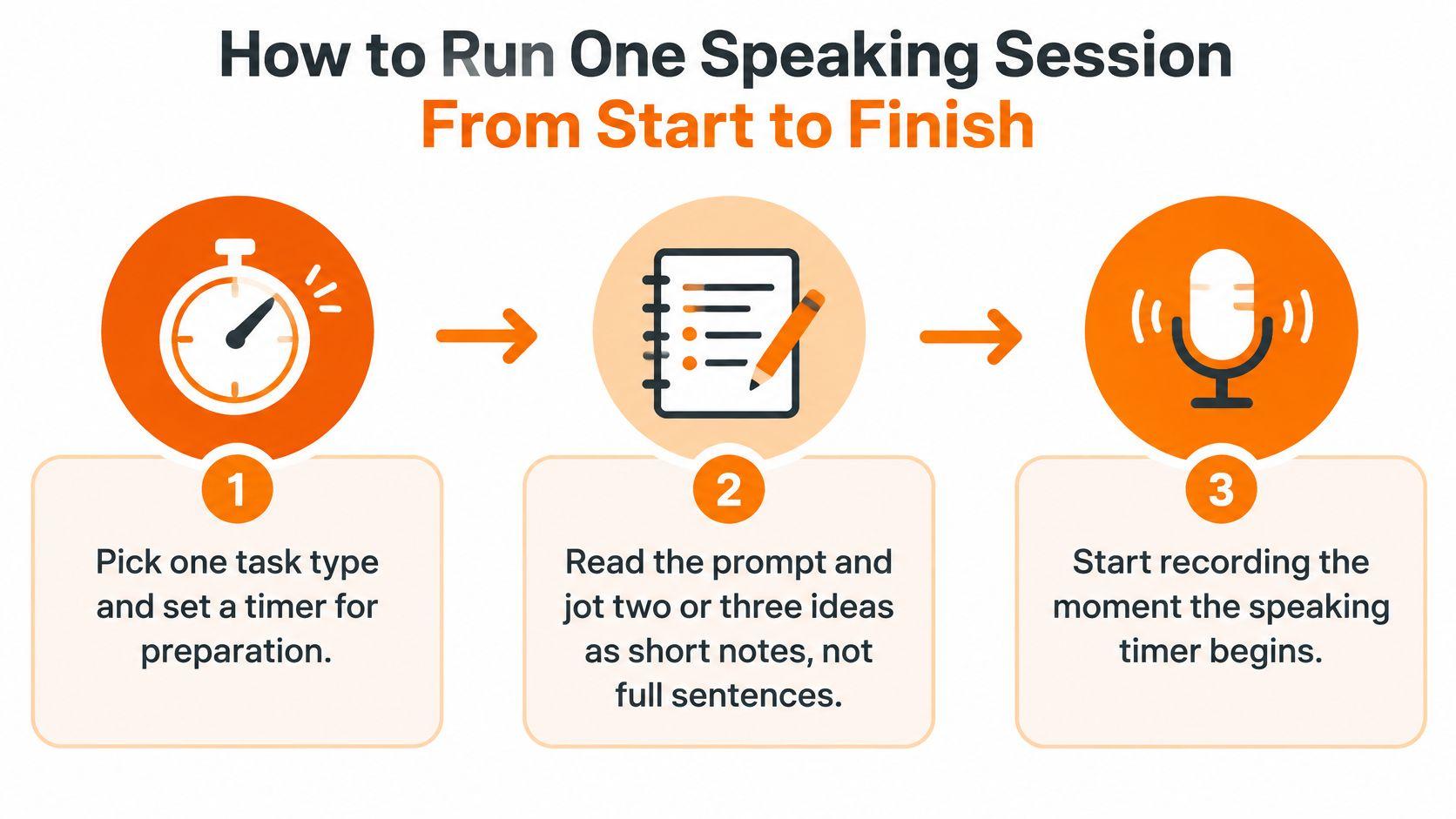
Prepare, record, review, repeat
-
Pick a task and set its preparation timer. Use a task-specific prompt, such as one selected through a CELPIP practice test, rather than inventing a topic after the clock starts. The common slip is choosing a comfortable conversation question that doesn't require the target skill.
-
Read the prompt and jot short notes. Write two or three ideas as keywords, not complete sentences, so you can see the response's direction without reading a script. Starting before you've chosen your main points often leads to rambling or repeated ideas.
-
Record as soon as the speaking timer begins. Keep going through minor mistakes and complete the response window without restarting. Stopping whenever a sentence sounds imperfect trains interruption rather than recovery.
-
Listen back once for the first clear problem. Identify something concrete, such as advice without a reason, an unclear pronoun, or a conclusion delivered in a rush. Don't turn the replay into a catalogue of everything you dislike about your voice.
-
Compare feedback with your own observation. Choose one change for the next attempt, such as explaining why your preferred option helps the listener. Trying to fix grammar, speed, vocabulary, and pronunciation simultaneously makes it hard to tell which change worked.
-
Repeat the same prompt within 24 hours. Keep the task and conditions similar so you can compare the recordings directly. Skipping the repeat leaves you with a correction you've read but haven't successfully used.
-
Log the date, task, and chosen change. Add a short result, such as whether your recommendation was complete before the recording ended. A score alone won't remind you what you did differently.
Judge the session by its result
Suppose your first advice response lists suggestions without explaining them. Your next-attempt goal is to attach a useful reason to each suggestion, not to sound more advanced in every sentence.
Keep both recordings, even if the first feels uncomfortable. The contrast gives you evidence that a particular adjustment helped, or tells you that you need a different adjustment.
A successful session ends with answers inside their windows and a clear statement of what improved.
If you can't name the improvement yet, record that. An unresolved problem is still useful when you've defined it precisely enough to investigate next time.
Why Speaking Out Loud Builds Skill Faster Than Listening
Watching swimming demonstrations can help you understand a stroke, but your arms still need practice in the water. Listening to English also provides a model; speaking requires you to retrieve words, organize meaning, and make yourself understood while time passes.

What the app study actually found
A 2020 ScienceDaily report on a study published in Foreign Language Annals described 85 undergraduates using Babbel for 12 weeks: 59% improved oral proficiency by at least one ACTFL sublevel; improvement rates were 69% among those studying at least six hours and 75% among those studying at least 15 hours, while 36% of initial participants discontinued before completing the requirements.
The study measured Spanish, not English. It supports the possibility of oral gains through sustained digital language learning, but it doesn't prove that speaking always improves faster than listening or predict a CELPIP score increase.
Persistence also matters when interpreting the result. A promising practice method won't help much if its demands make you stop using it.
Turn input into an answer
Use listening to collect a model, then do something with it. After hearing someone explain a choice, give your own explanation on a different topic without copying their sentences.
For pronunciation work, use English pronunciation practice to focus on a feature you can carry into a complete response. A clearly stressed contrast between your preferred option and its drawback is more useful than an isolated word you never use in conversation.
Active output includes pauses, imperfect sentences, and manageable repairs. Correct a selected error, then say the answer again so the correction becomes something you've produced, not merely recognized.
Track these weekly measures:
- Minutes spoken: Count your own recorded or conversational speech, not time spent browsing lessons.
- Complete responses: Note whether you developed and finished an answer rather than abandoning it.
- Recurring error: Name the pattern that still interferes with your message.
These measures don't replace assessment. They help you see whether you're doing the work your next assessment will require.
Reading AI Feedback Without Overtrusting It
One AI score isn't a diagnosis. Treat it as a claim to test against the recording and the listener's understanding, not a verdict on your English.
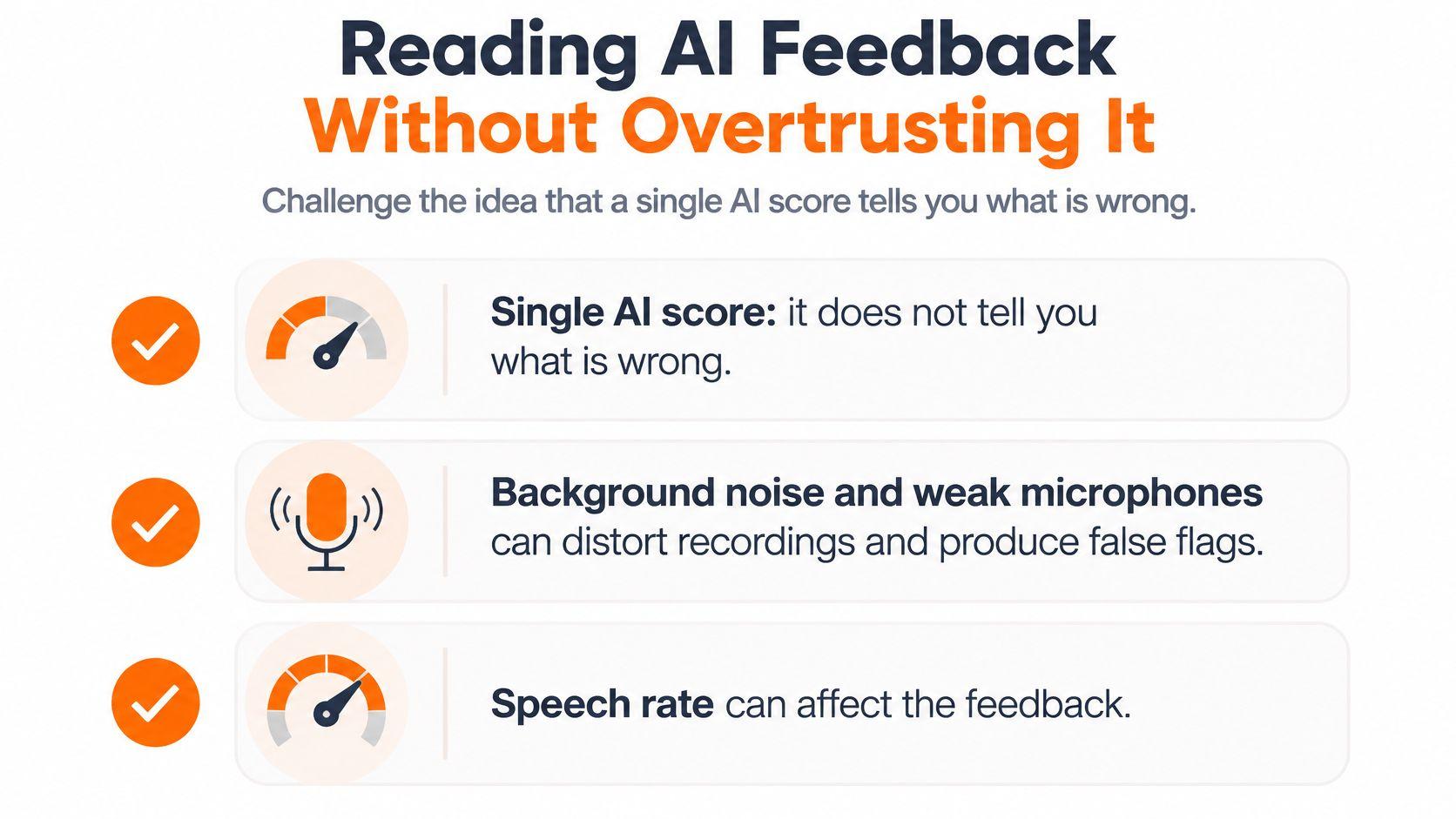
Separate recording problems from speaking problems
Background noise and weak microphone recordings can obscure sounds before a tool evaluates them. Speech rate and accent variation can also produce flags that a human listener wouldn't consider communication problems.
The TESOL Union paper on AI-supported pronunciation practice discusses benefits alongside limitations in automated evaluation, including technical problems such as background noise. That makes AI useful as a supplement to informed judgment, not a replacement for it.
There's also a difference between pronunciation accuracy and intelligibility. A tool may flag a sound while overlooking the fact that your listener understood it easily, or praise individual words while your sentence remains hard to follow.
A 2025 online intervention involving 90 learners found that visual and AI-generated narrative feedback improved prominence, thought groups, and intelligibility with a moderate effect. The useful feature is explanation: which words need emphasis, where ideas should be grouped, and why a listener might struggle.
Calibrate feedback before changing your speech
Use this practical checking routine:
- Control the recording conditions. Work in a quiet room with the same microphone position. Listen for clipping, distant speech, or background sound before judging pronunciation.
- Repeat before reacting. Record each task at least twice, then track patterns across three recordings rather than chasing an isolated flag.
- Test the message. Ask an unfamiliar listener to explain what you meant, without first showing them the prompt or transcript.
- Get periodic human assessment. Every few weeks, ask a qualified tutor to review representative answers and identify priorities.
These are practice checkpoints, not validated scoring thresholds. Their purpose is to help you distinguish a recurring speaking issue from an unstable measurement.
Say an automated tool repeatedly flags a phrase, but a listener accurately explains it. Ask whether the issue affects meaning, sounds unnatural, or differs from the tool's preferred model before making it your main priority.
Decision rule: Trust consistent patterns provisionally, question isolated flags from poor recordings, and seek human review when scores conflict with listener understanding.
Your aim isn't to make every indicator turn green. It's to make the intended message easier to understand under realistic speaking conditions.
Turning CLB 9 and 10 Targets Into Weekly Goals
For immigration, test choice matters before practice begins. IRCC's language-requirements guidance accepts CELPIP-General as a designated English test, limits CELPIP-General LS to citizenship purposes, and requires results to be no more than two years old when it receives an application.
The component ranges below are legacy CELPIP conversion values, not the current CELPIP-General score scale. Don't compare them directly with a current score report or an automated practice score.
CELPIP scores by skill for CLB 9 and CLB 10
| CLB level | Reading | Writing | Listening | Speaking |
|---|---|---|---|---|
| CLB 9 | 78–87 | 88–89 | 82–88 | 84–88 |
| CLB 10 | 88–90 | 90 | 89–90 | 89–90 |
Compare components on the same scale
An overall ambition such as reaching your immigration language target doesn't tell you what to practise tomorrow. You need a separate target and a trustworthy baseline for Reading, Writing, Listening, and Speaking.
For a hypothetical example using the legacy scale, a learner aiming for CLB 9 with Speaking at 80 and Reading at 88 would prioritize speaking. Speaking falls below that benchmark's range, while Reading already meets or exceeds it; this example isn't a conversion rule for current results.
Use a CELPIP score calculator as a planning aid, then verify the interpretation against your official report. Never assume that an app's percentage, estimated band, and official component result are interchangeable.
Assign the week by the weakest component
Give the largest share of focused practice to the component furthest below its required target. Keep the stronger components active with lighter practice so you don't discover an avoidable gap on test day.
As a practical review schedule, reassess the priority component every two weeks under comparable conditions. For speaking, compare task completion, answer development, and listener understanding, rather than treating a small automated score movement as proof of progress.
If the main weakness changes, change the schedule. Continuing to practise your strongest skill may feel reassuring, but it won't address the component preventing you from meeting your target.
These ranges are reference values, not eligibility advice. Your official score report, the current IRCC conversion guidance, and the requirements of your immigration program determine which results count.
Start a Timed Speaking Set This Week
Choose Giving Advice as your starting task if you often know what to say but struggle to develop it. Prepare a realistic situation, such as helping a friend choose between a shorter commute and a more affordable apartment.
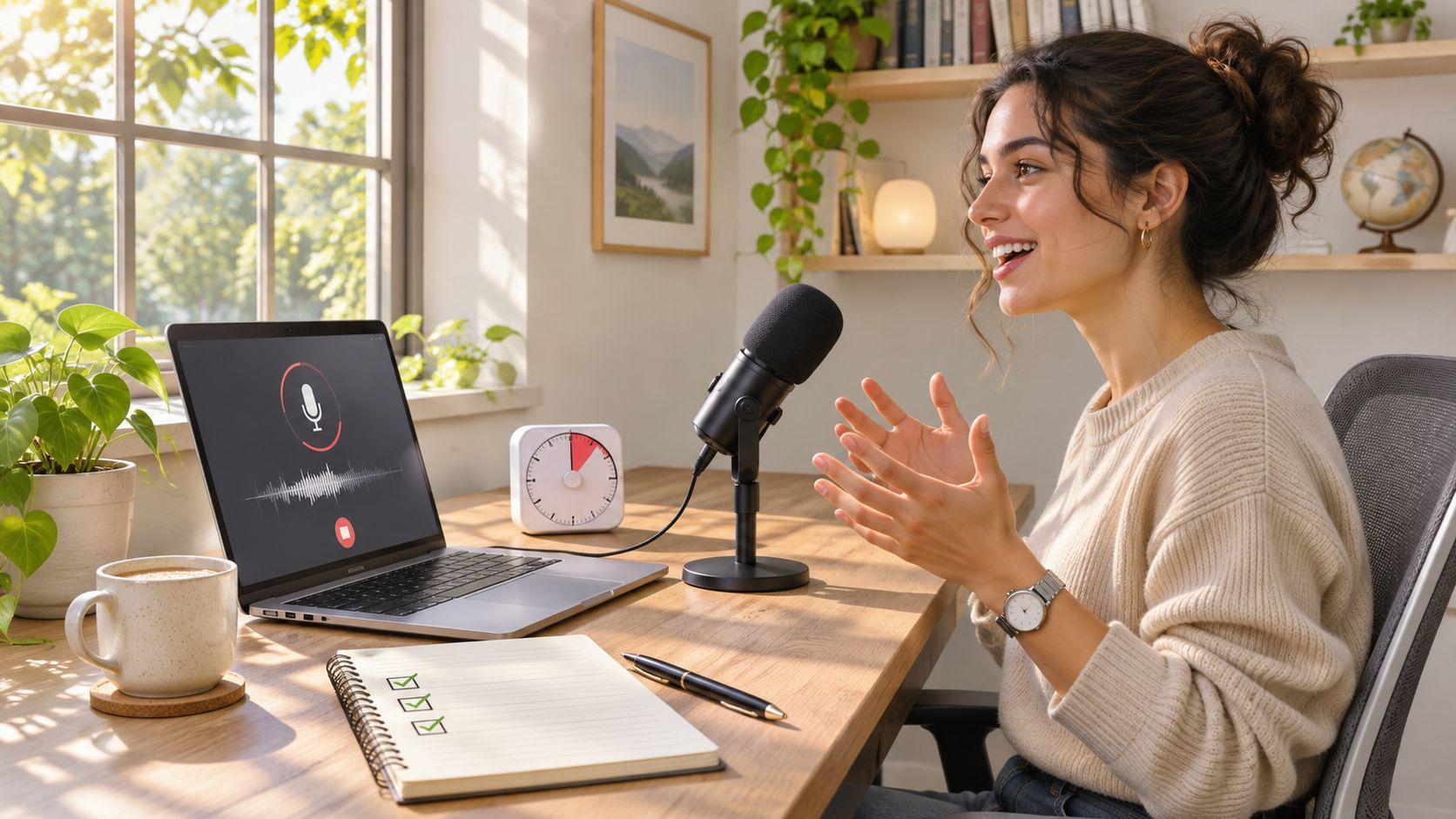
Your immediate objective isn't an impressive performance. It's a complete response that gives the listener useful reasons and reaches a clear recommendation before the recording stops.
Make a small set you can compare
Record three answers on three separate days. Begin with a baseline, repeat the same prompt the following day, and use a related situation for the final recording to check whether the improvement transfers.
For each attempt, prepare with short notes, speak through the response window, listen back once, and choose a single adjustment. Keep the prompt unchanged for the direct repeat so you aren't confusing an easier question with better speaking.
If you'd like scored feedback, our Celprep Speaking coach lets you record advice, experience, and prediction responses with pronunciation and fluency feedback. You can record a real CELPIP speaking task and receive one weakness plus one change for the next attempt; check that suggestion against what a listener understood before making it your priority.
Finish with evidence, not a general impression
At the end of the week, keep a short review:
- Your recordings: Save the attempts with filenames that identify their order and task.
- A measurable improvement: Record whether you finished your recommendation, supplied missing reasons, or made a previously unclear phrase understandable.
- Your next task: Choose a named task, such as Making Predictions, rather than writing only that you need more speaking practice.
If your repeat sounds smoother but the new prompt falls apart, keep working on the structure rather than memorizing the successful answer. You want a method you can use with unfamiliar content.
Set up your recorder and choose the advice prompt today. By the end of the week, you'll have a baseline, a direct comparison, and a specific reason for choosing your next practice task.
Celprep offers timed CELPIP speaking tasks with response-specific feedback to help you turn recordings into focused practice. Visit Celprep, record an answer, and use the suggested change to guide your next attempt.