You understand the question in a meeting, but when it's your turn to speak, the sentence won't come together. You reach for a word, restart, and finish with something simpler than you meant. Later, when you're alone, the answer comes easily.
If you're wondering how to improve English speaking, start by changing what you measure. Being understood and repairing your own mistakes are more useful targets than losing your accent. A weekly routine of recordings, focused practice, and listener checks gives you something concrete to improve, even when work and family leave little study time.
Measure Your Speaking Across Four Dimensions
Open your phone's voice recorder and speak for two minutes without preparation. Describe your job, a recent trip, or a problem at work. Don't restart when you make a mistake, because those moments tell you what needs attention.
Listen once without stopping. Then review pronunciation, fluency, vocabulary, and grammar separately, using the distinctions in the Cambridge English speaking assessment criteria, which describe stronger speech through intelligibility, natural pauses, vocabulary range, and errors that don't interrupt meaning.
Four speaking dimensions: stronger and weaker signs
| Dimension | Stronger speech | Weaker speech |
|---|---|---|
| Pronunciation | Intelligible, uses stress, rhythm and intonation to carry meaning | Sounds unclear or distracting, flat intonation, stress falls in the wrong places |
| Fluency | Mostly natural hesitation and pauses, steady flow | False starts, self-correction, repetition and unnatural hesitation |
| Vocabulary | Broad range, including collocations and idiomatic expressions | Limited vocabulary, same few words repeated, reliance on basic terms |
| Grammar | Errors are not intrusive and do not interrupt meaning | Errors interrupt meaning, reliance on simpler sentence forms |
Choose the problem you can hear
Mark each dimension as comfortable, inconsistent, or blocking meaning. These are personal tracking labels, not official exam scores.
Write down the evidence behind each label. Perhaps you explain technical ideas clearly but repeatedly abandon sentences when describing past events. That points toward tense control or sentence construction, not necessarily a vocabulary shortage.
Baseline rule: Score what's on the recording, not how embarrassed or confident you felt while making it.
Save the audio and notes together, labelled by date and prompt. Choose one weak dimension to focus on, while keeping the original recording unchanged for a later comparison.
How to Run the Retrieval-First Speaking Cycle
Repeating a speaker can help you notice sounds, but it doesn't tell you whether you can retrieve the language independently. Retrieval-first practice asks you to produce language before checking the answer.
In controlled foreign-language vocabulary experiments, a study comparing retrieval with imitation found more correct spoken productions with retrieval immediately after training, 0.40 versus 0.27, without a significant difference in pronunciation quality for correct responses. That's evidence for vocabulary learning, not a guarantee of instant conversational fluency.
Use this flow to keep listening connected to independent production.

Run a focused recording round
As a practical starting routine, allow about fifteen minutes for a prompt and its revisions.
-
Listen to a short model. Choose a clip of about twenty to thirty seconds containing useful phrases, such as explaining a delay or suggesting a solution. Listen for meaning and phrasing; the common slip is choosing material so difficult that you spend the session decoding it.
-
Hide the model. Close the transcript and pause the audio before rebuilding the message aloud. This makes you retrieve language rather than read it; leaving subtitles visible turns the task into supported repetition.
-
Record without stopping. Use your phone's recorder and finish the message even if you need simpler wording. Recording exposes gaps you might forget afterward; restarting whenever you hesitate hides those gaps.
-
Compare for meaning and clarity. Check your response against the model and note where the listener might misunderstand you. Don't mark every difference as an error, because a natural paraphrase can communicate the same idea.
-
Repair a narrow target. Choose a tense pattern, pronunciation contrast, or hesitation habit and answer again. If you try to correct everything simultaneously, you won't know which change helped.
-
Log the result. Save the prompt, the target, and a short note about the second attempt, then schedule a later return. Don't replace speaking with elaborate note-taking; the log should help you start the next recording.
When the cycle stops helping
Suppose the model explains a missed delivery. Your response should convey the delay, its cause, and the proposed solution, not reproduce every original word.
If you can't begin, shorten the message and retain its main point. If you can reproduce it effortlessly, change the situation, perhaps from a delivery delay to a postponed appointment.
A useful second recording contains a more complete message with less searching, without the model in view. More words alone aren't progress if you've added repetition or lost the point.
Practise Intelligibility Before Chasing an Accent
Ask whether a listener understood your message before asking whether you sounded native. An accent can remain while your speech becomes clearer and easier to follow.
Keep a recorder and brief notes beside you during pronunciation practice.
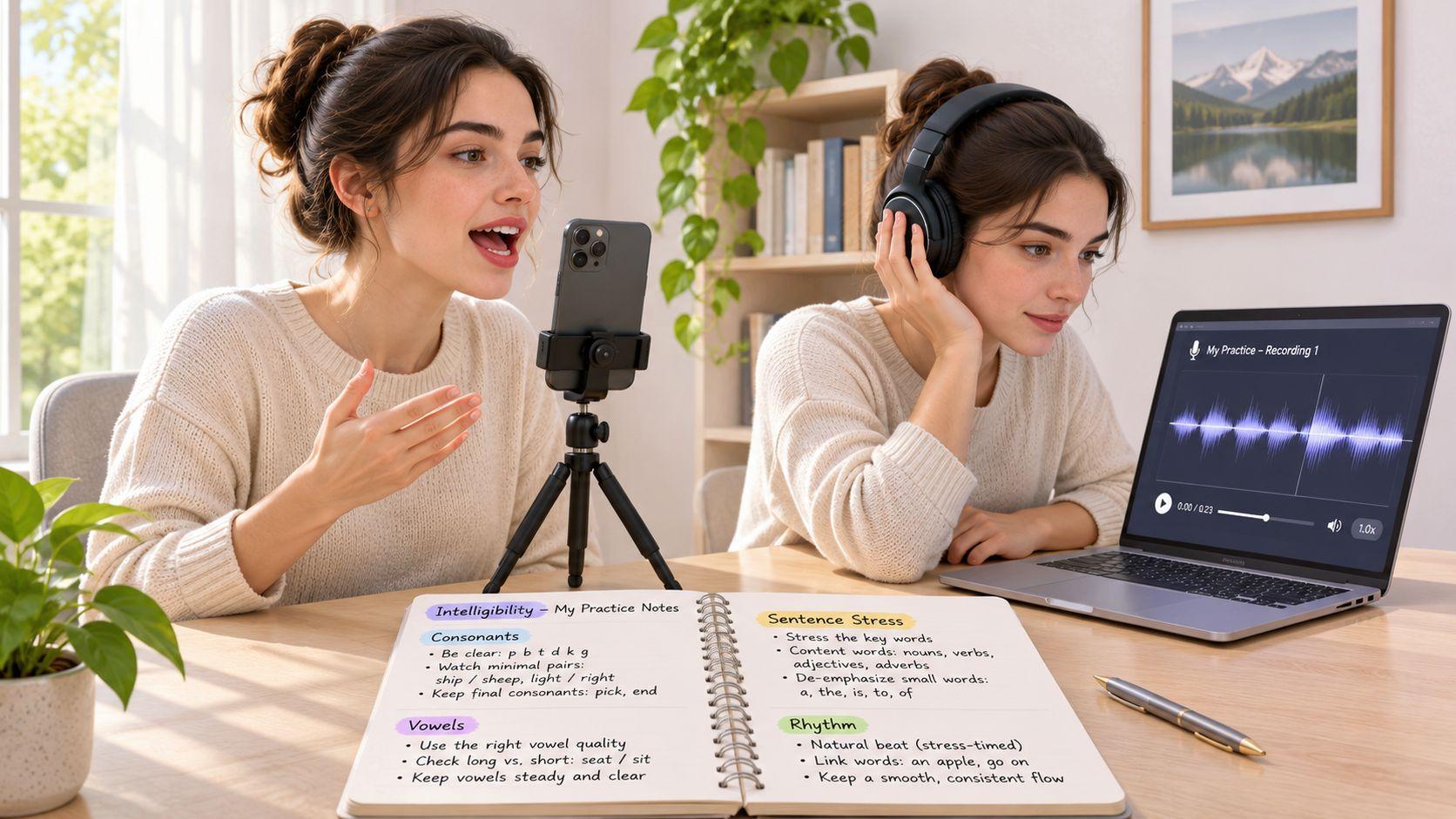
A meta-analysis of pronunciation interventions reported a medium gain in comprehensibility, d = 0.610, compared with a smaller gain in native-like accentedness, d = 0.278. These are different outcomes: making speech easier to understand isn't the same as removing its accent.
Select the features that block understanding
Record a spontaneous response and check consonants, vowels, sentence stress, rhythm, pausing, and speed. Select the two features most likely to confuse a listener, rather than the two you dislike most.
- Start with words. If listeners mishear a key vowel contrast, practise the relevant words slowly and accurately.
- Move into sentences. Put those words into useful messages, and stress the information the listener needs.
- Finish without a script. Explain a new situation that requires the same feature.
For example, practise stressing Friday when correcting an appointment date. Then explain a schedule change without reading, making the corrected date easy to hear.
Use the following video during a focused practice session, then test the feature in your own speech.
Let a listener check the result
Ask someone to write down your main message and any words they couldn't identify. Compare their version with your intended meaning, then repeat the check with an unfamiliar prompt.
Our English pronunciation practice guide can help you organise these drills. Don't spend the whole session eliminating your accent, equate speed with fluency, or assume an app's pronunciation score proves a person understood you.
A clear message at a manageable pace is a better result than a fast message your listener has to reconstruct.
Space Your Practice and Turn Feedback Into Repairs
Use this schedule as a practical review plan, not a deadline by which every error must disappear. Each return should require a fresh spoken answer rather than a memorised script.
Spaced review schedule for one speaking prompt
| Review point | What you do | What to check |
|---|---|---|
| Same day | Answer the prompt from memory and record it | Did you retrieve the phrases without rereading them? |
| 2 days later | Answer the same prompt again, unscripted | Fewer pauses and false starts than the first answer? |
| 1 week later | Answer a new prompt using the same vocabulary | Are the target words used naturally in new sentences? |
| 2 weeks later | Give a full timed response, then listen back | Is only one error left to fix, and is it the one you chose? |
Treat the last question as a diagnostic, not a pass mark. If several errors remain, identify which still interferes most with the message.
Turn a correction into another answer
A 2010 meta-analysis of corrective feedback in second-language acquisition found a medium overall effect on language development that was maintained over time, with implicit feedback better maintained than explicit correction alone. Implicit feedback can include reformulating an incorrect sentence or prompting the learner to try again.
Apply feedback to something you said. Suppose your recording contains Yesterday I go to the office. Write Yesterday I went to the office, then give another answer about yesterday that requires the same past-tense form.
Don't merely read the corrected sentence. Produce it inside a message, where you also have to manage meaning and delivery.
A partner can help by asking you to check the tense rather than immediately supplying the answer. If you still can't repair it, use the corrected model and attempt a fresh sentence.
Check whether the repair survives
Keep a short error log with the original form, corrected form, and later result. Mark whether you used the feature accurately without help, repaired it yourself, or needed another prompt.
That distinction matters. Recognising a correction while reading isn't the same as using it while speaking.
If an error survives repeated reviews, simplify the drill. Practise the troublesome sentence pattern with familiar vocabulary before adding time pressure or a demanding topic.
Our guide to study methods offers ways to organise review around active practice. Keep your schedule manageable: a completed recording-and-repair session gives you more useful evidence than a long study block with no spoken output.
Rehearse CELPIP Speaking Tasks Under Time Pressure
A timed response requires decisions as well as language. You need to choose relevant ideas, develop them, and finish before you run out of speaking time.
For advice practice, use our CELPIP Speaking Task 1 guide's structure: a greeting and problem summary, two or three suggestions with reasons, and a closing recommendation. The guide flags giving only one piece of advice as a common mistake and recommends planning at least two clear suggestions during preparation.
CELPIP speaking task types and what to rehearse
| Task type | What the response must do | Structure to rehearse |
|---|---|---|
| Advice | Give two or three clear suggestions, each with a reason | Greeting and problem summary, advice with reasons, closing recommendation |
| Experience | Narrate one real past experience in order and say what it taught you | Opening, sequence of events, reflection |
| Prediction | Say what will likely happen and support it with reasons | Claim, two reasons, conclusion |
Build advice around reasons
Suppose a friend is struggling to study after work. Plan distinct suggestions: protect a regular study period and practise the weakest skill before doing easier exercises.
Give a reason for each. A protected study period reduces the need to decide when to start; beginning with the weak skill keeps it from being postponed.
Our Task 1 sample answers use 90–110 words to fit the 60-second time limit. Use that as a model for answer length, not an instruction to rush through a fixed word count regardless of clarity.
A rehearsal might sound like this:
Hi Alex, it sounds like you're finding it difficult to study after work. I'd suggest choosing a regular time before dinner, because you'll be less likely to postpone practice until you're tired. You could also start with speaking rather than watching another lesson. Recording an answer will help you identify what you need to practise. Finally, keep your materials ready so you don't spend your study time searching for a topic. I'd start with the regular study time this week, then adjust the routine once you know what you can manage.
Rehearse in a useful order
- Prepare with keywords. Set the preparation timer shown in your task and note suggestions and reasons, not complete sentences.
- Speak and record. Follow the structure while keeping your attention on the person's problem.
- Check task completion first. Confirm that you supplied distinct suggestions and explained why they would help.
- Check delivery next. Review the ending, sentence control, hesitation, and clarity before repeating the prompt.
Use our online English speaking test guide to organise exam-style rehearsal. On the repeat attempt, retain the ideas but improve their expression rather than memorising the whole answer.
Review each speaking dimension separately. An organised response can still contain unclear pronunciation, while fluent delivery can still leave the task incomplete. These personal checks help diagnose weaknesses; they aren't an official CELPIP band calculation.
Climb From Solo Recording to Live Conversation
Speaking daily isn't enough if every session happens in the same comfortable setting. You also need to practise responding when someone interrupts, misunderstands, or asks an unexpected question.
A study of AI-supported role-play described perceived gains in communicative competence and reduced anxiety, while concerns involving peer judgment and high-stakes assessment remained. Rehearsal confidence and readiness for live interaction aren't interchangeable.
Use a gradual progression rather than jumping straight into the most stressful situation.
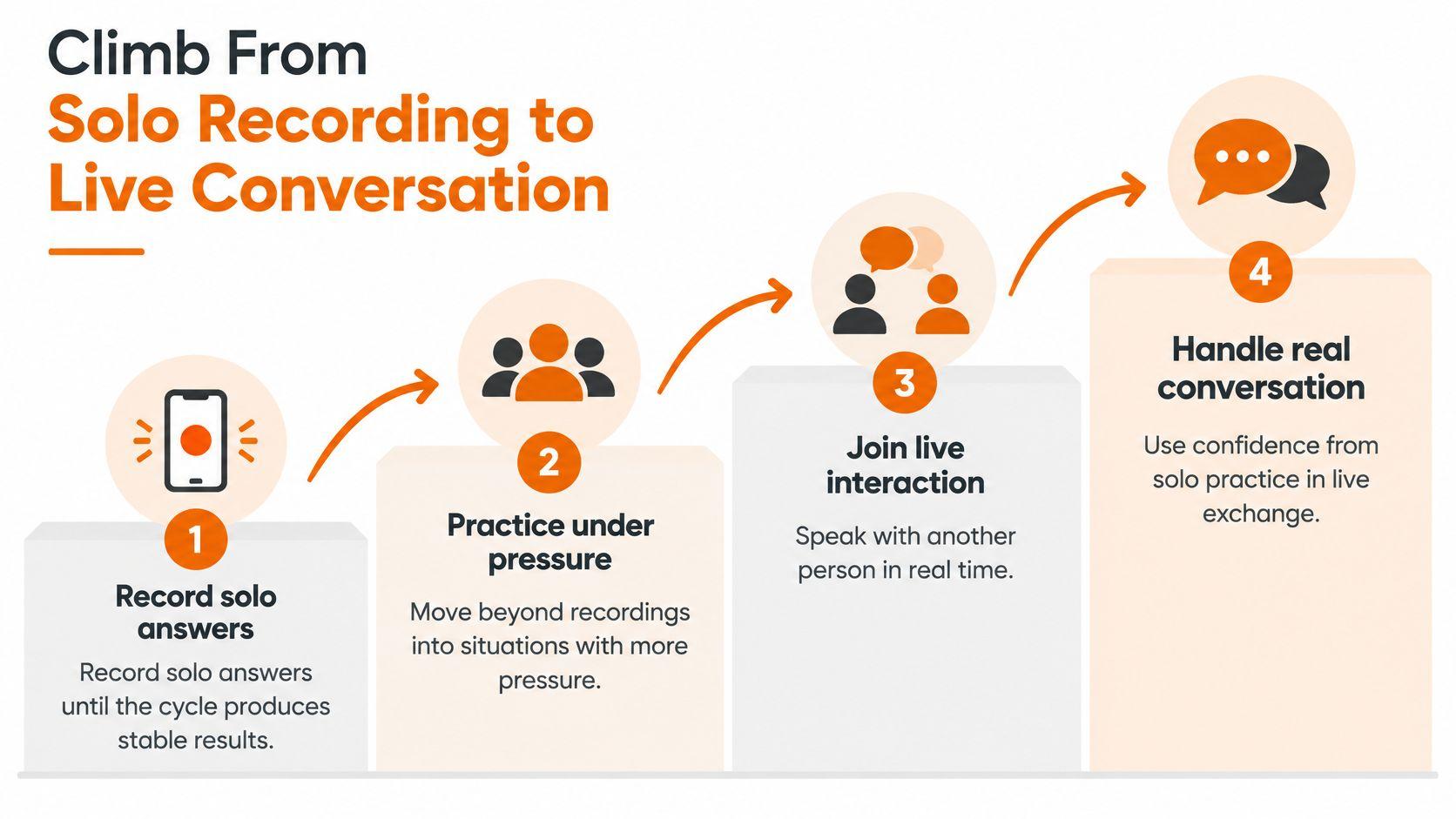
Increase the difficulty deliberately
- Record solo answers. Stay here until you can finish a message and handle your chosen language target without repeatedly restarting.
- Use constrained role-play. Practise a short exchange with a fixed goal, such as booking a repair or requesting a schedule change.
- Add interruptions and clarification. Ask your partner to interrupt or misunderstand a detail, then practise recovering calmly.
- Speak with less familiar people. Try a relevant, respectful exchange with a shop assistant or colleague from another team.
As a practical advancement rule, require successful completion on three consecutive attempts. Success means achieving the communication goal and recovering when necessary, not speaking without any mistakes.
Diagnose what made you stop
If you struggle even when recording alone, simplify the language or topic. If the breakdown appears only with a timer, add timing gradually; if it appears only with people, remain at the current interaction level.
Keep recovery phrases available:
- Request repetition. Could you say that again?
- Clarify the meaning. Do you mean the deadline or the meeting?
- Repair your message. Let me explain that more clearly.
AI can make rehearsal more accessible, but finish with an unpredictable human exchange. That's where you find out whether you can listen, adjust, and continue.
Start Your First Week of Recorded Practice
Choose a start date and put the following sessions in your calendar. Keep one weak dimension as your focus for the week instead of changing targets whenever an attempt feels difficult.
- Day one, your start date. Record the baseline prompt and mark evidence across the four speaking dimensions.
- Day two. Run a retrieval-first round targeting your chosen weakness.
- Day three. Return to the baseline prompt without reading your previous answer.
- Days four to six. Use related prompts, keeping the same target while changing the situation.
- Day seven. Compare recordings, identify the recurring error, and decide whether to retain the target or choose another.
For structured feedback, Celprep lets you record a real CELPIP speaking task and receive one weakness plus one change for the next attempt. We give personalised feedback on every attempt, and our My Progress tool tracks improvement and shows what to work on next.
Our free plan includes one exercise per task type across Writing, Reading, Listening, and Speaking, three starter templates, one vocabulary bundle per section, and three submissions per day. Use it to test whether this routine fits your schedule before deciding whether paid access suits your preparation timeline.
Record a speaking response with Celprep, review the specific weakness in your feedback, and apply the suggested change to your next attempt. Use the free plan to begin your recorded practice week and compare your progress through My Progress.