More than 4 million IELTS tests were taken worldwide in 2023, according to IELTS. Yet a familiar test name and a strong command of spoken English don't tell you whether you can produce a complete, well-organized written response under pressure.
An English writing test measures more than correct sentences. For CELPIP candidates, especially those aiming for Canadian permanent residency or professional registration, the practical challenge is to answer the whole prompt, write for the right reader, and finish on time. Once your grammar is steady, better decisions about content and organization are often more useful than a collection of rare words.
Why Writing Is the Score That Slips
Writing scores averaged 0.6 of a band below overall scores and 1.08 bands below Listening scores in a study of IELTS candidate performance. In that study, 84.8% of candidates still achieved at least Band 6.0 in Writing, a level commonly associated with undergraduate and postgraduate admission requirements.
Those findings aren't contradictory. Many candidates can reach a useful writing standard while still performing noticeably better in other skills. The important question isn't whether your writing is generally good. It's whether it meets the particular requirement attached to your application.
A report like this can be frustrating when the overall result looks reassuring.

A strong average isn't a writing diagnosis
When an institution requires a minimum writing result, stronger performance elsewhere doesn't remove that requirement. Check the component requirements for your intended immigration pathway, regulator, or educational program before deciding what to practise.
Then inspect what happens inside your written answers:
- Missing content: You explain the problem but forget the requested solution.
- Weak development: You state an opinion without showing how it affects anyone.
- Audience mismatch: You address a building manager as though you're messaging a close friend.
These problems call for different remedies. More grammar exercises won't teach you to notice an unanswered instruction. Memorizing formal phrases won't help if the reader still can't identify what you're requesting.
Practical rule: Diagnose the unfinished communication, not just the incorrect sentence.
For CELPIP preparation, treat writing as a performance you must rehearse independently. Start with the format table before opening a practice prompt, so you know what you're trying to complete and how the clock shapes the task.
CELPIP Email and Survey Formats at a Glance
CELPIP-General Writing consists of two scored tasks in a 53-minute session, with approximately 27 minutes for the email and 26 minutes for the survey response, according to the official CELPIP preparation material. That allocation is a preparation constraint, not permission to spend most of the session polishing your preferred format.
Each task has a 150–200-word target, as specified in the CELPIP-General Overview Study Pack. As a personal drafting target, aim around 170–190 words so you have room to develop an example and adjust the ending without padding.
CELPIP-General writing tasks, time and length
| Task | Time | Length | What you must do |
|---|---|---|---|
| CELPIP Task 1 email | About 27 minutes | 150–200 words | Everyday email covering the requested points in a suitable tone |
| CELPIP Task 2 survey | About 26 minutes | 150–200 words | Choose one of two options and explain why it is better |
| CELPIP writing total | 53 minutes | Two responses | Both tasks in one timed session |
The email requires a reader and an outcome
An email isn't a miniature academic essay. You might need to complain about a service, request information, explain a scheduling problem, or propose a practical solution. Your opening should tell the recipient why you're writing.
Say a prompt asks you to contact a building manager about a broken elevator. It also asks you to explain its effect on residents and suggest a solution. A response describing the mechanical problem in detail still isn't complete if you never explain the inconvenience or request action.
A workable plan would be:
- Purpose: Identify the broken elevator and explain why you're contacting the manager.
- Impact: Describe a concrete difficulty, such as a resident struggling to carry groceries upstairs.
- Requested action: Ask for a repair update and a temporary arrangement.
Choose the tone before drafting. A manager needs respectful, direct wording, not exaggerated praise or threats.
The survey requires a decision with support
The survey asks you to choose between alternatives and justify your choice. Suppose your neighbourhood must choose a public pool or a community sports complex. Saying that the complex is better leaves the reader asking why.
Connect the choice to a need: indoor exercise during poor weather, activities for different age groups, or access for residents who don't swim. Then explain why your selected option addresses that need better.
You don't need to pretend the other option has no value. A brief, fair comparison is more convincing than dismissing it without explanation. Practise both formats under their allotted clocks rather than relying on untimed essay writing.
The Four Scores That Decide Your Result
A polite email that never answers the requested questions is like a tidy workplace report that leaves out the decision the manager needed. Its sentences may be correct, but the document hasn't done its job.
CELPIP evaluates Content/Coherence, Vocabulary, Readability, and Task Fulfillment, as described in the official overview study pack. These are performance dimensions within Writing, not separate component results you can substitute for the Writing level.
Use the diagram to keep the dimensions distinct when reviewing an answer.
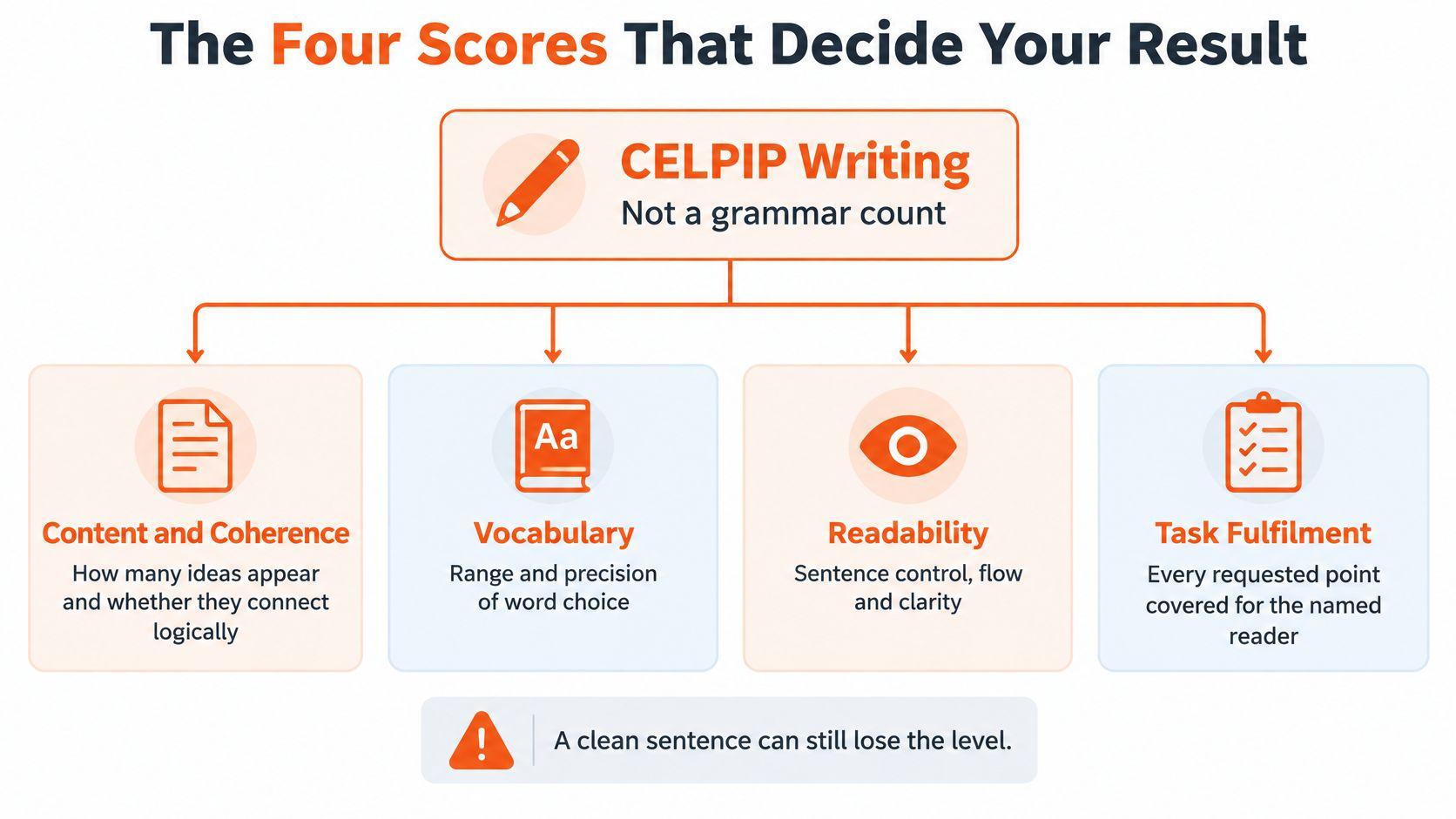
CELPIP writing criteria and what lowers them
| Dimension | What examiners reward | What lowers the level |
|---|---|---|
| Content and coherence | Enough good ideas, clear order, examples and support | Thin ideas, jumpy order, or claims with no detail |
| Vocabulary | Suitable, precise, accurate words with some range | Vague wording, or fancy phrases that don't fit |
| Readability | Paragraphs, transitions, grammar, spelling and punctuation | Walls of text, missing links, or repeated mechanical errors |
| Task fulfillment | Every requested point, the right tone, and 150–200 words | A skipped bullet, the wrong audience, or a response that's far too short or long |
Diagnose the effect on the reader
Consider an email asking a supervisor to change your shift. You explain that your current schedule is difficult and use accurate, varied sentences, but you don't say which replacement shift you can work.
The immediate problem is task fulfillment. The supervisor can't act on the request. Adding a specific alternative does more useful work than replacing difficult with challenging.
Now suppose you do name an alternative, but you scatter your availability across unrelated paragraphs. That's an organization problem. Put the scheduling details together so the reader doesn't have to reconstruct your proposal.
Vocabulary needs the same practical approach. A more convenient shift is understandable, but the evening shift, which begins after my class ends is more precise. The improvement comes from specifying the arrangement, not making the language sound grander.
A clean sentence can still leave the reader without the information they need.
Don't let correction replace evaluation
Grammar feedback can be useful without being complete. If a tool fixes articles and verb endings but never checks the prompt, you still need a separate content review.
Ask the reviewer to identify the sentence that satisfies each instruction. Then ask where an idea needs evidence and whether the opening suits the recipient. Those questions make feedback actionable instead of reducing your response to a list of surface errors.
What Separates Level 9 from Level 10
A CELPIP 9 corresponds to CLB 9 and CEFR B2, while CELPIP 10 corresponds to CLB 10 and CEFR C1, according to the official CELPIP overview and equivalency information. The official descriptions distinguish effective proficiency in some high-stakes social, educational, or workplace contexts from highly effective proficiency in those contexts.
Treat these as different benchmarks, not interchangeable labels. CELPIP reports component results separately, so a stronger Listening result doesn't raise your Writing result.
The comparison below is a coaching aid, not a promise that a particular sentence earns a particular level.
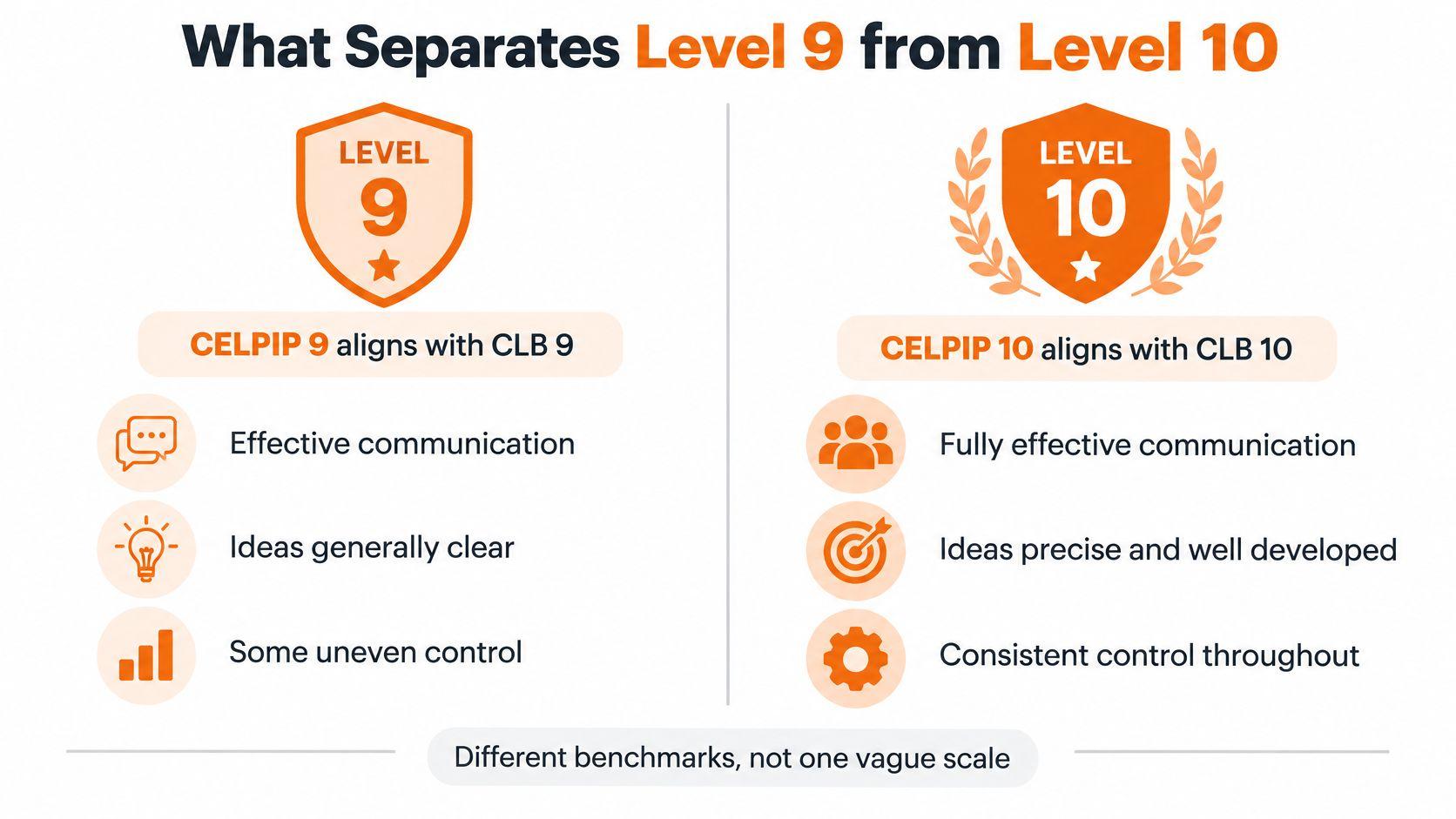
CELPIP 9 and 10 side by side
| Level | CLB | CEFR shown | Official picture | What the writing must add |
|---|---|---|---|---|
| 9 | CLB 9 | B2 | Effective in some high-stakes social, educational or workplace contexts | A complete, organized response with a fitting tone |
| 10 | CLB 10 | C1 | Highly effective in those same contexts | Fuller reasons, precise wording, and every prompt point still covered |
Compare development, not impressive words
Return to the choice between a pool and a sports complex. A clear starting argument might say:
I prefer the sports complex because residents could play different sports and exercise indoors during winter.
That gives a position and relevant reasons. A more developed version connects those reasons to specific users:
I prefer the sports complex because families could use different facilities during the same visit. Parents could attend a fitness class while their children play badminton, making regular exercise easier to fit around work and school.
The second passage doesn't depend on rare vocabulary. It explains who benefits, how they benefit, and why that matters.
A fair comparison can strengthen the argument further: a pool would serve swimmers well, while a multipurpose complex could accommodate residents with different interests. But don't add comparisons merely to sound balanced. Every sentence needs to help justify the selected option.
Consistency matters across the response
An excellent opening doesn't compensate for a rushed, vague conclusion or an omitted instruction. Look for control throughout: precise references, sensible paragraph boundaries, appropriate certainty, and examples that support the reason.
Use an AI essay feedback review to frame criterion-level questions rather than chasing a flattering overall label. Ask which reason is underdeveloped, where your wording is ambiguous, and whether the response stays focused.
A short extract can't establish an official level. Judge the complete response against the complete task, and seek qualified human review when a borderline estimate affects an important decision.
Other Writing Tests Compared
An English writing test is shaped by its audience and purpose. Check the test name, module, and task instructions before choosing practice materials, since the same writing habit can serve one test but misfit another.
IELTS reports Writing separately on a 9-band scale. Its Academic Writing module is one part of the test, not a single writing task, so preparation still needs to cover the response types the module requires.
The UK National Reference Test's 2024 English writing test used one extended task worth 25 marks, according to the Department for Education results digest. In ETS's 2025 report on test takers worldwide, 59% of TOEIC Writing test takers were working professionals.
English writing tests compared
| Test | Writing format | Scoring | Typical audience |
|---|---|---|---|
| IELTS | Academic Writing module with multiple tasks | 9-band scale, reported separately | Undergraduate and postgraduate admission |
| UK National Reference Test | One extended task, 25 marks | Marked out of 25 | Students in England's school assessment context |
| CELPIP-General | Email and survey response, 53 minutes | Writing level assessed across four criteria, including target Levels 9 and 10 | Canadian immigration and licensing candidates |
| TOEIC Speaking and Writing | Workplace-oriented written communication tasks | Test-specific Writing assessment, not CELPIP levels | Working professionals, 59% of writing takers |
Match practice to the examination
Carry over useful habits, not an entire response format. Planning a clear purpose, supporting a claim, and proofreading can help across tests. Yet memorizing a CELPIP email structure will not prepare you to sustain an extended argument when another examination calls for one.
The reverse mismatch matters too. An academic introduction can sound awkward in a practical email. A building manager needs to know that a repair is overdue and what action you are requesting, not read a broad opening about urban housing.
Use this English proficiency test comparison to check which test and format fit your goal before selecting materials. Then practise the response type you will need to produce. For CELPIP, that means treating an email and a survey response as distinct tasks, with their own audience and purpose.
Timed Practice and Revision Routine
Use a complete session to expose your habits, then revise deliberately. The official Writing Pro Target 9 study pack emphasizes organization, supporting detail, suitable vocabulary, and task fulfillment rather than lexical sophistication alone.
The visual gives you a compact reminder of the practice cycle.
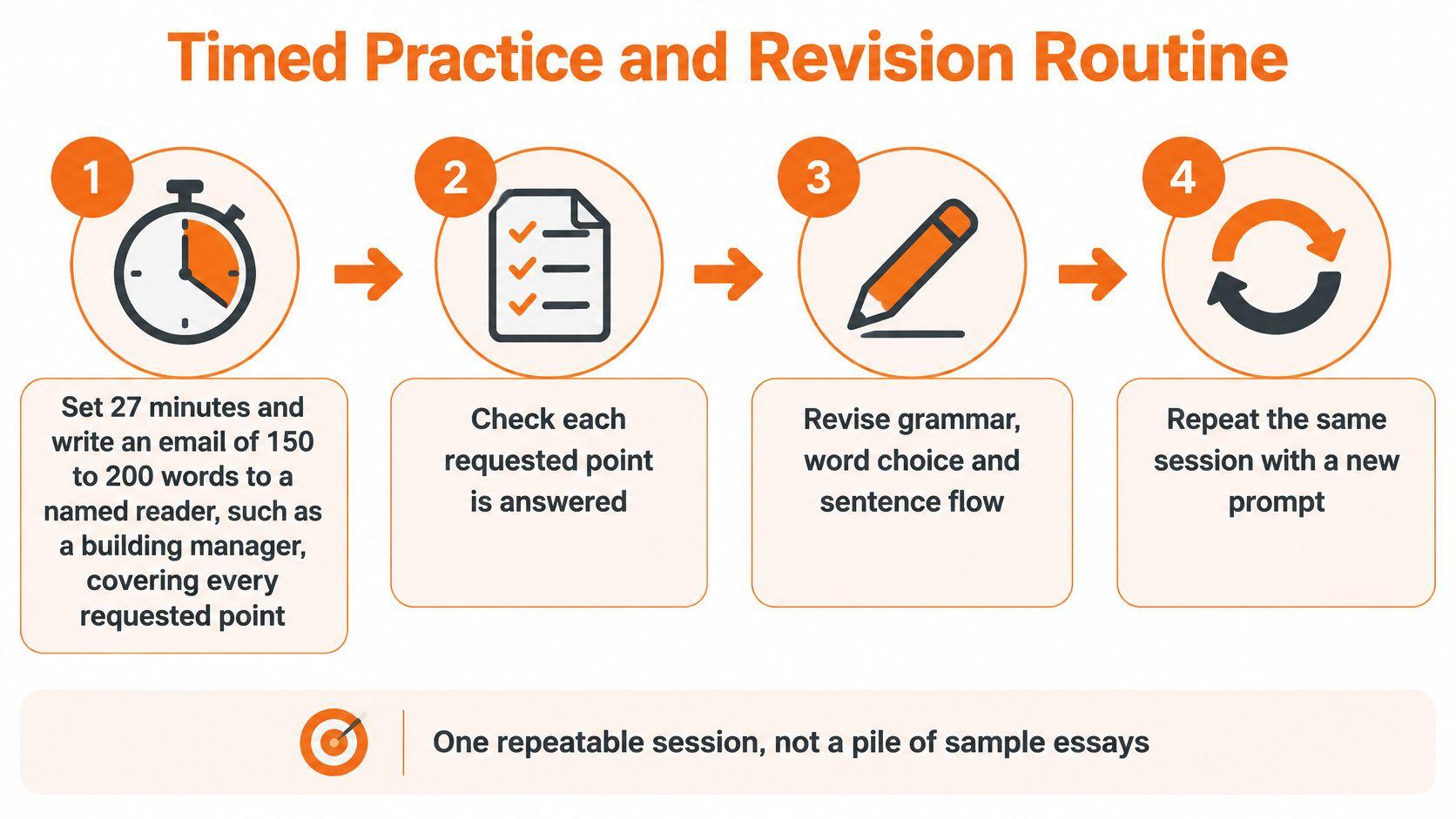
Draft before you diagnose
-
Start the email clock. Use the email allocation in the format table and write to a named reader, such as a building manager. In a practice scenario, ask about a delayed repair, describe its effect, and request a clear next step.
-
Plan briefly inside the allocation. As a suggested practice method, spend about three minutes listing the required points and selecting the tone. For someone in authority, choose respectful, direct language; for a neighbour, a warmer and plainer style may fit.
-
Complete the survey under its own clock. Choose the pool or sports complex and commit to a position. Build reasons around who benefits, include a concrete example, and briefly explain why the alternative meets the neighbourhood's needs less well.
-
Stop when time ends. Save the timed version before making any changes. An unfinished ending is useful evidence: it may reveal that you overplanned, repeated an idea, or spent too long repairing sentences while drafting.
Revise from communication to mechanics
Start with coverage. Match each instruction to the passage that answers it. A missing point is a task-fulfillment problem, but don't assume there's a universal automatic score cap for every omission.
Next, label sentences by function: purpose, requested detail, reason, example, or conclusion. Delete material that doesn't advance the task. If a sentence repeats your frustration without adding an effect or request, it probably needs to go.
Then check paragraph control. Keep related details together, and add a connector only when it explains a real relationship. However should introduce a contrast, not decorate an unrelated sentence.
Replace vague language with useful information. In an email, the service was bad might become the technician left before testing whether the heater worked. After that, correct grammar, spelling, and punctuation, then check the response against the required word range.
Editing priority: Repair what the reader can't understand or act on before polishing what already works.
Use this video as an additional practice aid, then return to your own timed draft.
Keep a compact self-check beside your next answer:
- Coverage: Every instruction has a clear answer.
- Support: Each main reason has an explanation or example.
- Reader: The tone matches the recipient and purpose.
- Control: Paragraphs and sentences follow a sensible order.
- Finish: Mechanics and length have been checked.
Use structured English writing practice to repeat the process with unfamiliar prompts. Compare the original and revised versions so you can name the change you'll make while drafting next time.
Start Timed Practice Before Test Day
Build a weekly routine you can keep alongside work and family commitments. On one weeknight, complete an email under the official allocation; on another, complete a survey response. Revise each before looking at a model, so you don't confuse recognizing a strong answer with producing one yourself.
On the weekend, complete both tasks together under the full-session clock. Save your first drafts and record the weakest dimension rather than writing a vague judgment such as needs better English.
Keep an error log you can use
| Missed prompt point | Tone | Thin example | Grammar |
|---|---|---|---|
| Requested action wasn't stated | Complaint sounded accusatory | Benefit wasn't explained | Verb tense changed unnecessarily |
Use the column that fills first to choose your next exercise. If thin examples recur, practise expanding reasons into effects on specific people. If tone is the problem, rewrite the same request for a manager and a neighbour.
Don't accept vocabulary praise as a CELPIP level estimate. Ask which instruction remains unanswered, which sentence needs support, and whether the recipient could act on the message.
Celprep is an independent practice resource, not the official test provider. Our Writing coach provides email and survey practice with detailed grammar and tone feedback, and our AI feedback is trained specifically on CELPIP scoring criteria, including coherence, vocabulary range, grammar accuracy, and task completion. The free plan includes 1 exercise per task type across Writing, Reading, Listening, and Speaking, 3 starter templates, one vocabulary bundle per section, and 3 submissions per day.
Judge your week's work by the changes in your own answers. Before paying for a longer plan, check whether you're making fewer omissions, developing more relevant examples, and finishing with enough time to review.
Visit Celprep to submit an email or survey response and receive feedback on your own writing. Use the Writing coach to identify a specific weakness, revise the answer, and carry that change into your next timed English writing test practice.