You've highlighted model answers, underlined useful phrases, and read the book cover to cover. Then you press record, the countdown starts, and your mind goes blank. That gap is normal, and it's exactly what a well used CELPIP speaking practice book should close.
What Target Score Your Speaking Practice Must Reach
A candidate reads every sample answer twice. She can explain what a good answer looks like, yet when the recording timer starts she freezes, restarts twice, and stops after 20 seconds. Silent reading builds recognition. Timed speaking practice has to build something else: output under pressure.
That's why this kind of book earns its place only as a workout. Each prompt should end with a recording you can play back, score, and improve. A session that produces notes but no recording trained a different skill from the one the test measures.
Speaking also stands alone in your results. The Government of Canada language test tables map CELPIP-General scores to CLB levels by component, so Speaking is reported as its own skill. Strong Reading, Writing, or Listening results won't cover a weak Speaking result when your pathway requires the target level in every skill.
CELPIP Speaking score targets by CLB level
| Target CLB level | Required in each skill | Speaking requirement |
|---|---|---|
| CLB 9 | Level 9 in Reading, Writing, Listening and Speaking | Level 9 in Speaking |
| CLB 10 | Level 10 in Reading, Writing, Listening and Speaking | Level 10 in Speaking |
Check where your current component scores sit against that target in the CELPIP score chart before you plan your drills. This guide is independent preparation material, not the official test provider. Celprep describes itself as an independent practice resource, and CELPIP is a registered trademark of Paragon Testing Enterprises.
Set your target as a recording standard. "Ready for CLB 9" means you can produce an answer inside the clock that a scorer could rate at that level, and that standard is what every drill in the next sections is built to reach.
Task Timings Every Drill Should Match
Timing isn't a detail you add later. It's a mechanical constraint, and every drill in your book has to reproduce it from the first attempt. A drill with unlimited thinking time trains a skill the test never measures, which is why silent planning always feels easier than a live recording. The official Speaking Pro Target 9 study pack allocates 30 seconds of preparation and 90 seconds of speaking for Task 1, 30 and 60 for Tasks 2 to 4, 60 and 60 for Task 6, and 30 and 90 for Task 7.
Preparation and speaking time for each CELPIP Speaking task
| Task | Preparation time | Speaking time |
|---|---|---|
| 1. Giving Advice | 30 seconds | 90 seconds |
| 2. Talking about a Personal Experience | 30 seconds | 60 seconds |
| 3. Describing a Scene | 30 seconds | 60 seconds |
| 4. Making Predictions | 30 seconds | 60 seconds |
| 5. Comparing and Persuading, part 1 | 60 seconds | No separate speaking window in this part |
| 5. Comparing and Persuading, part 2 | 60 seconds | 60 seconds |
| 6. Dealing with a Difficult Situation | 60 seconds | 60 seconds |
| 7. Expressing Opinions | 30 seconds | 90 seconds |
Notice the pattern before you set anything. The two longest speaking windows belong to the tasks that ask you to give advice and to express an opinion, so those answers need development. The 60 second tasks reward a tighter answer built on fewer, fuller points. Task 5 needs care because it's split into two parts, so set two preparation windows rather than treating it as one long answer. Read the table in test order before each session, and match the timer to the task you're about to record.
Setting Your Timers
Set the preparation timer first, then the speaking timer, and don't extend either one. When preparation ends, speak. When speaking ends, stop, even if you're mid sentence. That hard stop teaches you to plan for a finish, not just a strong start.
The full component takes about 15 to 20 minutes once transitions are included, so add one run of consecutive tasks each week. Single task drills build accuracy. Back to back tasks build stamina and recovery after a weak answer.
Length check: A recording that ends well before the window usually lacks development. A recording that's cut off mid idea usually needs a tighter plan, not faster speech.
Use that check before you judge vocabulary or grammar. Length tells you first whether your structure fits the clock, and it only takes one replay to hear it.
Building an Answer That Fits the Clock
A timed answer works like a bus route with fixed stops. You know the stops before the timer starts, and you move through them in order rather than deciding the route while you speak.
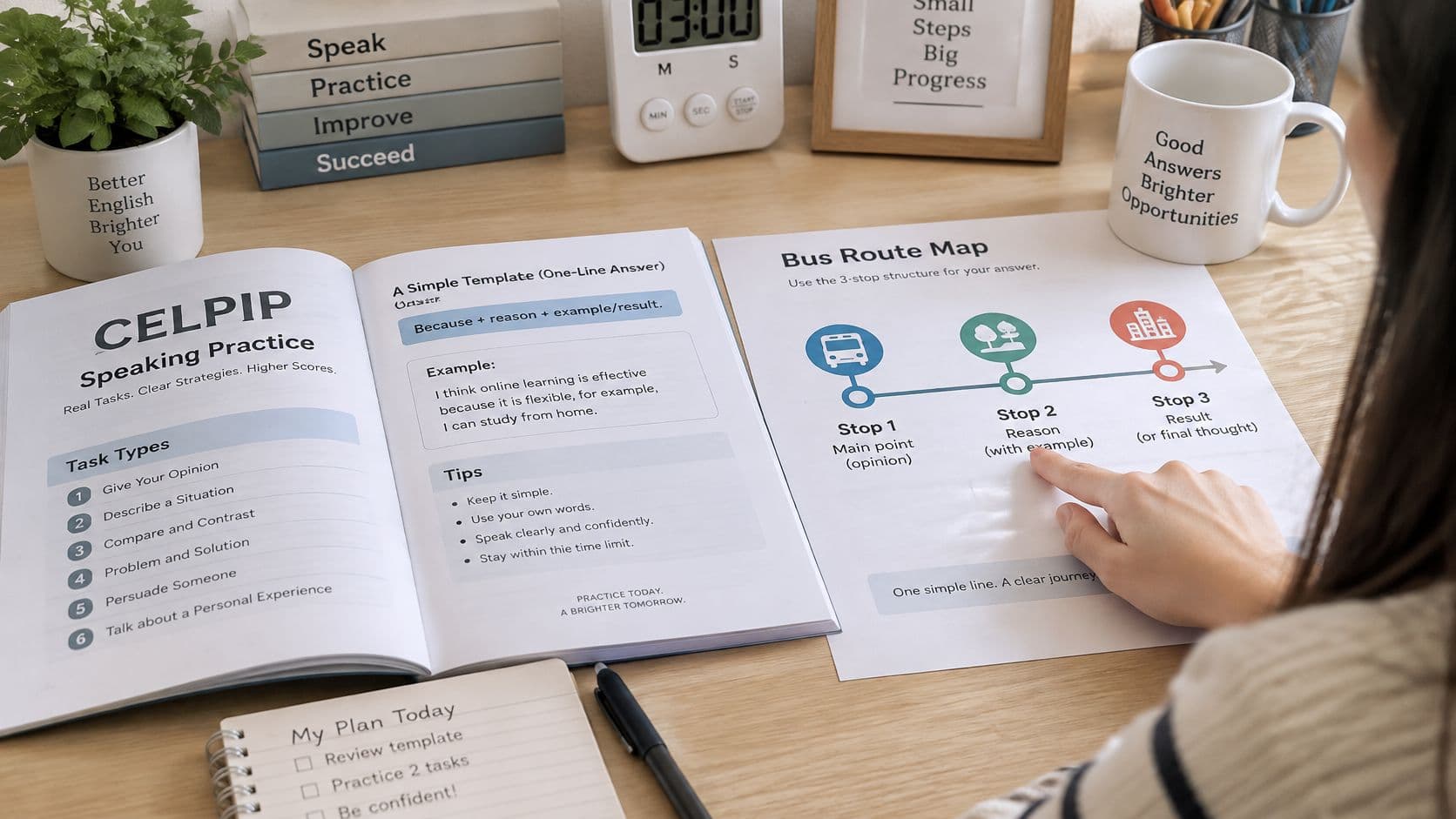
Use the same three stops for every task, then adapt the content to the prompt.
- Stop 1, answer directly: Give a one line response, such as your advice, your opinion, or a summary of the scene. Don't circle the topic for 15 seconds.
- Stop 2, develop two or three points: Give each point a reason and a specific example. For 90 second tasks, develop each point more fully instead of adding a fourth or fifth point. For an advice task, plan at least two clear suggestions during preparation, since a single suggestion leaves the middle thin.
- Stop 3, close cleanly: End with a clear recommendation, conclusion, or final comment. A finished answer sounds deliberate, even if it's simple.
That structure lines up with Celprep's 3-step Speaking Task 1 template: a greeting and problem summary, two or three pieces of advice with reasons, and a conclusion with a recommendation. Sample answers in Celprep's Task 1 guide stay within 90-110 words, which shows why adding more points often hurts. Extra points crowd out the examples that give your answer weight.
Writing Notes You Won't Read Aloud
During preparation, write each stop as a short label, not a full sentence. Write "visit first, less unknown" rather than a line you'll try to recite. Labels let you glance, remember, and keep speaking in your own words.
Full sentence notes create a different problem. You read, your intonation flattens, and one missed word can derail the next sentence. Treat the template as a scaffold, not a script, and change the examples in each drill so your delivery stays spontaneous. For more prompts to run through the same routine, use the Prep Academy page on CELPIP Speaking Task 2 practice and map each task onto the three stops.
A drill only counts when it produces a recording you can score for coherence, vocabulary range, grammar accuracy, and task completion. End each one with the timing check. If you finished far too early, Stop 2 needs more development. If you were cut off, shorten Stop 2 so Stop 3 still gets spoken.
How to Run One Timed Speaking Session
A useful book has to cover the whole test, not just the tasks you enjoy. The official CELPIP test format and scoring page describes the CELPIP-General Speaking component as a 15-minute test containing 8 scored tasks plus 1 practice task. If your book skips one task type, you'll meet that unfamiliar format for the first time on test day.
The visual below summarizes why full coverage matters before you start drilling individual prompts.
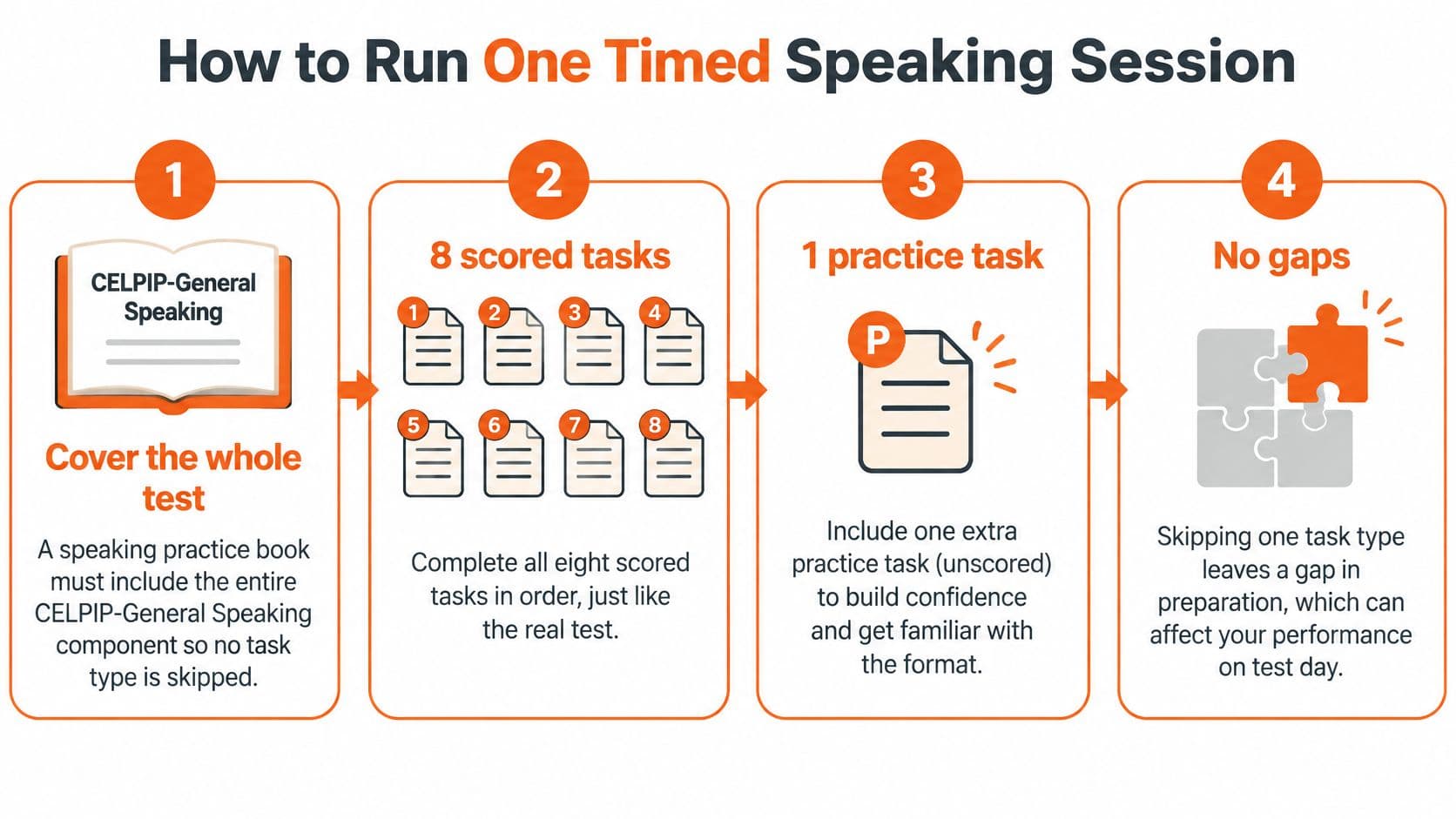
Run every prompt the same way. Consistency makes your recordings comparable from week to week.
- Choose one prompt and name its task type. Advice, scene description, and prediction need different content, so identify the job before you plan. The common slip is using an opinion structure for every prompt.
- Start the preparation timer for that task. Don't read the model answer first. You'll copy its wording instead of building your own response.
- Jot only three keywords. Use a position and two reasons, or a sequence of visual details for a scene. Over planning in full sentences leads to reading aloud.
- Record without stopping. Speak through small errors and keep moving. Pausing to edit yourself trains hesitation, and you can't restart on test day.
- Stop when the speaking time ends. Stop even mid sentence. This shows you whether your plan fits.
- Listen back once and score all four criteria. One focused listen is enough for a first diagnosis. Playing it five times usually turns into self criticism without a clear target.
- Choose one revision target. Pick one change, such as adding a specific example or replacing repeated words. Trying to fix everything at once leaves nothing measurable.
- Re-record the same prompt within 24 hours. The prompt is still familiar, so you can see whether that one change worked. Waiting a week makes the comparison less useful.
You don't need special equipment. A microphone on an ordinary phone or laptop is enough, as long as you can hear pauses, pronunciation, and sentence endings clearly. Sit in the same quiet spot when possible so background noise doesn't hide delivery problems.
Watch the routine demonstrated once, then run it yourself without pausing the video to prepare.
A finished session leaves three things behind, one recording, four scores, and one target for the next attempt. You can compare your attempt with CELPIP speaking samples after you've recorded, not before, so the sample becomes feedback rather than a script.
Reading the Four Scoring Criteria
Many learners ask only one question after a recording. Was my grammar correct? Grammar matters, but it's only part of the picture. The CELPIP Performance Standards evaluate Speaking across four named dimensions, Content/Coherence, Vocabulary, Listenability, and Task Fulfillment, and a strong answer has to perform on all four at once.
The checklist below turns those four dimensions into something you can apply in two minutes after each recording.
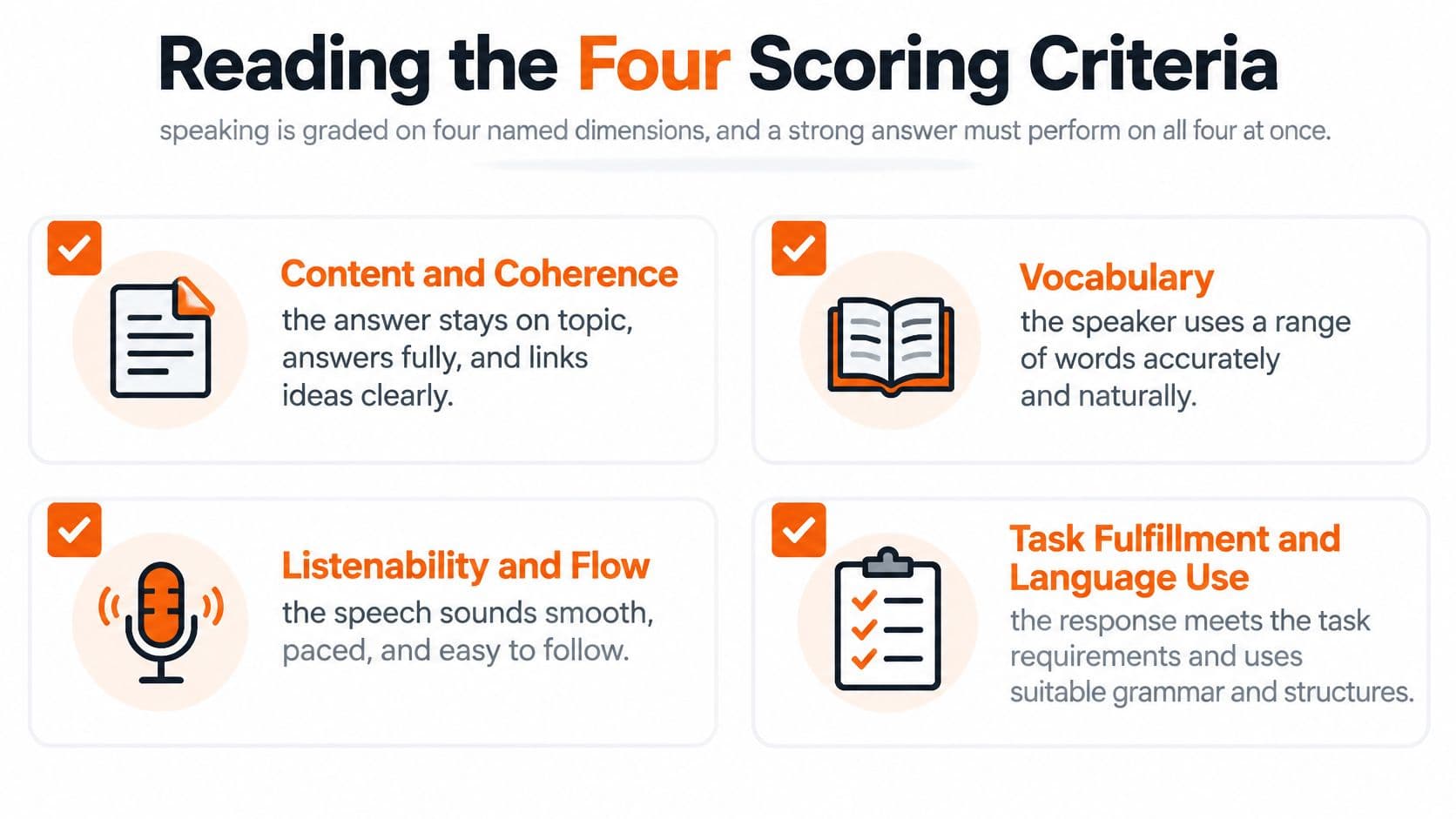
CELPIP Speaking criteria and self-check questions
| Criterion | What it covers | Self-check question |
|---|---|---|
| Content and Coherence | Number and quality of ideas, organization, supporting examples | Did I give at least two developed reasons, each with an example? |
| Vocabulary | Word choice, range, precision, accuracy | Did I use a precise word where I would normally use a vague one? |
| Listenability | Rhythm, pronunciation, intonation, pauses, self-correction, grammar, sentence variety | Could a stranger follow me without replaying the recording? |
| Task Fulfillment | Relevance, completeness, tone, length | Did I answer every part of the prompt, in the right tone and length? |
Applying Each Criterion to a Recording
For Content and Coherence, listen for order. Could you label your opening, your points, and your closing as you hear them? If you can't, the listener probably can't either.
For Vocabulary, don't count difficult words. Check whether your words fit the situation precisely. "Expensive," "manageable," and "worth the cost" do different jobs, and choosing among them shows control.
Listenability is where recordings give you information a page can't. Notice long pauses in the middle of sentences, flat intonation, rushed endings, and repeated sentence patterns. A grammatically accurate answer can still be hard to follow if the rhythm keeps breaking.
For Task Fulfillment, reread the prompt after listening. Did you speak to the right person, cover every part, and use a suitable tone for the full length? Advice to a friend shouldn't sound like a formal essay.
An answer can be grammatically accurate and still lose effectiveness through weak organization, insufficient development, inappropriate tone, or incomplete task coverage.
Score each recording on all four criteria in writing. Written scores let you compare attempts across weeks instead of relying on whether a session felt good or bad.
Fixing Recurring Speaking Problems From Your Recordings
Start with a mistake that's easy to hear and easy to fix. In an advice task, many learners give only one piece of advice, then repeat it in different words until time runs out. Plan at least two clear suggestions during preparation time instead, and give each one its own reason.
That fix works because it changes the plan, not just the delivery. The official Revised Speaking Pro study pack supports a cause and effect approach where adding well organized supporting details can improve coherence, while uncontrolled pauses or monotonous intonation can reduce intelligibility even when grammar is accurate. Diagnose the cause in your recording, then set one revision target for the next attempt.
Four Patterns and Their Targets
- Repetitive wording: You hear the same word, such as "good" or "important," again and again. Your target is to replace one repeated word with one precise alternative in the re-recording, not to insert advanced vocabulary everywhere.
- Uncontrolled pauses: You stop mid sentence while searching for an idea. Rehearse a short planning phrase, such as "One reason is this," and pause briefly between points on purpose. Planned pauses sound controlled. Panicked pauses break the sentence.
- Reading from notes: Your voice flattens and you stumble when you lose your place. Cut your notes to labels before the next attempt. If you can't say it from a two word cue, simplify the idea.
- Running out of time: Your second point expands and the recording cuts off before your conclusion. Shorten that second reason by removing one detail so the closing sentence is spoken. A complete shorter answer beats a detailed unfinished one.
A rambling answer usually doesn't need more ideas. It needs one idea organized better, with one specific example that proves the point. Flat delivery usually doesn't need louder speech. It needs varied clause structures, clearer stress on key words, and pauses placed between ideas.
A book with sample scripts alone can't show you these patterns. Memorized answers hide the pause, the repeated word, and the missing conclusion because you're reproducing someone else's finished product. Your own recording exposes the problem, and that's what makes it fixable.
Start Your First Recorded Session This Week
Don't wait until you feel ready to record. Your first recording is a baseline, not a judgment, and you need it to measure progress.
Week one is for that baseline. Run one session on two different task types, such as Giving Advice and Describing a Scene, and score both recordings on the four criteria. Keep the files even if you dislike them.
Weeks two and three build the habit. Run three sessions a week of about 25 minutes each, choose one revision target per session, and re-record within 24 hours. Rotate task types so you don't become confident on advice tasks while avoiding predictions or difficult situations.
Week four tests whether the work transferred. Re-record your baseline prompts under the same timings, score them without looking at your old scores first, then compare. Note which criterion moved and which one stayed flat.
Track everything in a simple sheet with the date, task type, four scores, and one target. Keep recordings for at least two weeks so you can compare first and later attempts side by side. Extra prompts can come from your book, and Prep Academy articles such as a guide to CELPIP Speaking Task 1 questions and answers can supply additional task specific practice.
For feedback beyond self review, ask a study partner to answer the four self-check questions, or record a real CELPIP speaking task and receive one weakness plus one change to make on the next attempt. Either way, start with one baseline recording this week. Everything else in the plan depends on having that first honest sample.
Turn your book practice into timed, recorded attempts with clear feedback on what to fix next. Visit Celprep to record a speaking task, identify one weakness, and re-record with one specific change for your next attempt.