CELPIP vocabulary is judged through four considerations, not a checklist of impressive words: word choice, suitable use, range, and precision and accuracy, according to the CELPIP teacher guide. That changes how you should study. A familiar word used precisely can do more for your response than an advanced synonym that changes your meaning.
For permanent residency applicants and professionals, the useful question isn't how many words you know. It's whether you can recognize the right expression, choose it for the situation, and retrieve it when you need it.
CELPIP Vocabulary Targets for Each Score Level
CELPIP levels, CLB benchmarks and vocabulary targets
| CELPIP level | CLB level | Proficiency descriptor | Express Entry points per ability |
|---|---|---|---|
| CELPIP 7 | CLB 7 | Adequate proficiency in workplace and community contexts | 4 |
| CELPIP 8 | CLB 8 | Build beyond adequate proficiency toward effective communication | 5 |
| CELPIP 9 | CLB 9 | Effective proficiency | 6 |
| CELPIP 10 | CLB 10 or higher | Highly effective proficiency | 6 |
| CELPIP 11–12 | CLB 11–12 | Advanced proficiency | 6 |
Immigration, Refugees and Citizenship Canada's language-test table maps CELPIP-General results to CLB levels and awards Federal Skilled Worker first-official-language points per ability: 4 at CELPIP 7, 5 at CELPIP 8, and 6 at CELPIP 9 or higher. These are Federal Skilled Worker selection points, not CRS points.
The CELPIP provider guide describes Level 7 as adequate proficiency, Level 9 as effective proficiency, Level 10 as highly effective proficiency, and Levels 11–12 as advanced proficiency. The Level 8 wording in the table is a practical study target, not an official descriptor; CELPIP 10 itself corresponds to CLB 10, while the immigration points tier includes results at that level or higher.
Read each row as a separate target
Points apply to Speaking, Listening, Reading, and Writing individually. Say your Writing result reaches the effective-proficiency band but your Speaking remains at adequate proficiency. Your stronger written response doesn't move your Speaking result into the higher points tier.
This is why vocabulary preparation should start with your component results rather than a general advanced-word list. Someone who understands formal articles but struggles to speak needs retrieval practice. Someone who speaks comfortably but writes vague comparisons needs more exact descriptions and sentence patterns.
Use the CELPIP score chart to interpret your results before deciding what to study. Keep your immigration or professional requirement separate from your personal ambition: meeting the required benchmark and pursuing a stronger result are related, but they're not identical goals.
Translate your target into language choices
For effective communication, learn words that identify the problem and support a useful action. In a housing email, leak, maintenance request, and arrange a repair are more useful than a collection of elaborate adjectives.
To move toward highly effective communication, add distinctions that let you explain relationships:
- Concrete descriptions: A leaking pipe, damaged flooring, an interrupted bus service.
- Abstract concepts: Reliability, accessibility, affordability, long-term consequences.
- Precise comparisons: More convenient for commuters, less disruptive to residents, better suited to evening students.
- Qualified recommendations: A practical option provided that maintenance costs remain manageable.
Your vocabulary target should describe what you need to communicate, not how sophisticated you want to sound.
Write down your target for each ability. Then choose vocabulary sets that address the actual gap: recognizing paraphrases, writing precise comparisons, or retrieving words smoothly in speech.
How CELPIP Scores Vocabulary in Speaking and Writing
Vocabulary isn't a separate CELPIP section, and it isn't a word count. Assessors evaluate it within your spoken and written responses, alongside the other features that make communication effective.
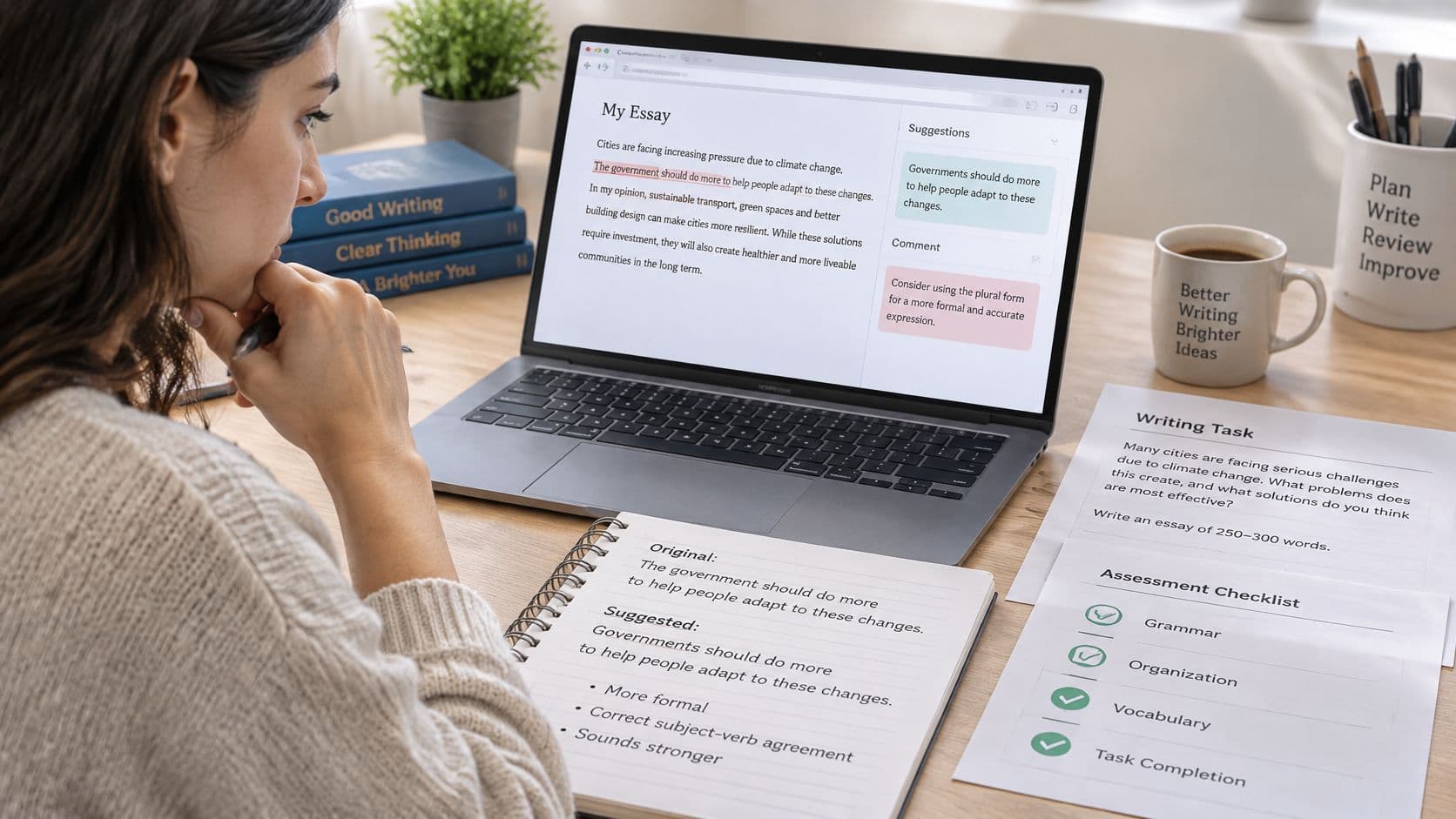
Keep your notebook focused on usable language rather than isolated definitions.

What the vocabulary dimensions mean
| Dimension | What you need to demonstrate | A useful check |
|---|---|---|
| Word choice | Words that express the intended meaning | Does frustrated fit better than angry? |
| Suitable use of words and phrases | Natural combinations and appropriate register | Would you raise a concern or incorrectly make a concern? |
| Range of words and phrases | Enough flexibility to develop ideas without unnecessary repetition | Can you describe the benefit instead of repeatedly calling it good? |
| Precision and accuracy | Exact meaning and correct use | Is the service unreliable, infrequent, or unavailable? |
Consider this hypothetical shipment complaint:
The manager was upset about the delay.
The manager was frustrated that the shipment arrived three days late.
The second sentence identifies the feeling, the delayed item, and the extent of the delay. Its advantage is precision, not length. But those details only help if they fit the scenario; inventing a delay that the prompt doesn't support won't improve task fulfillment.
The official CELPIP performance standards expect Level 10 writers to choose words and phrases that provide precise details, descriptions, and comparisons, while Level 12 vocabulary includes specialized, formal, and common words and a broad range of figures of speech and idioms. Common words remain part of strong performance even at the upper end.
Why rare words and idioms can backfire
A candidate may replace help with facilitate everywhere. Yet Could you facilitate me with my application? is unnatural; Could you help me complete my application? is clear and appropriate. Facilitate a discussion works because the verb fits that noun and meaning.
Idioms require the same control. Keep an eye on the delivery status fits an everyday conversation, but The broken heater costs an arm and a leg confuses the problem unless you're specifically discussing repair costs. Don't add an idiom just to display knowledge.
Use the video alongside active practice: pause, produce your own response, and check the language you chose.
Before submitting a response, check:
- Meaning: Is each key word correct for this situation?
- Repetition: Have you reused a word because it's necessary, or because you couldn't retrieve an alternative?
- Purpose: Does each comparison, explanation, or recommendation express exactly what you intended?
CELPIP is a registered trademark of Paragon Testing Enterprises. This guide is an independent preparation resource.
Vocabulary Categories for Everyday Canadian Tasks
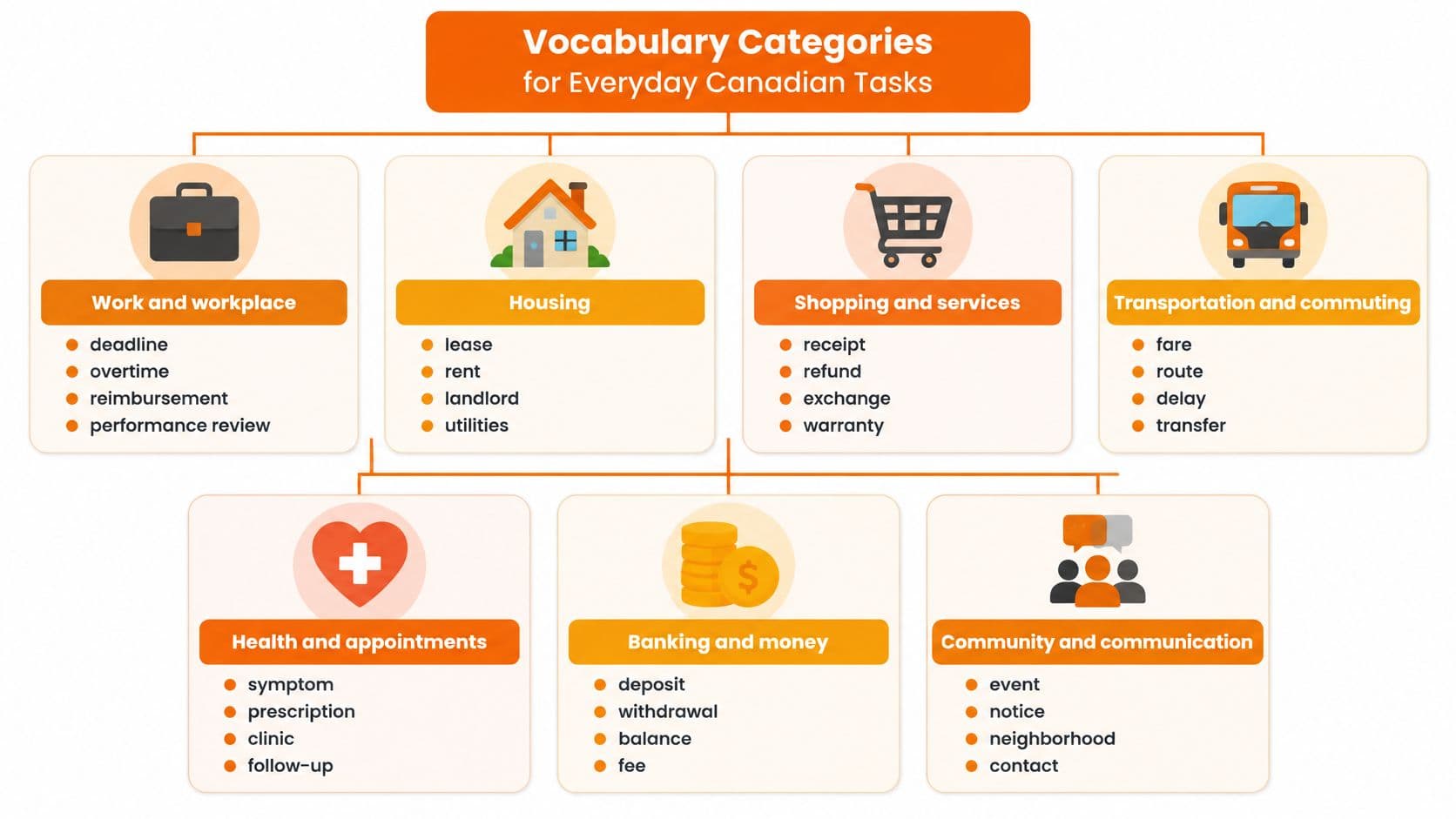
Study CELPIP vocabulary around situations you can picture. A workplace problem gives deadline, overtime, and reimbursement a reason to appear together; an alphabetical list doesn't.
The diagram groups everyday language into practical situations, including related shopping, transportation, and banking terms.
Build theme lists around actions
- Work and workplace: Learn deadline, overtime, reimbursement, and performance review. Connect them to actions such as meeting a deadline, claiming an expense, and discussing feedback with a supervisor.
- Housing: Start with lease, deposit, landlord, maintenance request, and sublet. A useful practice situation is a tenant explaining a repair problem and proposing a convenient appointment.
- Travel and services: Include itinerary, refund, rebook, complaint, and service fee. Practise explaining what went wrong, what you were charged for, and what resolution you want.
- Health and appointments: Use referral, prescription, wait time, and follow-up. Distinguish booking an appointment from asking about a treatment or collecting medication.
- Education and courses: Add enrolment, credits, assignment extension, and transcript. Write requests about course registration or explain why a student needs extra time.
- Community and government: Learn permit, application, eligibility, notice, and consultation. These support questions about public services and opinions about local proposals.
- Opinions and surveys: Practise trade-off, priority, benefit, drawback, and long-term effect. These words help you evaluate options rather than merely announce a preference.
Don't stop at naming objects. For each theme, include the verbs that people use to solve problems: submit, confirm, reschedule, approve, replace, and resolve. An email becomes much easier when you can state both the problem and the requested action.
Cross-reference words instead of relearning them
| Word | First context | Another useful context |
|---|---|---|
| Deadline | Completing a work project | Submitting an assignment |
| Application | Applying for a permit | Applying for a course |
| Refund | Cancelling a travel purchase | Returning a work-related purchase |
| Deposit | Securing a rental arrangement | Paying toward a service booking |
Refund language may appear alongside a workplace reimbursement claim, but the transactions aren't interchangeable. If a retailer returns money for a work purchase, that's a refund; if your employer repays your expense, that's reimbursement.
Label each entry with its theme and its function. For example, request a refund belongs to travel or shopping and also to requesting a resolution. Pair theme terms with functional phrases such as I would suggest, and develop fuller entries with meanings and sample sentences.
Study shortcut: Learn a word once, then practise changing its audience, purpose, and surrounding sentence.
Writing Task 1 email practice can draw heavily on housing, services, and work. Task 2 survey practice is well suited to community, education, and opinion vocabulary, though neither task is restricted to those themes.
As a manageable study exercise, build a list of about 15 to 20 entries per category. Choose situations you can explain meaningfully, rather than filling the list with unfamiliar terms you'll struggle to use.
Useful Phrases for Agreeing, Contrasting and Recommending
Functional phrases by communicative purpose
| Function | Phrase | Register | Example sentence |
|---|---|---|---|
| Agreeing | I share your view that | Neutral to formal | I share your view that the new schedule will reduce wait times. |
| Contrasting | Although | Neutral | Although the rent is high, the location saves two hours of commuting every week. |
| Qualifying | to some extent | Neutral | The proposal is workable, to some extent, but it needs a larger budget. |
| Recommending | I would suggest | Polite and formal | I would suggest booking the inspection before signing the lease. |
| Describing trends | There has been a steady increase in | Formal written | There has been a steady increase in complaints since March. |
| Explaining impacts | As a result | Neutral | As a result, the team missed two project deadlines. |
These are model sentences for practice, not factual claims about rent, complaints, or project performance. Replace their details with information that fits your prompt.
The CELPIP scoring-level resources emphasize suitable language and vocabulary breadth. Practise controlled flexibility: choose a phrase because it expresses the relationship between your ideas, not because it sounds more formal than the alternative.
Turn each phrase into a usable card
A flashcard in Anki, Quizlet, or a notebook should contain more than a translation. Record a natural collocation, register label, grammatical pattern, and separate spoken and written examples.
For I would suggest, your card could contain:
- Collocation: Suggest booking an inspection.
- Register: Polite; suitable for a professional recommendation.
- Pattern: Suggest + -ing form, or suggest that + clause.
- Spoken example: I would suggest checking the heating before you move in.
- Written example: I would suggest booking the inspection before signing the lease.
I would suggest booking the inspection suits a formal landlord message. Maybe you could book the inspection sounds more conversational and may be too casual when you're making a formal recommendation. Neither phrase is wrong; the relationship with the recipient determines which fits better.
Avoid I suggest you to book. Use I suggest booking or I suggest that you book. Learning the grammatical pattern prevents you from remembering the expression but assembling it incorrectly.
Make the connector match the logic
Although introduces a contrasting clause: Although the course is expensive, it includes practical training. However normally connects a separate statement: The course is expensive. However, it includes practical training.
Don't use a contrast word when the second idea adds information. The apartment is spacious. However, it has a large kitchen doesn't establish a clear contrast. It has a large kitchen, but very little storage does.
For a practice response, limit to some extent to one purposeful use rather than placing it in every paragraph. It qualifies a claim, so you should explain the limit: the proposal works for daytime users but not for evening workers.
A trend expression such as a steady increase in needs a time reference or supported numerical context. Don't invent figures to make it sound precise; if the prompt offers no trend, describe the problem without claiming one.
Use the CELPIP speaking samples to practise phrases inside complete answers. For each phrase, write a sentence about your job, school, or home, then try saying it within ten seconds as a retrieval drill.
Keep idioms in a separate, smaller list. Only move them into responses when their meaning, grammar, and tone fit naturally.
Topic Entries with Collocations and Sample Sentences
Topic terms with meaning, collocation and sample sentence
| Term | Meaning | Collocation | Sample sentence |
|---|---|---|---|
| Lease | Written rental contract | sign a lease, renew a lease | We need to renew the lease before June. |
| Deposit | Money held as security | pay a deposit, get a deposit back | The landlord returned my deposit within two weeks. |
| Refund | Money returned for a purchase | request a refund, issue a refund | I would like to request a full refund for the damaged item. |
| Itinerary | Planned schedule of a trip | confirm the itinerary, change the itinerary | Could you send the revised itinerary by Friday? |
| Referral | Note sending a patient to a specialist | get a referral, need a referral | My doctor gave me a referral to a cardiologist. |
| Overtime | Hours worked beyond the normal schedule | work overtime, paid overtime | Overtime is paid at one and a half times the normal rate. |
| Reimbursement | Repayment of an expense you paid | claim reimbursement, submit for reimbursement | I submitted my travel receipts for reimbursement. |
The sentences are hypothetical language examples. In particular, the deposit timing isn't a legal deadline, and the overtime sentence illustrates a possible employment arrangement, not a universal pay rule.
Learn the pairing, not just the definition
A collocation is a natural word combination. Knowing lease means rental contract helps comprehension; knowing sign a lease helps you produce a sentence.
Lease and rent aren't interchangeable. You sign or renew the document, but pay the recurring charge: We signed the lease and arranged to pay rent by bank transfer. Pay a lease usually fails to express the intended action.
The same distinction matters with refund and reimbursement. Say you buy a damaged headset and return it to the shop. You request a refund; if you buy a headset for work and your employer repays you, you submit an expense claim for reimbursement.
A workplace email can use both terms accurately:
The retailer issued a refund for the faulty headset, so I withdrew my reimbursement claim.
That sentence demonstrates more control than replacing either noun with a loosely remembered synonym.
Check word forms and grammatical roles
Referral is a noun; refer is a verb. A doctor can refer a patient to a specialist, and the patient can get a referral.
Get a referral naturally describes obtaining one in a Canadian health appointment conversation. Have a referral is also correct when you mean you already possess it: I have a referral and would like to book an appointment. Choose the verb according to the stage of the process.
Likewise, complaint is a noun and complain is a verb. You make a complaint about a service or complain about a service, not complaint about a service.
Expand your bank with these combinations:
- Sublet: Sublet an apartment. I'd like to ask whether I can sublet the apartment during my placement.
- Maintenance request: Submit a maintenance request. I submitted a maintenance request about the leaking tap.
- Prescription: Fill a prescription. I need to fill my prescription before travelling.
- Transcript: Request an official transcript. The college asked me to submit an official transcript.
- Eligibility: Check eligibility. Please confirm my eligibility for the evening course.
- Performance review: Schedule a performance review. My supervisor scheduled a performance review.
- Service fee: Charge a service fee. The agency charged a service fee for changing the booking.
- Rebook: Rebook a flight. Could you help me rebook my cancelled flight?
Write your own collocation and sample sentence for each. In Writing, wrong verb-noun pairings are conspicuous because readers can inspect the sentence closely; don't assume they carry a fixed penalty or necessarily matter more than a serious meaning error.
How Vocabulary Works Across Reading, Listening, Writing and Speaking
CELPIP-General time and vocabulary demand by skill
| Skill | Approximate time | Vocabulary demand | Practice focus |
|---|---|---|---|
| Listening | 46–55 minutes | Recognize paraphrased terms in conversations and announcements | Timed listening with paraphrase spotting |
| Reading | 43–56 minutes | Recognize topic words and figures of speech in passages | Skim for key terms under time pressure |
| Writing | 53 minutes | Precise word choice and range in emails and survey answers | Timed email and survey responses |
| Speaking | 15 minutes | Retrieve words instantly with clear pronunciation | Short timed responses with recovery phrases |
The official CELPIP test-format page gives these approximate component times, distinguishes CELPIP-General from Listening-and-Speaking-only CELPIP-General LS, and states that score reports are valid for two years from the date issued. The component times are full-section allocations, not the length of every individual task.
Recognition and retrieval need different practice
Reading and Listening are receptive skills. You must recognize meaning even when a passage or speaker uses wording different from the answer choices.
For Reading, connect eligible applicants with people who meet the requirements. For Listening, connect the appointment has been pushed back with the appointment has been delayed. Matching only the exact word can lead you past the correct meaning.
Writing and Speaking are productive skills. You have to supply the expression yourself, with suitable grammar and tone.
A learner-corpus study available through Kobe University's repository describes different developmental patterns in spoken and written vocabulary, with writing generally showing greater lexical diversity and speaking requiring real-time deployment with distinct lexical-density patterns. It also discusses evidence that aural vocabulary size can be the strongest vocabulary-related predictor of speaking proficiency.
Hearing a word matters because spoken retrieval depends partly on knowing its sound. Record pronunciation and stress alongside the spelling, then practise the whole phrase rather than repeatedly reading the word.
Prepare a recovery route for speech
Don't let an ambitious word stop your answer. Keep a simpler accurate alternative ready.
- Substitute: If reimbursement won't come, say repayment of my work expenses.
- Define: If itinerary disappears, say the schedule for the trip.
- Reformulate: If accessible feels uncertain, say easy for residents to reach and use.
A simpler accurate phrase keeps your meaning intact. A long search for a sophisticated word can interrupt the answer.
For CELPIP-General LS, prioritize audio recognition, pronunciation, and immediate spoken use. Written examples can still clarify grammar, but they shouldn't replace listening and speaking practice.
Start unfamiliar entries slowly, then time every exam-style practice set. An untimed definition drill can help you learn a meaning, but it can't show whether you'll retrieve that expression during a response.
Skill-Specific Examples for Reading, Listening, Writing and Speaking
One phrase family can appear differently across the skills. In Reading, you identify the author's relationship between ideas; in Speaking, you must express that relationship yourself.
Use these hypothetical examples as prompts. For receptive practice, explain the meaning without copying the sentence; for productive practice, change the topic and create your own version.
Follow the function across the skills
| Phrase family | Reading example | Listening example | Writing example | Speaking example |
|---|---|---|---|---|
| Agreeing | The committee supports the proposal to extend library hours. | I'm with you on keeping the library open later. | I share your view that longer opening hours would help students. | I agree because evening access would fit my work schedule. |
| Contrasting | Although the site is central, parking is limited. | It's easy to get there, but finding parking is difficult. | Although the venue is convenient, it may not suit drivers. | The location is great, but I'd prefer somewhere with parking. |
| Qualifying | The policy would benefit residents provided that fees remain affordable. | It could work, as long as the price doesn't go up too much. | I support the proposal to some extent, but affordability needs attention. | I'd support it if families could still afford to use it. |
| Recommending | The notice recommends booking an inspection before occupancy. | You should get the place checked before moving in. | I would suggest arranging an inspection before the move. | I'd book an inspection first so you know what needs fixing. |
| Describing trends | There has been a sharp decline in attendance since the schedule changed. | Fewer people have been coming since the hours changed. | Attendance has declined since the revised schedule began. | It seems fewer people are attending because the hours don't suit them. |
| Explaining impacts | Residents may have to bear the cost of additional maintenance. | People living here might have to pay for the extra repairs. | As a result, residents could face higher maintenance charges. | That means residents might have to pay more. |
For trend examples, the hypothetical context supplies the change and time reference. In an actual answer, don't convert a possibility into an established trend.
Recognize formal and conversational paraphrases
Reading may use in response to, a sharp decline in, or bear the cost of. Translate those into plain meanings: because of or following, a large decrease, and pay for. Keep the surrounding context in view because a phrase can have more than one appropriate paraphrase.
A workplace passage might say The company will reimburse approved expenses. An answer choice may use pay employees back. Match who pays whom and for what, not just the shared topic of money.
Listening requires the same attention without the chance to inspect every sentence. The earliest available slot may replace the next opening. Listen for restrictions too: We can rebook you, but the service fee is non-refundable doesn't promise a full refund.
Produce language that fits the audience
For a landlord email, use I am writing to request a repair and I would appreciate it if you could confirm an appointment. For a survey answer, The main benefit is improved access introduces a reason, while On balance, I favour the evening option states a considered choice.
Use the CELPIP writing tips to practise these expressions within a complete message rather than a disconnected sentence list.
Speaking recovery phrases should clarify your idea: What I mean is, residents need a route that runs after work. In simpler terms, the current timetable doesn't suit shift workers also works.
The closest word I can think of is can help occasionally, but defining the missing term directly is often smoother. Rehearse full-section sets using the component allocations, and use the individual prompt timer for each task rather than treating a whole section as one answer.
Build, Score and Test Your Vocabulary Bank
A vocabulary bank is useful only when you can produce its entries correctly. Keep separate labels for expressions you recognize, expressions you can use with notes, and expressions you can retrieve independently.
Use this workflow to connect your target with practical rehearsal.
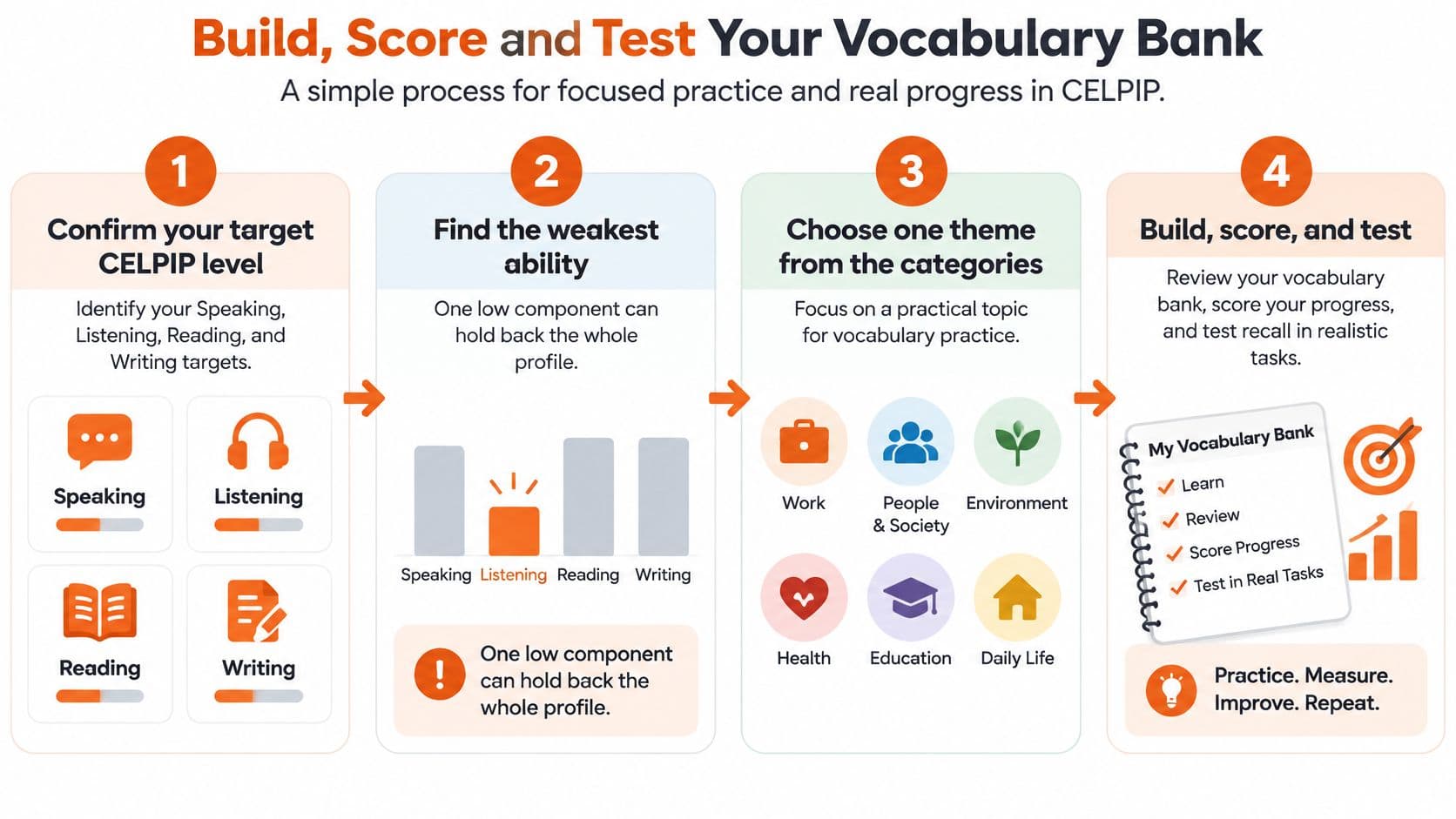
Follow a repeatable study routine
-
Confirm your component targets and identify the weakest ability. Record the required result beside your latest practice evidence. If speaking retrieval is the problem, don't spend the entire study session collecting words from articles.
-
Choose a relevant theme and a supporting category. Work and housing make a practical combination for a permanent residency applicant. As a study exercise, select 15 to 20 entries for the first theme, mixing nouns, collocations, and functional phrases rather than choosing nouns alone.
-
Build complete entries. Record meaning, a natural collocation, register, grammatical pattern, and a spoken and written example. Add pronunciation or a short audio recording when you can recognize the spelling but hesitate over the sound.
-
Write a timed practice email. For this exercise, aim for about 150 to 200 words and use at least five entries, provided they fit naturally. Follow the Task 1 timer shown in your practice task, leaving room to check the response rather than forcing every selected word into it.
-
Audit the official vocabulary dimensions. The CELPIP test-results descriptors assess word choice, suitable use of words and phrases, range of words and phrases, and precision and accuracy. Mark each dimension as secure or needing revision; this is a study audit, not an official CELPIP score.
-
Replace specific weaknesses. Flag needless repetition, vague nouns such as thing, unnatural idioms, inappropriate register, and imprecise modifiers. Replace The service was bad with the actual problem, such as The technician missed the appointment without notifying me.
-
Rewrite without notes after a delay. As a spaced-retrieval exercise, return to the same task after 48 hours. Compare whether you remembered the expressions, kept the meaning accurate, and completed the request more clearly.
-
Promote entries only after successful retrieval. Use a practice rule of moving an entry to your retrieval list after you've used it correctly in three separate responses. Keep a simpler speaking substitute beside it, and repeat a timed writing and speaking check every two weeks to decide what still needs work.
Review evidence, not impressions
Don't judge improvement by whether the revised response sounds more elaborate. Compare the action verbs, noun choices, comparisons, and tone.
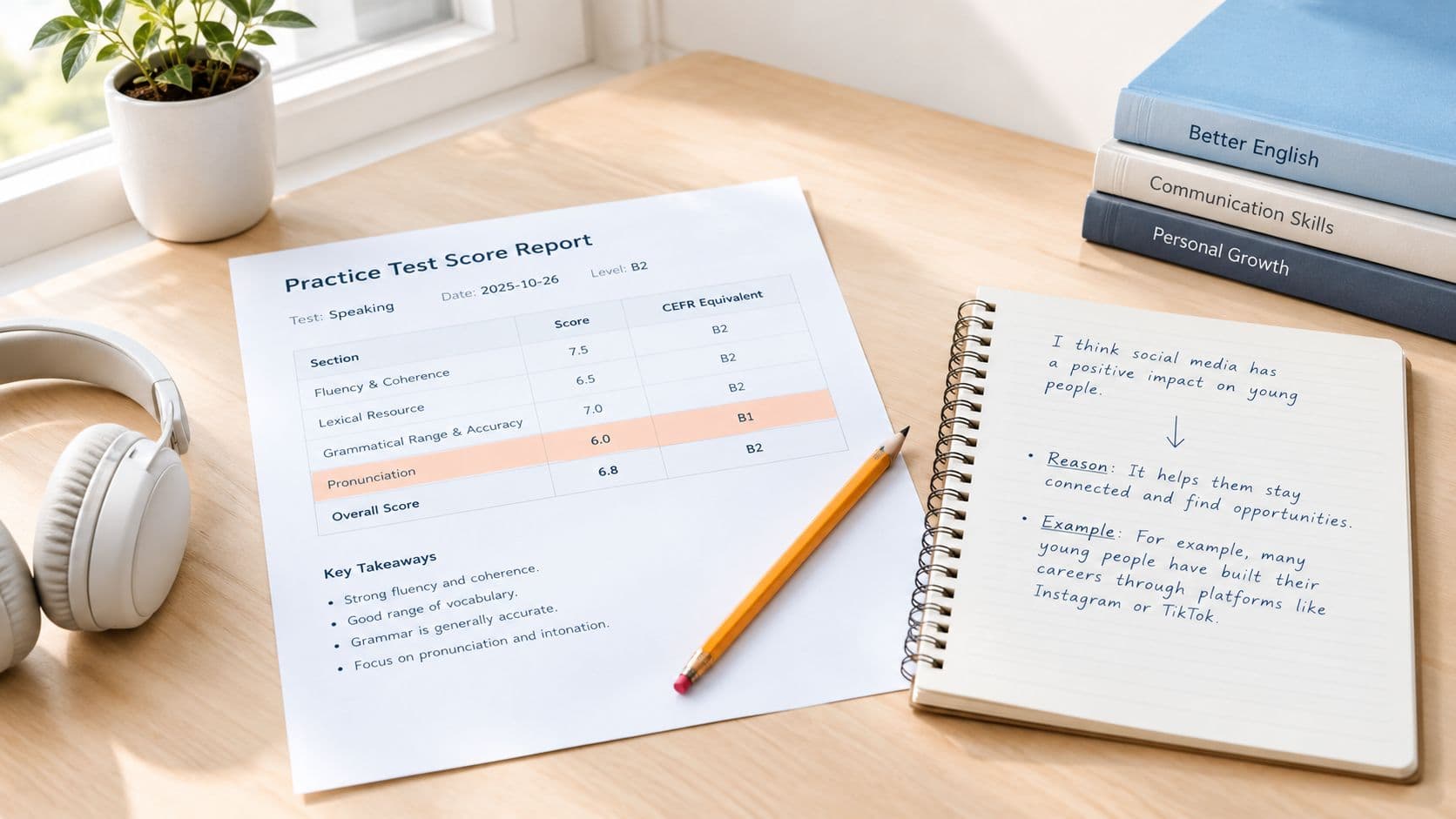
A useful review note is specific: Used “request a refund” correctly, but confused “refund” with “reimbursement” in the explanation. That tells you what to practise next; Improve vocabulary doesn't.
Our Celprep exercises require you to write, speak, read, and listen, and our AI feedback is trained specifically on CELPIP scoring criteria, including coherence, vocabulary range, grammar accuracy, and task completion. Use response-specific feedback to choose a correction, then test that correction in a fresh answer instead of only rereading the feedback.
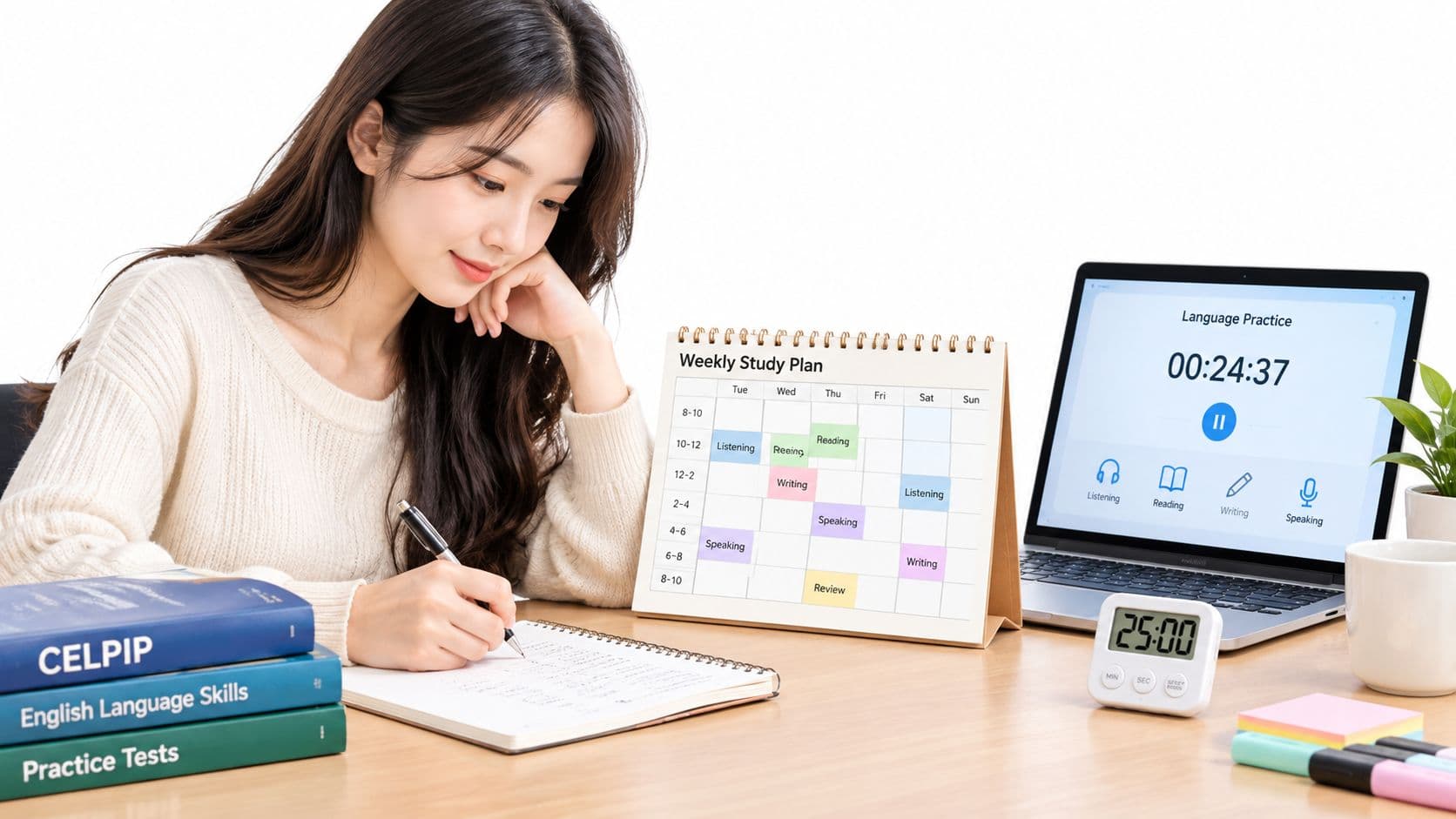
Plan backward from your test date and application timeline, including time to review weak entries and confirm that your score report will remain valid when needed. Don't build a schedule around collecting vocabulary alone.
Your first action is simple: write down your weakest ability, choose a relevant theme, and create an entry you can both explain and use.
Celprep offers resource pages on Writing tips, Writing samples, Writing Task 1 samples, Writing Task 2 samples, Reading tips, and a Listening score chart. Visit Celprep to pair your vocabulary bank with timed practice and feedback on the answers you produce.