A polished draft isn't proof that your English writing has improved. Feedback can help you repair a familiar response more easily than write a new one, so the test is what you can produce on an unfamiliar topic without help. Effective English writing practice makes room for both revision and that independent test.
How Much Weekly Writing Practice Is Enough
Aim for 2 to 3 hours of writing practice a week. That is a practical weekly commitment for exam preparation, not a guaranteed formula for a particular score. How you divide the hours matters more than reaching the total, and every plan below reserves part of the week for revision and for tasks you have not seen before.
Use the following plans as calendar templates. The outputs include work on existing drafts, so you do not need to write every response from scratch during the week.
Weekly writing plans by available time
| Time per week | Sessions | Task mix | Expected output |
|---|---|---|---|
| 1 hour | 2 sessions of 30 minutes | 1 timed email, 1 self-check | 2 scored drafts |
| 2 hours | 3 sessions of 40 minutes | 1 email, 1 opinion response, 1 revision | 3 drafts and 1 revision |
| 3 hours | 4 sessions of 45 minutes | 1 email, 2 opinion responses, 1 revision, 1 unseen transfer task | 4 drafts, 2 revisions and 1 transfer task |
For the shorter plan, score a new email and revisit an older draft. For the longer plans, bring unfinished responses into the week and count revised versions separately from first drafts. The unseen transfer task in the three-hour row is the main measure of the week, because it shows whether the choices you practised on familiar prompts still hold when the topic changes. These are working schedules, not promises about how much every learner can finish.
Make the sessions connect
Short sessions on separate days make it easier to remember why you changed a paragraph and apply that decision again. A long weekend block can still help with exam rehearsal, but fatigue makes careful revision harder.
Keep the same prompt type for consecutive sessions when possible. Revise a request email, then write a different request email that needs the same polite but direct tone. Use the same scoring rubric each time so your weekly records remain comparable.
The purpose extends beyond passing a test. The British Council's English Effect report estimates that approximately 1.75 billion people speak English at a useful level, and many of them will read your writing without sharing your first language. Clear organization and an explicit purpose matter more to that reader than elaborate phrasing.
Calendar rule: Choose the schedule you can repeat during a busy week, not the one you could manage only during a quiet week.
Block the sessions in advance, ideally on separate days. If you struggle to finish responses in the time available, these CELPIP time-management techniques help you decide where planning, drafting, and checking belong.
Choosing Prompts That Build Real Skill
Rotate prompts by the skill they require, not just by their topic. Writing about transport today and shopping tomorrow won't broaden your skills much if both answers use the same familiar argument.
Start with a clear purpose, such as requesting a repair. Once that feels manageable, add another responsibility, such as explaining the inconvenience and proposing an appointment.
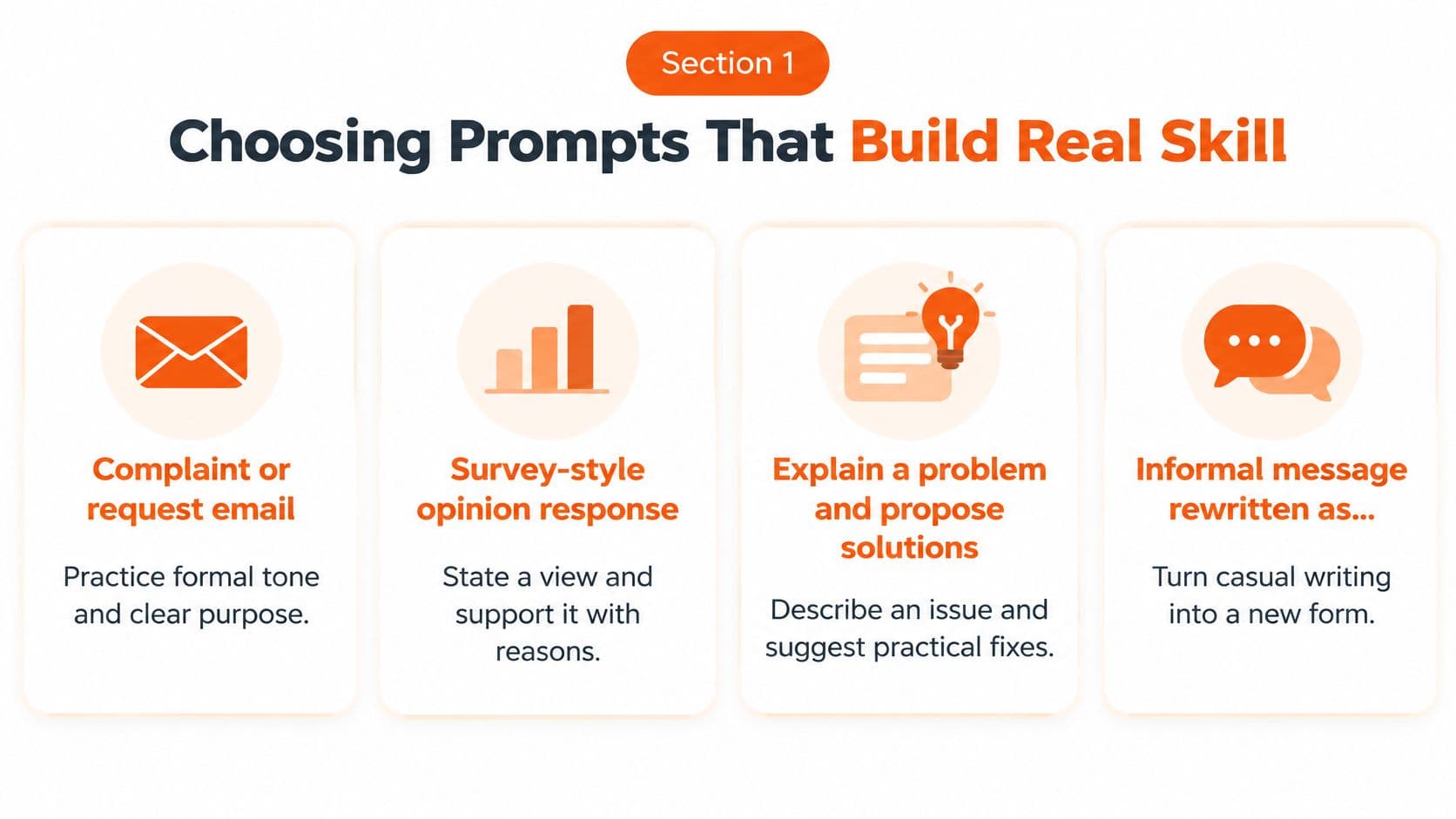
- Complaint or request email: Explain a problem to a landlord, manager, or service provider and ask for a practical action.
- Survey-style opinion response: Choose between alternatives, such as longer library hours or additional weekend programs, and defend your choice.
- Problem-and-solution message: Describe an issue at work or in your community and suggest workable fixes.
- Informal-to-formal rewrite: Turn a casual message to a friend into an appropriate message to a supervisor without changing its meaning.
Use this prompt rotation to keep the purpose of each exercise visible.
Practise a strategy, not a memorized answer
In a meta-analysis of students in Grades 6–12, the writing-instruction review published in Reading and Writing reported effects of 0.75 standard deviations for process-based instruction, 0.59 for strategy instruction, and 0.30 for feedback. Those results support guided practice in planning, drafting, and checking, though they aren't predictions of adult CELPIP score gains.
Model answers can demonstrate those decisions, but reading them isn't the same as making the decisions yourself. Use CELPIP Writing Task 1 samples to identify how a writer introduces a purpose, develops relevant details, and asks for action. Then close the sample before writing.
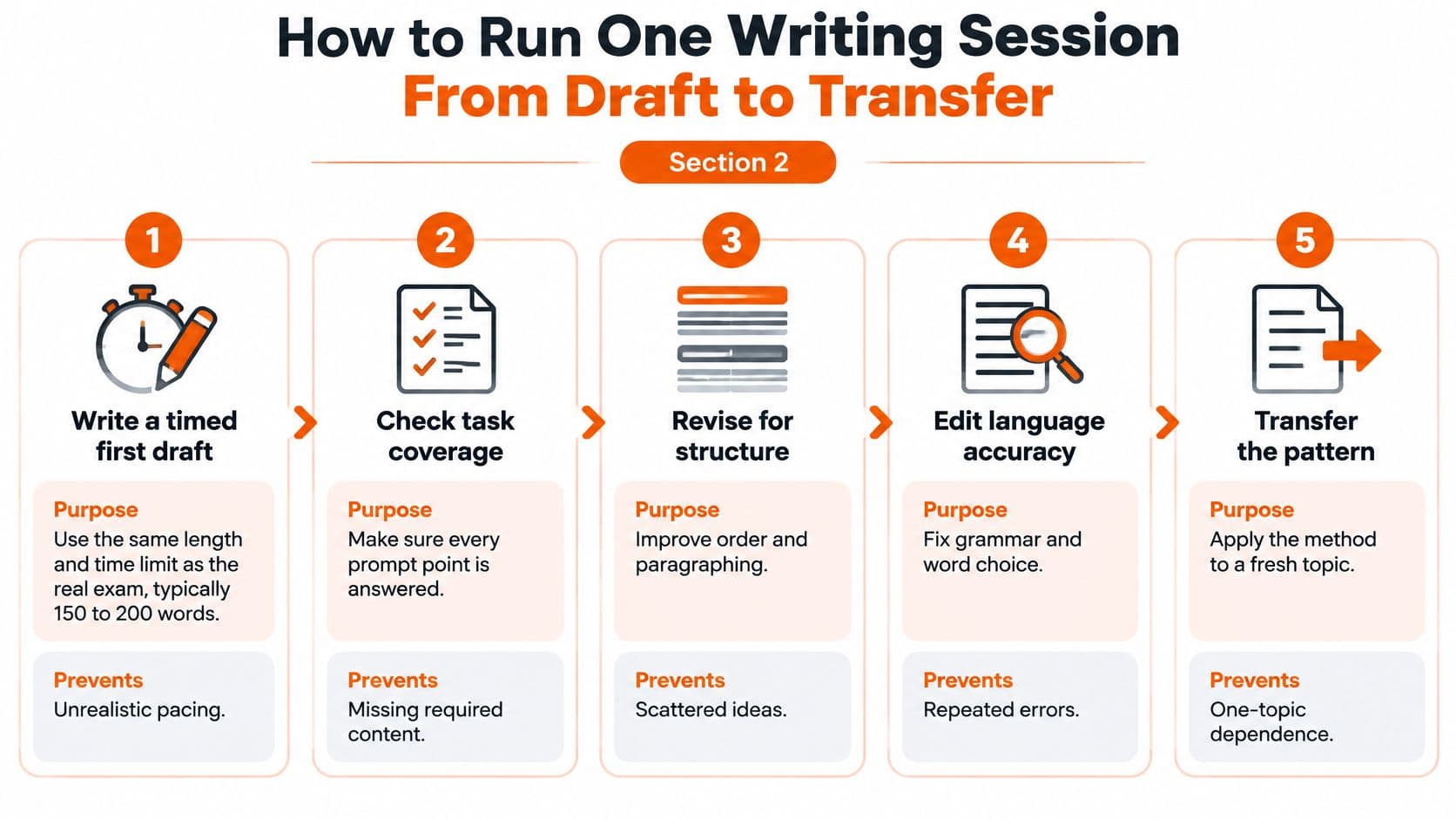
For exam rehearsal, the official CELPIP participant package specifies 150–200 words for each writing task, with 27 minutes for the email and 26 minutes for the survey response.
Use a reusable planning pattern:
- Opening: State the purpose or your position.
- Development: Build two or three relevant points with explanations or examples.
- Closing: Request action, recommend an option, or conclude.
For practice, spend two minutes writing that outline before drafting. Keep the structure familiar while changing the ideas, audience, and language.
How to Run One Writing Session From Draft to Transfer
A useful session produces more than a corrected document. It should leave you with a decision you can make independently next time, such as placing the request earlier or explaining how an example supports your opinion.
A meta-analysis in TESOL Quarterly covering 26 second-language writing studies found a significant overall benefit from peer feedback, with Cohen's d = 0.73, and stronger effects on revisions than on new compositions. That distinction matters: successfully repairing a response doesn't automatically mean you can reproduce the improvement elsewhere.
Follow the complete practice cycle
-
Write a timed first draft.
Match the length and timing of the task you're preparing for. Draft without a model answer, grammar assistant, or suggested outline beside you. This prevents an assisted performance from becoming your baseline. -
Get targeted feedback.
Check content first: did you answer everything the prompt required? Then examine organization, vocabulary, and grammar in separate passes. Asking a reader to identify where your explanation becomes unclear is more useful than asking whether the answer is good. -
Revise the same response.
Don't abandon it because starting another topic feels more enjoyable. If your survey answer lists benefits without explaining them, develop those benefits before changing individual words. Otherwise, you may polish a paragraph that still doesn't do its job. -
Compare versions in an error log.
Record the original wording, your change, the rule or reasoning, and the sentence type affected. Keep the entry short enough to review before your next attempt. A log should guide decisions, not become a second essay. -
Complete a later transfer task without assistance.
Choose a new topic that requires the same underlying skill. After practising a polite request about a broken appliance, for example, request a work-schedule adjustment. Keep your notes closed until you've finished.
The visual below summarizes the decisions within that cycle, from realistic drafting through independent application.
Keep the error log practical
Say your original sentence is: The bus service is bad. Your revision might be: The evening bus often arrives after my shift begins, so I have to arrange another way to work.
The change isn't merely better vocabulary. You've replaced a vague judgment with a specific problem and its consequence. In your log, record the transferable decision: explain what happens and why it matters.
Fix task coverage before sentence accuracy. There's little value in perfect grammar inside a paragraph that doesn't answer the question.
For a sample 60-minute learning session, allocate 30 minutes to drafting, 10 to feedback, 15 to revision, and 5 to the log. That's a teaching schedule rather than an exact exam simulation; when rehearsing the exam, use its task-specific timer.
Schedule the transfer response separately. Judge progress by what you retain there, including whether the improvement survives time pressure, rather than by how polished the corrected version looks.
Using Feedback Without Letting It Do the Work
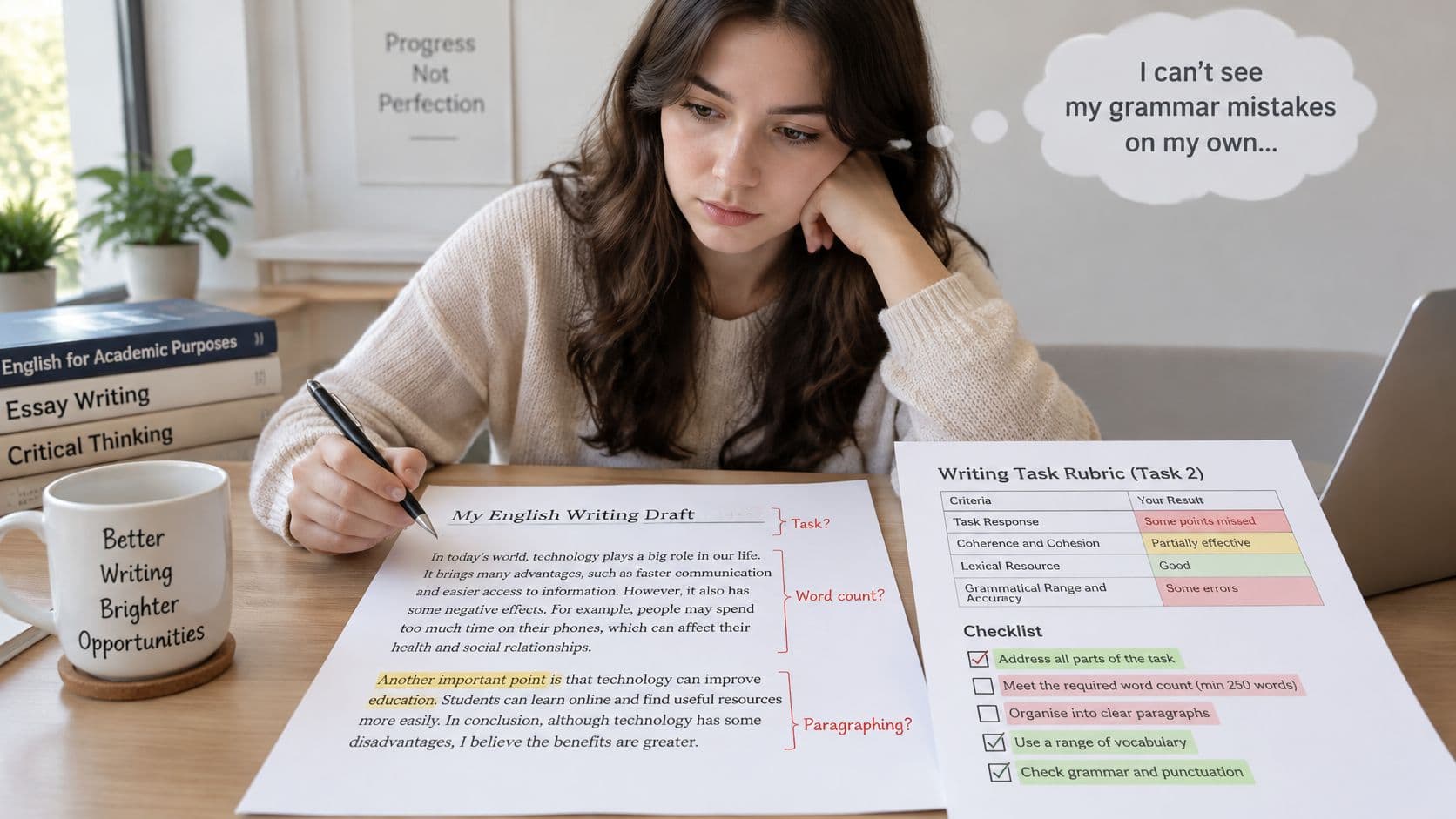
Choose feedback according to the question you need answered. A classmate can tell you where your reasoning becomes confusing even if they can't explain every grammar error.
Keep the prompt and rubric beside the draft while reviewing.
Feedback sources compared
| Feedback source | Catches well | Misses | Best use |
|---|---|---|---|
| Self-check against a rubric | Missed task points, word count, paragraphing | Own grammar blind spots | After every draft |
| Peer feedback | Unclear logic, reader confusion | Accuracy of grammar | Weekly exchange with a partner |
| Teacher or tutor | Organization, tone, register | Speed and availability | Monthly calibration |
| Automated AI feedback | Recurring grammar and vocabulary patterns, instant turnaround | Changes to meaning and task fit | Between drafts, feeding the error log |
Self-checking is always available, but familiar wording can appear correct because you've read it repeatedly. A peer provides a fresh reader's perspective; treat their grammar corrections as suggestions to verify rather than automatic replacements.
A teacher or tutor can diagnose why a paragraph feels unsuitable for its audience and demonstrate an appropriate alternative. Availability and cost may limit frequent review, so save difficult questions about organization and register for that conversation.
Make automated feedback explain itself
Automated feedback is convenient between drafts, especially for identifying repeated language patterns. Its weakness is that a fluent replacement may alter your intention: changing could to will, for instance, changes a possibility into a commitment.
A meta-analysis of automated writing feedback published in Frontiers in Psychology found an effect of g = 0.65 on transfer or later learning tasks, while the immediate-revision effect of g = 0.27 wasn't statistically distinguishable from zero. The practical question isn't whether the tool can improve this document, but whether you learn something usable.
Use the video as a prompt for active review, with your own draft available.
Before accepting a change, check meaning, tone, register, and task requirements. Explain the correction in your own words, then add the recurring pattern to your error log.
For accuracy tracking, calculate errors per 100 words across independent tasks, using the same error-counting rules each time. Don't compare a heavily edited response with an unaided draft as though they represent equivalent performances.
End each review with a manageable feedback format: three things to change and one thing that already works. That balance gives you direction without encouraging you to replace everything.
Fixing the Problems That Keep Scores Flat
Your grammar looks clean, yet the score refuses to move. Usually the missing ingredient is a reason the reader can follow, backed by enough detail to make it convincing. Harder vocabulary and more elaborate sentences rarely supply that.
Writing symptoms, causes and fixes
| Symptom | Likely cause | Fix |
|---|---|---|
| Clean grammar, but the score stays flat | Thin ideas with no supporting detail | Add one fact, example or reason to each point |
| Long, rare words that blur the meaning | Vocabulary chosen to impress, not to inform | Replace rare words with precise, common ones |
| The answer drifts from the question | Task requirements not checked before writing | Underline each requested point before drafting |
| Paragraphs run together | No planned structure | Plan three blocks: opening, points and close |
| Every sentence starts with I or The | Repetitive sentence starters | Vary openings with connectors and subordinate clauses |
| Running out of time | Too long spent on the first paragraph | Set a 5-minute plan and a 5-minute final check |
Treat the final row as a practice allocation to test, not a rigid requirement. If that planning allowance leaves you rushing, shorten it while retaining a final check. That last pass earns its time: catching one missing requested point is worth more than polishing a sentence that already works.
Develop the opinion instead of decorating it
For learners moving from CELPIP levels 7–8 toward 9–10, vocabulary complexity alone is not a reliable lever. Structure, clarity, and specific supporting detail deserve priority. The official Level 9 writing profile describes organized texts, relevant support, accurate detail, and controlled complex grammar, with occasional errors that don't impede meaning.
Writing Task 2, Responding to Survey Questions, is often the hardest exercise for learners at first. The usual trap is choosing an option and then supporting its alternative just as strongly, which leaves the reader unsure what you recommend.
Say a survey asks whether a community should improve bus service or expand parking. A weak answer says buses are convenient and environmentally friendly, then stops, with neither claim explained. A developed answer attaches a consequence to each reason: later buses would get shift workers home, and more frequent service would make medical appointments easier to reach.
Choose the option you can support most clearly, not the one you think sounds more sophisticated.
Worried that acknowledging the other side weakens your answer? One sentence covering it is enough, as long as it doesn't displace your argument or blur the conclusion. Give your chosen option concrete reasons, then explain what those reasons lead to.
Now check whether the repair transfers. Use the CELPIP writing tips as a checklist when selecting a single fix, then test it in your next response before adding another challenge. If the target is supporting detail, ask whether each main point now answers the reader's natural question: How, or why? The fix counts when it shows up in a fresh task without the checklist open beside you.
Set Your Next Week's Writing Targets
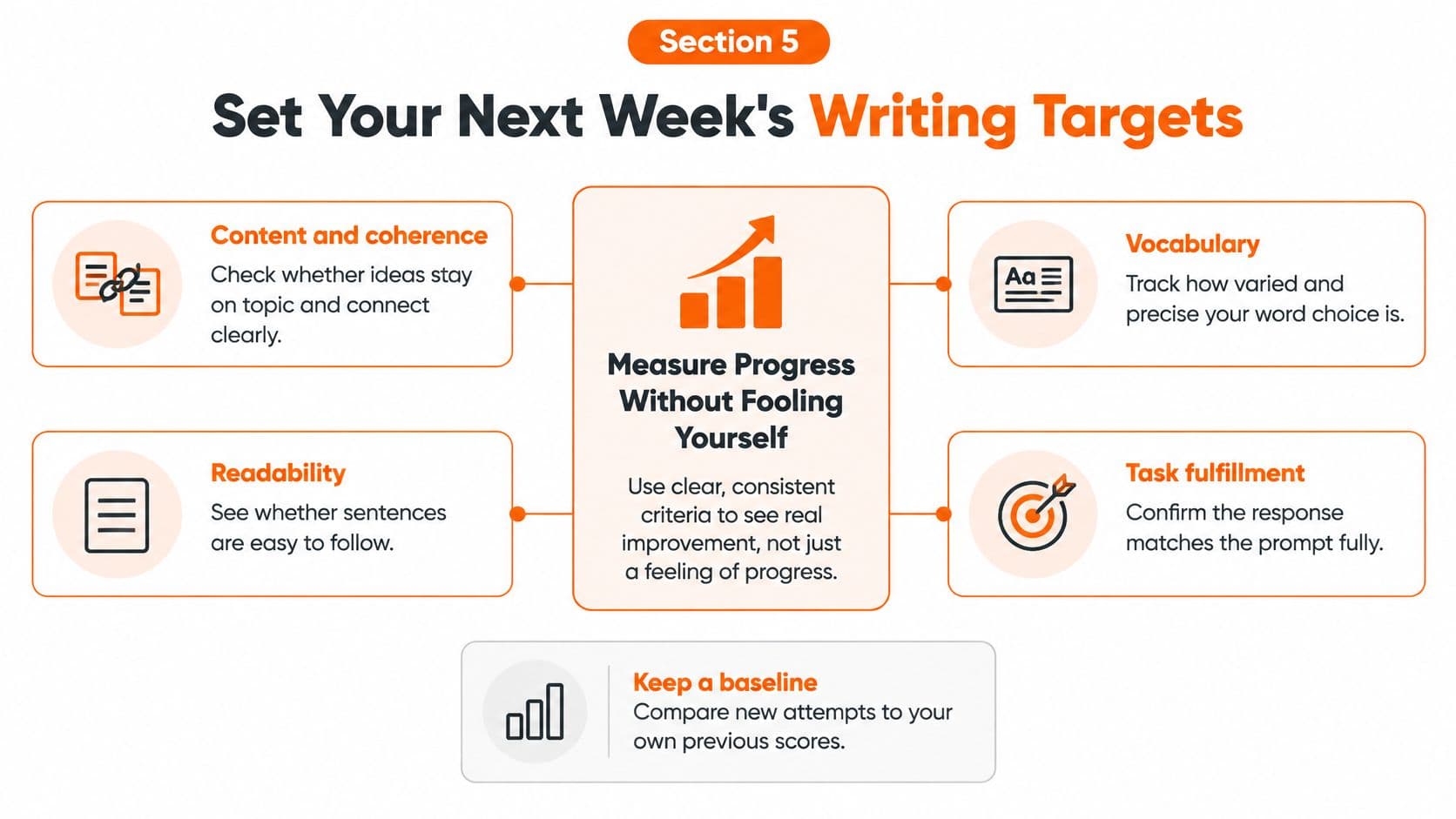
Measure progress against a stable standard rather than your feeling about a particular topic. Familiar subjects are easier to write about, and a helpful correction can make an individual answer look stronger than your independent writing.
The official CELPIP writing framework uses four performance categories: Content/Coherence, Vocabulary, Readability, and Task Fulfillment. Use those categories for every response, and keep self-scores or automated estimates separate from official test results.
- Content and coherence: Are your ideas relevant, developed, and logically connected?
- Vocabulary: Are your words precise, suitable, and accurate?
- Readability: Can the reader follow your paragraphs and sentences comfortably?
- Task fulfillment: Have you completed the request with an appropriate tone and format?
Keep these categories visible when recording your weekly targets.
Choose a correction you can actually test
Keep your first week's baseline and compare it with an unseen prompt a week later under similar conditions. Look for a specific change, such as clearer reasons or fewer unfinished sentences, rather than expecting every category to improve together.
Choose a focus from the changes that appear most often in your feedback, and record a strength to preserve. Useful feedback identifies a particular response, a specific weakness, and an achievable correction: for example, the survey response names convenience but needs an example explaining who benefits.
Our Writing coach provides email and survey-response practice with detailed grammar and tone feedback; Celprep's feedback connects an individual response with a specific weakness and an achievable correction. A tutor can also provide outside judgment, but a self-scored log remains useful without one.
Write your baseline draft this week, then fill in the first row of your error log before your next session. Give the next attempt a clear purpose instead of merely adding another completed answer.
Celprep offers timed CELPIP practice and response-specific feedback to help you turn writing attempts into focused revisions. The free plan includes 1 exercise per task type (Writing, Reading, Listening, and Speaking), 3 starter templates, one vocabulary bundle per section, and 3 submissions per day. Visit Celprep to try a writing response and choose a concrete improvement for your next independent draft.