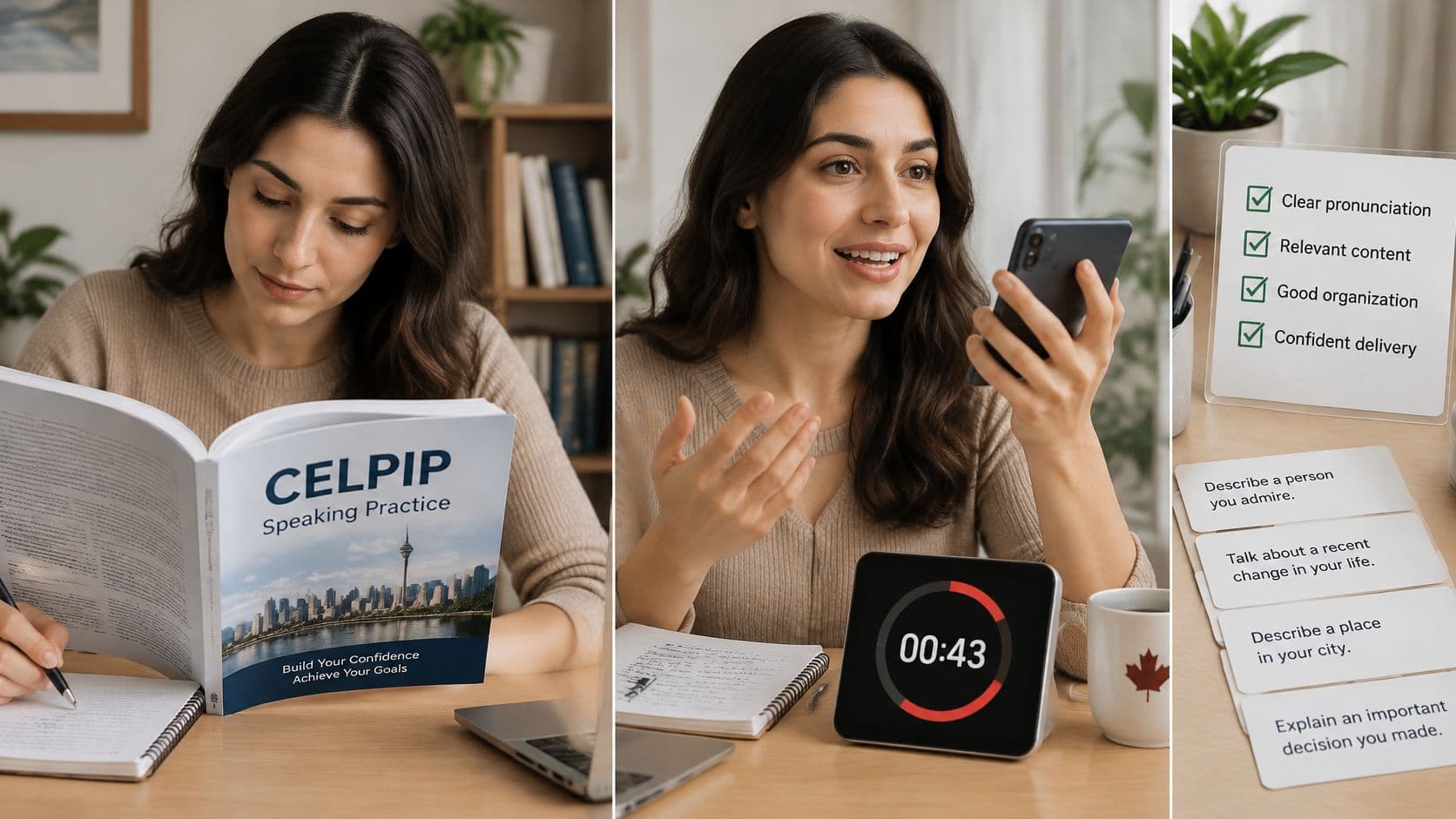
You practise English every day, repeat words from videos, and still hear the same problems when you record yourself. Then someone asks you to repeat a simple sentence, and you wonder whether all that practice is helping. Often, the missing piece isn't effort. It's a clear connection between what you hear, what you say, and what a listener understands.
Effective English pronunciation practice gives each recording a purpose. Instead of trying to change your entire accent, work on the sounds, stress patterns, and pauses that help someone follow your meaning without extra effort.
A Weekly Pronunciation Routine at a Glance
Give each day a clear job rather than repeating whichever words feel difficult. This suggested schedule fits around work or study and gives you recordings you can compare.
Seven-day pronunciation practice schedule
| Day | Focus | Method | Session length |
|---|---|---|---|
| Monday | Schwa identification | Listen to short clips and mark each unstressed vowel | 20 minutes |
| Tuesday | Weak forms | Contrast full and reduced forms in short sentences | 20 minutes |
| Wednesday | Word stress | Mark primary and secondary stress on multisyllabic words, then say them | 20 minutes |
| Thursday | Shadowing | Shadow one 10-20 second clip and record yourself | 15 minutes |
| Friday | Novel prompt | Record a fresh answer to an unfamiliar prompt | 20 minutes |
| Saturday | Connected speech | Practise linking and reduction in phrases | 20 minutes |
| Sunday | Delayed test | Retell or answer material from earlier in the week without a model, then try unpractised material | 30 minutes |
Short, structured sessions make feedback usable. Passive listening can supply examples, but you also need to attempt the target, hear your attempt, and decide what to change.
The 2015 meta-analysis by Lee, Jang, and Plonsky, summarised in Humanities and Social Sciences Communications, synthesised 86 studies and found a medium overall effect for explicit pronunciation instruction, d = 0.80, compared with groups without pronunciation-focused instruction. Outcomes depended on learners' proficiency, instructional setting, target features, and teaching method. That supports deliberate practice, not a promise that everyone improves at the same speed.
Why the week follows this order
Perception comes before controlled production. First, notice a feature in audio. Then practise producing it with a model, before removing that support and using it in your own answer.
Sunday adds delayed retrieval: can you produce the pattern after time away? Include material you haven't rehearsed that week so you're checking transfer, not just memory. Keep your practice calendar alongside these study methods for structured preparation.
Progress check: Compare familiar prompts for clearer delivery, then use unfamiliar prompts to see whether that clarity survives.
Listen for practical changes: your earlier prompts sound clearer a week later, and listeners need less repetition. Don't judge the week only by whether you like the sound of your voice.
Weak Forms and Schwa Drills That Sound Natural
Common weak forms in connected speech
| Word | Full form | Weak form | Example sentence |
|---|---|---|---|
| to | /tuː/ | /tə/ | I went to England. |
| for | /fɔː/ | /fə/ | A holiday for a week. |
| a | /eɪ/ | /ə/ | Bring a coat. |
| and | /ænd/ | /ənd/ | Bread and butter. |
| of | /ɒv/ | /əv/ | A cup of tea. |
| can | /kæn/ | /kən/ | I can go now. |
These are useful practice models, not commands to reduce every occurrence. The transcriptions use common British-style forms; you may hear differences in other English varieties, especially in words containing an r.
English uses stress timing: speakers normally give prominence to meaningful content words and reduce grammatical words between them. The British Council's guide to teaching schwa explains how these weak forms become shorter and quieter, often with the vowel /ə/.
Move from contrast to a sentence
Start with to. Say /tuː/, then /tə/, noticing how little movement the reduced vowel needs. Next, say I went to England, allowing England to stand out instead of giving to equal weight.
Repeat that contrast with the other table entries. In I can go now, keep can light when you're describing availability. If you're correcting someone who thinks you can't go, the full, stressed form may be appropriate.
Weak doesn't mean missing. You're making an unstressed word less prominent, not removing information the listener needs.
Find schwa by ear
Spelling can mislead you. The BBC's schwa guide identifies /ə/ as English's most common sound and explains that any vowel letter can represent it, including the first vowel in connect and the second vowel in bonus.
Use this listening drill:
- Listen without text. Choose a short, clear clip and notice the syllables that sound light or unstressed.
- Write what you hear. Note the words containing those vowels and mark where you think /ə/ occurs.
- Check carefully. Use the transcript to locate the words, then replay the audio. A transcript alone doesn't reveal which vowels the speaker reduced.
- Produce the phrase. Copy the contrast between prominent and unstressed syllables, not merely the speed.
Keep the grammatical words audible enough that someone unfamiliar with your message can still follow it.
If reduction makes your sentence harder to understand, slow down and restore the unclear word. Set a practical one-week challenge: identify schwa in ten sentences before looking at their text, then check your guesses against the audio.
Stress and Linking Drills for Smoother Speech
A learner can pronounce every syllable carefully yet make pronunciation sound like separate pieces. The problem is equal force: the listener doesn't hear a clear centre to the word.
Marking that centre makes the practice more concrete.

Primary stress is the strongest syllable prominence, marked /ˈ/. Secondary stress, marked /ˌ/, is weaker than primary stress but stronger than an unstressed syllable. Cambridge's explanation of word stress gives pronunciation as /prəˌnʌnsiˈeɪʃən/, with primary stress on the syllable containing /eɪ/.
Build a word, then a phrase
Use a short list drawn from your actual speaking vocabulary:
- Mark the stress. Check dictionary audio and underline the syllable with primary stress.
- Give it prominence. Make that syllable noticeably clearer and more prominent without shouting.
- Lighten its neighbours. Reduce the surrounding syllables where the model does, then put the word into a sentence.
For connected speech, practise a piece of cake as a phrase rather than separate dictionary entries. The BBC's connected-speech lesson illustrates the reduced pattern /ə piːsə keɪk/, where sounds connect across written word boundaries.
Saying every word separately may still be understandable, but it can sound less natural. It can also leave you unprepared to recognise the same words when another speaker links them.
Use the video as an additional listening model, then test the phrase without playback.
Match the mistake to the correction
- Reading vowel letters instead of listening. Check audio before practising an unfamiliar word. Don't build a pronunciation from spelling and rehearse it unchecked.
- Practising isolated words only. Add each target to a useful phrase, then say it inside a complete response.
- Stressing every content word equally. Choose the word that carries your main point. Other content words can remain audible without competing for the strongest emphasis.
Finish with a small practice test: say five phrases from your week. In each, check whether a listener can hear a main stressed word, rather than a string of equally heavy beats.
How to Run a Shadowing Session
Shadowing means speaking just behind an audio model while following its delivery. Treat it as a feedback cycle, not a challenge to keep talking at any cost.
Set up each take consistently: use the same phone in a quiet room, keep it at a fixed distance from your mouth, and save each recording with its date. That makes comparisons less vulnerable to changes in recording conditions.
This visual outlines the preparation and first attempt.
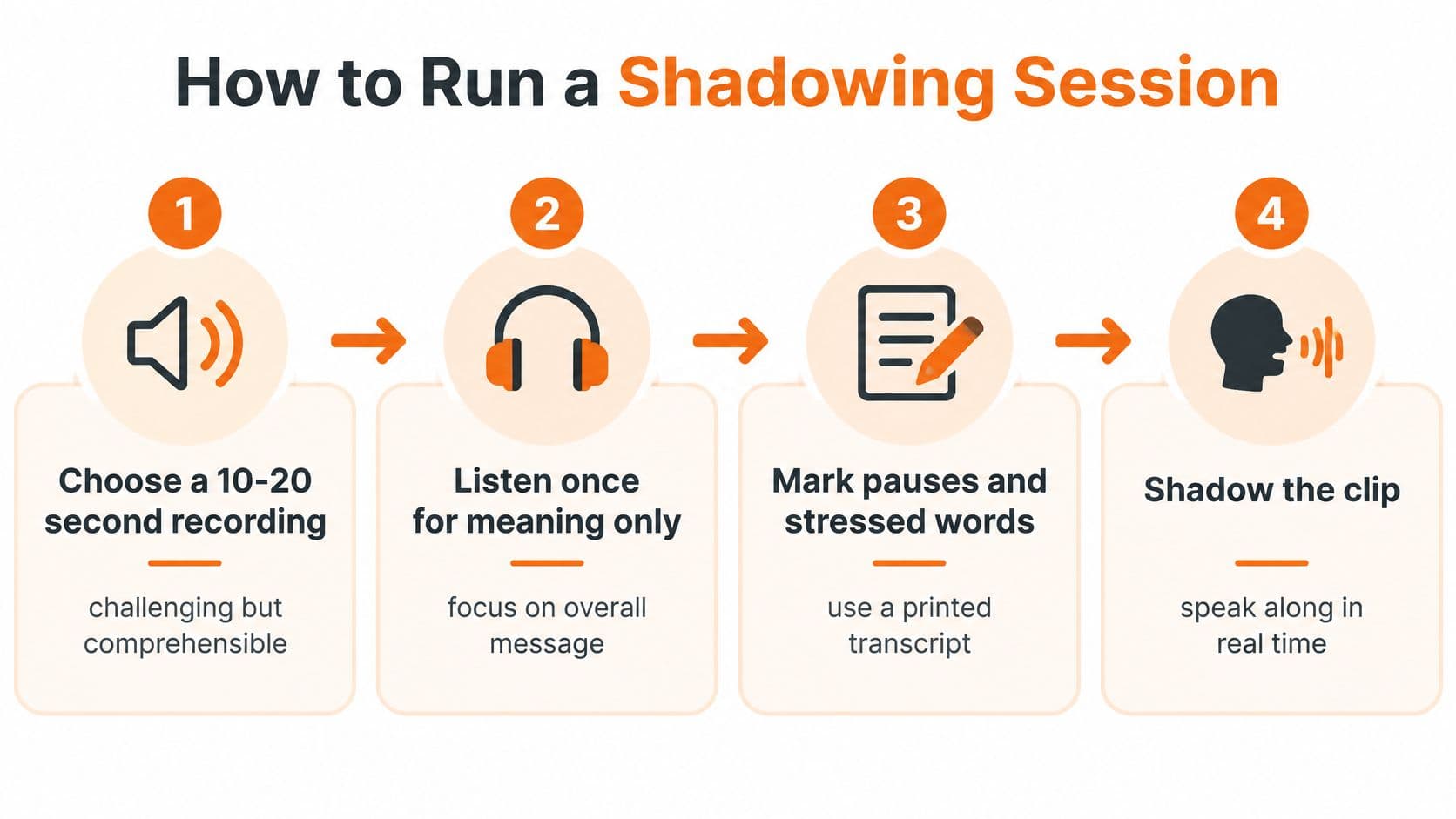
Follow the complete feedback cycle
-
Choose a 10-20 second recording. Pick speech that's challenging but comprehensible, with a transcript available. If you can't follow the message, choose easier material so you can attend to delivery rather than guess the words.
-
Listen once for meaning only. Identify what the speaker wants the listener to understand. Meaning helps you distinguish purposeful emphasis from sounds you're copying mechanically.
-
Mark pauses and stressed words on a printed transcript. Use slashes for phrase boundaries and underline prominent words. These marks give you manageable speaking groups instead of an uninterrupted stream.
-
Shadow with a minimal delay while recording yourself. Follow the speaker closely enough to retain the rhythm, without trying to predict every word. Continue through a minor slip rather than restarting automatically.
-
Replay and choose no more than two priorities. Listen for something specific, such as dropped final consonants or misplaced nuclear stress, the strongest emphasis in a phrase. Limiting corrections lets you practise a change you can monitor.
-
Repeat slowly, then at natural speed. Use the slower attempt to coordinate the troublesome sounds and pauses. Return to the original pace only when the words remain clear.
-
Paraphrase without the recording. Explain the same message in your own words. This checks whether you can use the delivery pattern beyond a memorised script.
Judge the message, not the waveform
A systematic review of shadowing studies found positive outcomes in 10 of 11 studies, while noting that controlled tasks and acoustic measurements weren't consistently connected to real listener judgments. The review also summarises immediate effects around d = 1.00 for expanding or equal-interval practice, compared with approximately d = 0.55 for massed practice.
Those findings support spaced practice, not a guaranteed personal improvement rate. Keep daily shadowing brief, using Thursday's session for careful comparison and Friday's unfamiliar prompt for a transfer check.
Don't optimise a waveform while ignoring whether anyone understands you. Ask a listener to identify your main point or write down a difficult phrase, and rotate passages rather than polishing a single script indefinitely.
A useful finish: You can name what improved, and your unscripted paraphrase is easier to follow.
Over successive weeks, look for fewer recurring correction priorities and smoother paraphrases. A flawless imitation alone isn't enough.
Checking Clarity Without a Native Speaker
You don't need a native speaker to check whether your message lands. You need someone who understands English and can tell you what they heard and where they struggled.
Intelligibility means whether the listener understood the message. Comprehensibility means how easily they understood it. Accentedness describes how much speech differs from native norms, a distinction discussed in this study of accent-inclusive pronunciation training.
An audible accent isn't automatically a communication problem. Track it descriptively, not as a failed attempt at speaking.
Clarity measures and how to test them at home
| Measure | Question it answers | Home test |
|---|---|---|
| Intelligibility | Did the listener get the message? | Transcribe your recording and count missed words |
| Comprehensibility | How easily was it understood? | Ask a listener to rate one listen from 1 to 5 |
| Accentedness | How far is it from native norms? | Note it, but do not score it as a failure |
| Stress accuracy | Did the key words stand out? | Mark stressed words on a transcript and compare |
| Delayed transfer | Does it hold on new prompts? | Record a fresh prompt one week after practising |
For the suggested rating scale, let 1 mean difficult to follow and 5 mean easy to follow. Keep those definitions consistent; this is a home tracking tool, not an official exam score.
The checklist keeps attention on successful communication.
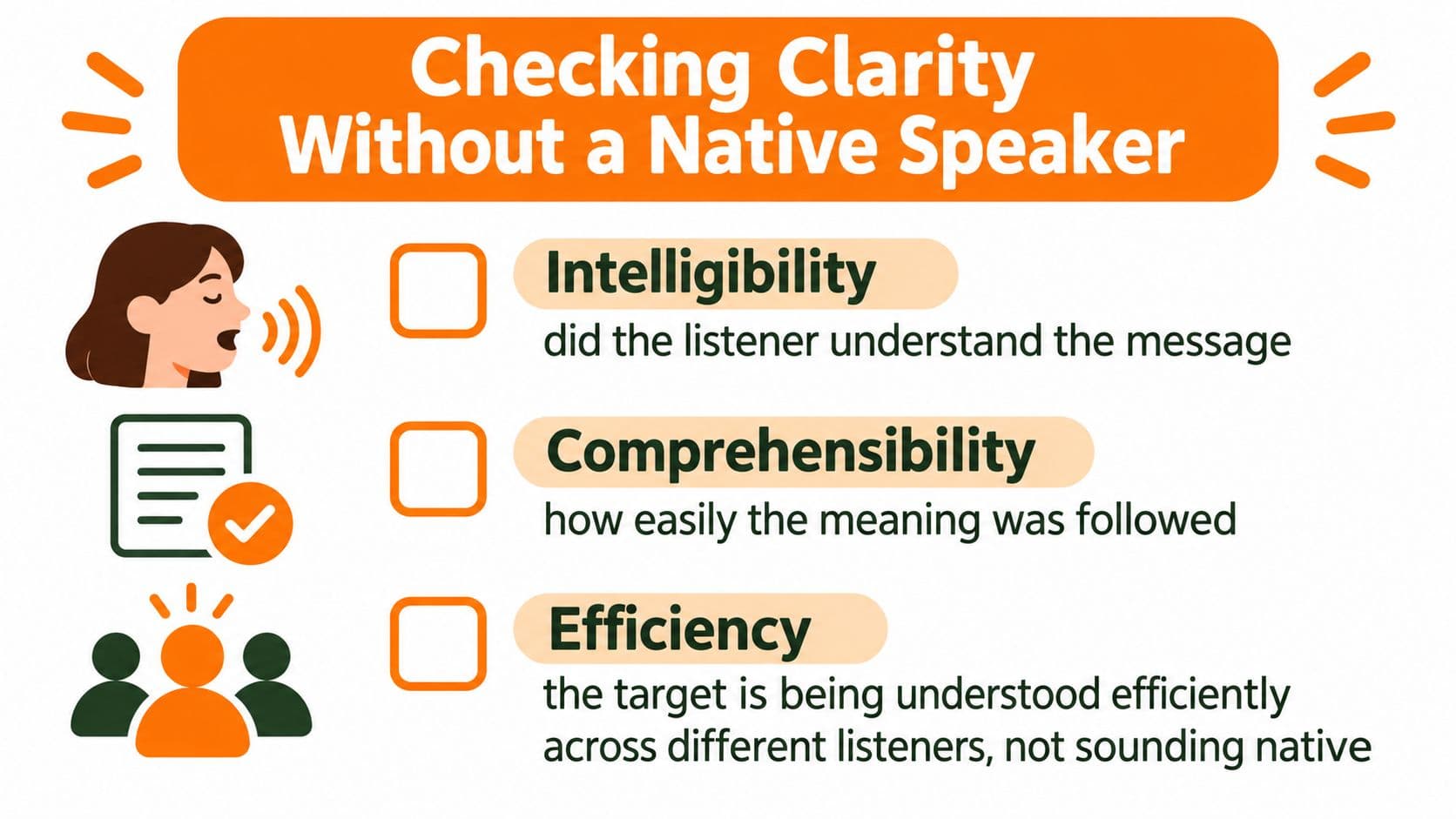
Combine automated feedback with listener feedback
Automated feedback offers repeated attempts and sound-level checks. Evidence discussed in Computer Assisted Language Learning points to gains in phoneme accuracy but more limited improvement in word stress, supporting a hybrid approach rather than automation alone.
Use a human listener for rhythm, prominence, and pausing. Ask where they had to work to follow you, rather than whether you sounded native. If an automated transcript looks wrong, replay the passage before assuming your pronunciation caused the error.
For a home check, record a one-minute answer, transcribe it yourself, and mark words a listener might miss. Treat your count as provisional: you already know what you intended to say, so ask someone else to transcribe or confirm unclear passages when possible.
Use the CELPIP speaking practice guide to choose relevant response formats. Then test a fresh prompt after a week, rather than only repeating a polished answer.
The Cambridge review on optimising phonetic learning highlights limited generalisation from trained to untrained items. Familiar answers can therefore make your progress look broader than it is.
Start Your First Week Tomorrow
Make the first week manageable enough to complete. You'll need a phone recorder, a notebook, suitable audio, and a willing listener, not a perfect study setup.
-
Record your baseline. Answer an everyday question for one minute, such as describing a useful change at work. Transcribe it word for word and count potentially missed words, asking a listener to confirm them where possible.
-
Commit to the schedule for seven days. Tick off each session in a notebook or calendar and write the correction you're practising. Keep the original recordings so you can compare attempts rather than rely on memory.
-
Book an end-of-week listener check. Ask a friend or tutor to rate one listen from 1 to 5 for comprehensibility. Record a fresh answer of similar length and difficulty, transcribe it, and count missed words again.
Decide what to practise next
Use this working decision rule, not an exam benchmark: if the week-end recording has fewer than two fewer missed words than your baseline, extend the stress and linking drills for another week. If your baseline already has very few missed words, pay more attention to listening effort and misplaced emphasis.
For a structured attempt, our online English speaking practice lets you record a real CELPIP speaking task and receive one weakness plus one change to make next time. Keep the human listener check as your practical measure, especially for rhythm and prominence.
Visit Celprep to practise recorded CELPIP speaking responses and turn feedback into a focused correction for your next attempt. Signing up takes 30 seconds and gives instant access to the practice exercises. Start with a baseline recording, then check whether your next response is easier for someone else to follow.