Canada's Express Entry accepts CELPIP-General, IELTS General Training and PTE Core, with results converted into Canadian Language Benchmarks (CLB) for each of the four skills separately. The right choice is the accepted test version that lets you reach your required benchmark in every ability, not just earn a high overall score.
That distinction matters when you're choosing an English proficiency test for Canada. Booking the wrong version can leave you with unusable results, while a strong Reading score won't cancel out Speaking that falls below your program's requirement.
English Proficiency Tests Canada Accepts and How Scores Convert
For many candidates, English testing is an immigration decision before it's an educational one. In the 2024 CELPIP data report, 96.0% of test takers identified Canadian immigration or citizenship as their primary purpose. Your preparation should therefore start with the application you intend to submit.
An English proficiency test provides evidence of your ability to understand and communicate in English. But acceptance belongs to the receiving organization: IRCC, a university and a professional regulator may require different tests, versions and scores.
Match the test to its main use
The distinction between immigration and academic testing is especially important. An academic test accepted by a university isn't automatically an approved Express Entry test, and university admission requirements aren't identical to study-permit requirements.
English proficiency tests used in Canada and their main uses
| Test | Skills assessed | Accepted for | Scoring | Validity |
|---|---|---|---|---|
| CELPIP-General | Listening, Reading, Writing, Speaking | Express Entry, economic PR programs, citizenship, some professional licensing | 1–12 per skill, mapped to CLB | 2 years for immigration submissions |
| CELPIP-General LS | Listening, Speaking | Canadian citizenship language proof | 1–12 per skill | Check citizenship evidence rules |
| IELTS General Training | Listening, Reading, Writing, Speaking | Express Entry, economic PR, citizenship | IELTS bands, converted by ability | 2 years for immigration submissions |
| IELTS Academic | Listening, Reading, Writing, Speaking | University admission, study-related applications and some licensing bodies | IELTS bands | Receiving institution's recency rule |
| PTE Core | Listening, Reading, Writing, Speaking | Express Entry and economic PR programs | 10–90, mapped to CLB | 2 years for immigration submissions |
| PTE Academic | Listening, Reading, Writing, Speaking | University admission and study-related applications | 10–90 | Receiving institution's recency rule |
| CAEL | Listening, Reading, Writing, Speaking | Canadian colleges and universities | 10–90 | Receiving institution's recency rule |
| TOEFL iBT | Listening, Reading, Writing, Speaking | University and college admission, institution-specific | TOEFL score report scale accepted by the institution | Receiving institution's recency rule |
Treat this as a shortlist, not permission to book. For academic admission or professional registration, find the receiving organization's accepted-test page and check the exact version, component minimums and result-recency requirements.
For immigration, the benchmark framework gives you a common way to interpret otherwise different score reports.
Understand CLB as the conversion system
Think of IELTS bands, PTE scores and CELPIP scores as different currencies. CLB is the exchange system IRCC uses to interpret English results for the relevant immigration requirement. Universities and regulators may instead assess the original scores directly.
The Canadian Language Benchmarks framework grew from a federal initiative launched in 1992, establishes a 12-level national scale, and assesses listening, speaking, reading and writing separately. Its CELPIP-General equivalencies are straightforward: CELPIP 4 corresponds to CLB 4, 7 to CLB 7, 9 to CLB 9, and 10 to CLB 10.
Say you're comfortable reading workplace documents but hesitate when giving spoken advice. Don't label yourself only “advanced” and assume that description applies across your application. Record a separate target and diagnostic result for each ability.
Practical rule: Compare each component with its required benchmark before you consider an overall result.
For IELTS and PTE, use the program's official conversion table rather than assuming that identical-looking scores represent identical proficiency. Even within a test, the required score can differ by ability.
Also check result age before paying. Immigration evidence has a validity window, and your application calendar can matter just as much as your available test date.
Matching the Test Version to Your Immigration Goal
The first version trap is IELTS One Skill Retake. IRCC's Express Entry language-test guidance states that Express Entry doesn't accept it, even though IELTS General Training itself is an approved test. Don't assume that acceptance of the original test means acceptance of every retake format.
The second trap is CELPIP-General LS. It covers listening and speaking, making it relevant to citizenship language proof, but it doesn't supply the complete language evidence required for Express Entry. A shorter exam isn't a useful saving if your application needs abilities it doesn't assess.
Choose by pathway, then compare practicalities
Use your intended application to narrow the options:
- Express Entry: Choose an approved full-test version, then check the minimums for the immigration program you qualify under.
- Citizenship: Check the accepted evidence rules before booking, since listening-and-speaking evidence may be sufficient.
- Study: Follow the college or university's admission requirements and separately confirm your immigration-document obligations.
- Professional licensing: Use the regulator's current accepted-test list, including any component minimums or restrictions.
A focused Express Entry language-test guide can help you organize the decision, but your final booking should match IRCC's current requirements.
After confirming eligibility, compare the practical experience of taking each test. Consider computer use, speaking format, local appointment availability and the preparation resources you'll use. Familiarity can help you perform consistently, but it can't make an unaccepted version eligible.
Put validity on your application calendar
According to IRCC's result-validity requirements, Express Entry results must be less than two years old both when you create your profile and when you submit your permanent-residence application. A result that qualifies at profile creation can therefore expire before submission.
Record the test date, expiry date and expected application milestones together. Leave room for results processing, appointment availability and another accepted test if your initial attempt doesn't meet the target.
Don't book the earliest available appointment until you know whether its result will remain usable when you need to submit it.
Before paying, compare current fees on the official test-provider sites. Include travel, accommodation if necessary, and the possible cost of another full exam. A retake plan should follow your pathway's acceptance rules, not an assumption that you'll be able to replace just the weakest component.
What Score Targets Look Like in Real Applications
A useful target sheet looks less like a report-card average and more like an application checklist. Each ability has its own requirement, and each document has its own submission rule.
An Express Entry candidate aiming higher
Say your target is CLB 9 across the tested abilities. IRCC's official language-result equivalencies map CELPIP 9 to CLB 9 separately in Reading, Writing, Listening and Speaking. A stronger Reading result doesn't repair Speaking below that target.
CELPIP scores, CLB levels and Express Entry points per ability
| CLB level | CELPIP score needed | Express Entry points per ability |
|---|---|---|
| CLB 7 | 7 | 4 |
| CLB 8 | 8 | 5 |
| CLB 9 | 9 | 6 |
| CLB 10 or higher | 10 or above | 6 |
Important distinction: These figures describe the relevant Federal Skilled Worker selection-factor language table, not a universal CRS calculation. Don't use them as your CRS points per ability. Check both the Express Entry language-test equivalency table and the scoring rules that apply to your profile.
Use a CELPIP score calculator to organize component targets, then verify consequential decisions against the official program tables.
A caregiver applicant checking the paperwork
The IRCC Interim Pathway for Caregivers language-testing guidance specifies CLB 5, equivalent to CELPIP 5, in each ability, and requires original test results rather than photocopies. This is a pathway-specific example, not a claim that every current caregiver stream uses identical rules.
The lesson is to check the CELPIP-General equivalency table on your actual caregiver program page, along with application status and document instructions. Meeting a language threshold and submitting acceptable evidence are separate tasks.
A citizenship applicant avoiding unnecessary preparation
A citizenship applicant who needs listening-and-speaking proof may choose CELPIP-General LS rather than prepare for components their application doesn't require. They should check IRCC's citizenship language-evidence list, rather than borrow an Express Entry conversion table.
If another immigration application is relevant, investigate whether a full approved test would serve that purpose too. Choose based on a realistic application plan, not a hypothetical future use that may arise after the result expires.
How CELPIP Tests Listening, Reading, Writing and Speaking
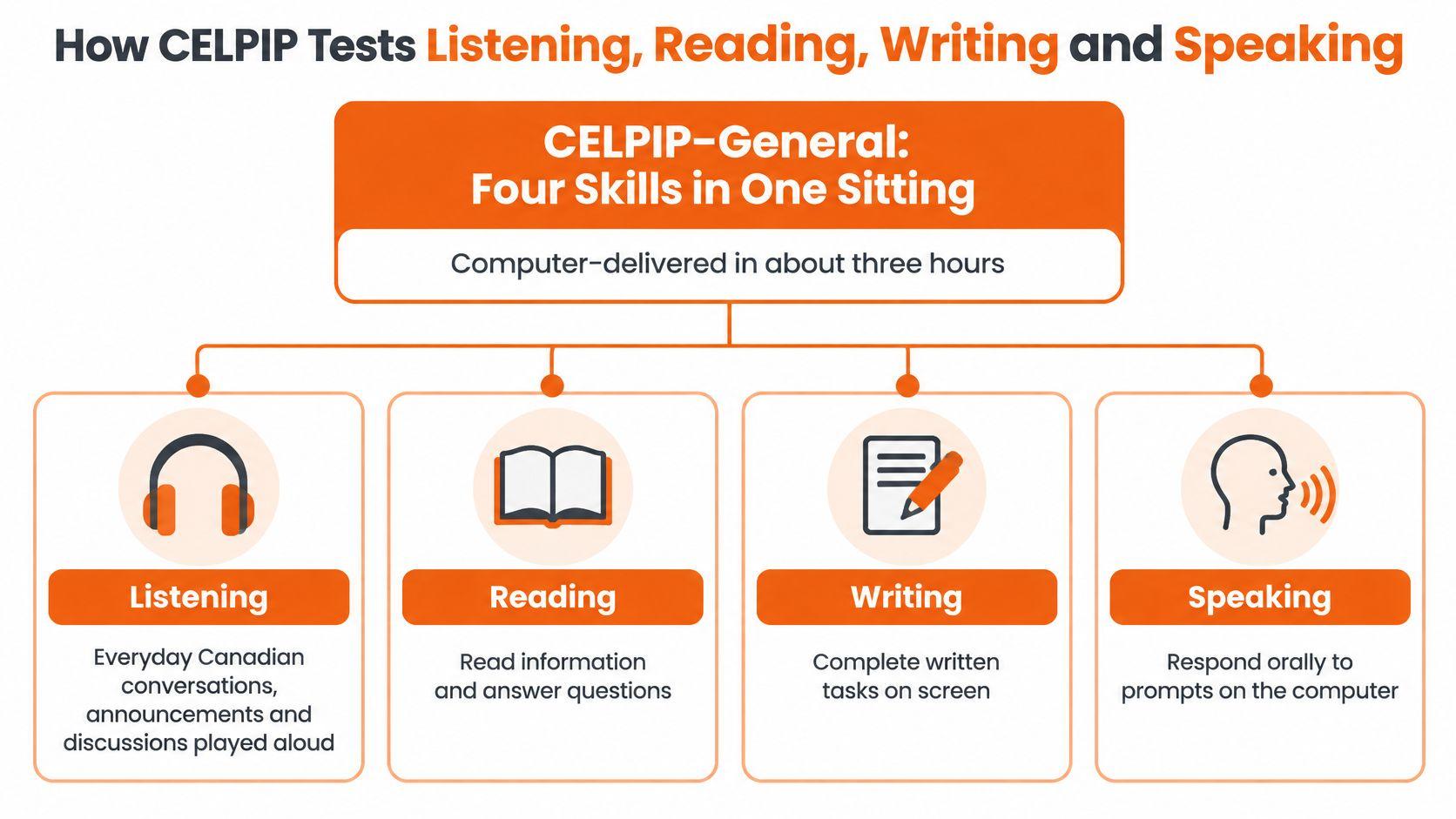
CELPIP-General is computer-delivered, so preparation should include reading on screen, typing under pressure and speaking into a microphone. Knowing English and demonstrating it through an unfamiliar interface aren't quite the same task.
Use the diagram to separate the abilities you'll practise.
Listening and reading require evidence-based answers
Listening involves understanding spoken situations such as conversations, announcements and discussions. Practise identifying who's speaking, what they want, what changes during the conversation and what the speakers imply rather than state directly.
Take selective notes, not a transcript. Names, contrasting opinions, decisions and reasons are more useful than a page of disconnected words. After a wrong answer, identify whether you missed the information, misunderstood it or chose an option that sounded familiar without answering the question.
Reading includes practical information, correspondence, diagrams and viewpoints. Preview the question, locate the relevant passage and distinguish the writer's actual meaning from a plausible statement the passage doesn't support.
When reviewing, underline the evidence for your answer. If you can't identify it, you may have guessed correctly without using a repeatable method.
Writing and speaking require complete responses
For Writing, practise emails and survey responses with a clear purpose, appropriate tone and logical organization. Address every requested point before adding advanced vocabulary. A well-organized answer that completes the task is more useful than an elaborate introduction followed by unfinished content.
For Speaking, rehearse giving advice, describing experiences and explaining predictions aloud. Record yourself, then listen for unfinished ideas, unnecessary repetition and reasons that don't clearly support your recommendation.
Our Speaking Task 1 examples use 90–110 words to fit the 60-second limit. Treat that as a pacing model for that task, not a universal word requirement for every spoken response.
- For written responses: Reserve attention for proofreading, especially verb forms, sentence boundaries and tone.
- For spoken responses: Finish your main point cleanly rather than accelerating through a memorized ending.
- For both: Make the answer specific to the prompt instead of forcing every topic into the same prepared script.
Writing and speaking deserve close diagnostic attention because you must generate and organize language yourself. Don't assume they're automatically your weakest abilities, though. Let your recorded responses and marked practice determine where you spend your time.
Use the video as a supplement to active rehearsal, not a substitute for producing answers.
How to Prepare for the CELPIP Exam Step by Step
Start with a diagnostic, not a playlist. A useful study session ends with an answer you produced, an error you understood or a response you improved.
Use this preparation sequence to keep your work focused.
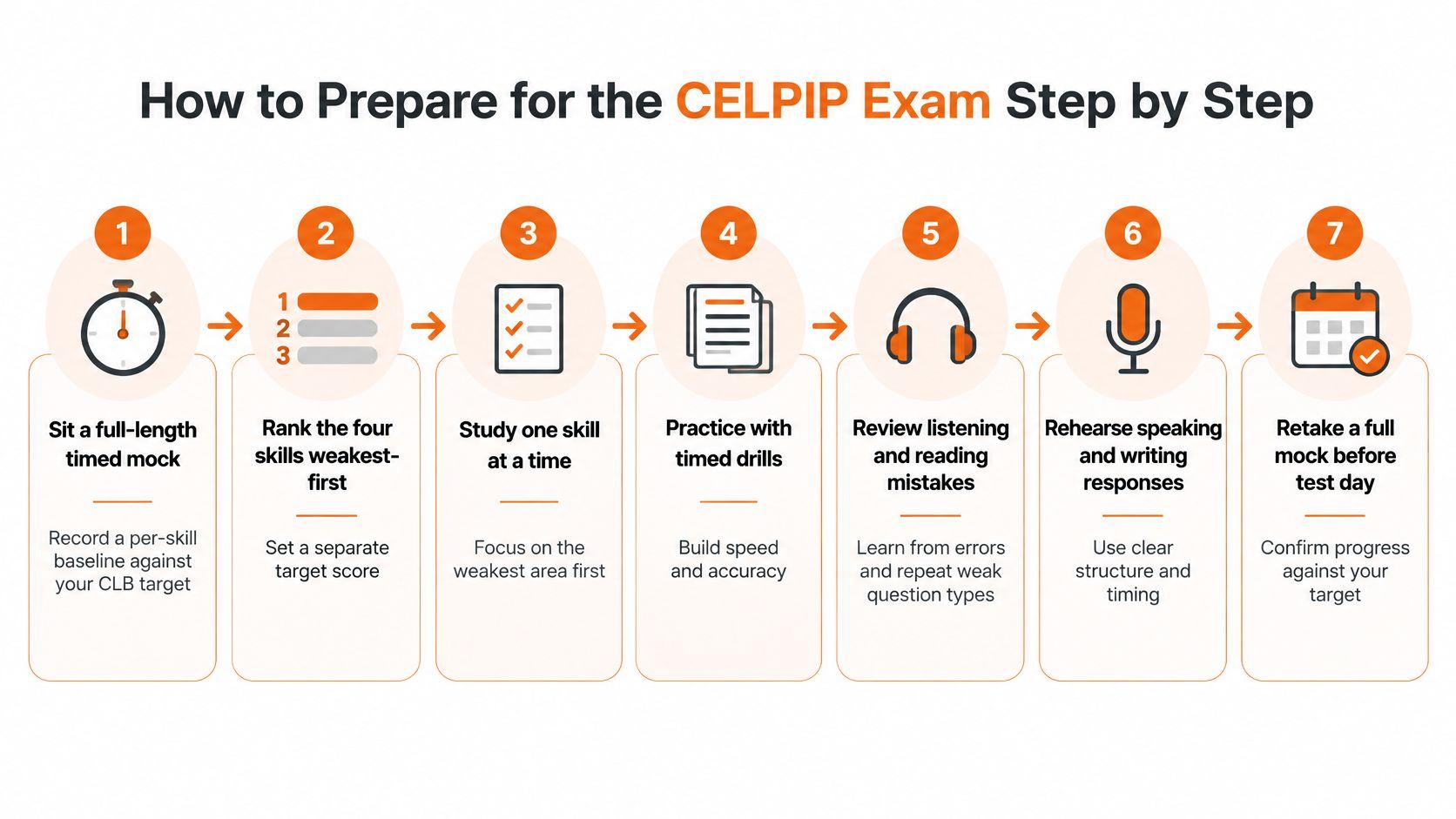
Build a repeatable practice routine
-
Sit a full-length timed mock. Use realistic conditions, including the computer, keyboard and microphone you'll practise with. Record a separate baseline for each ability, and treat unofficial practice scores as estimates rather than guaranteed exam outcomes.
-
Rank your skills weakest-first. Compare each baseline with its intended benchmark and identify the largest gap. Don't spend most of your study time on Reading because it feels more comfortable than recording yourself speaking.
-
Learn the task formats precisely. Use the current task instructions and an on-screen timer to rehearse planning, answering and checking your work. A common mistake is practising without limits, then discovering that your normal answer structure takes too long.
-
Produce answers instead of only watching lessons. For an advice response, use a greeting and problem summary, give two or three suggestions with reasons, then finish with a recommendation. Plan ideas rather than full sentences so you can speak naturally instead of trying to read an internal script.
-
Get feedback and revise the same response. Assess coherence, vocabulary range, grammar accuracy and task completion, then choose a specific change to make. Repeating the task after revision shows whether you can apply the feedback, while immediately switching topics can hide the same recurring weakness.
-
Use a weekly timed mock to check transfer. Track component trends alongside a brief error log, such as missed inferences, incomplete email instructions or unsupported spoken advice. Keep difficult question types in rotation even after an isolated successful attempt.
-
Plan any retake around acceptance and cost. If a component remains below target, check whether your pathway accepts the available retake format before paying. Compare targeted preparation with another full exam, including travel and time away from work.
Make improvement affordable and measurable
“Just retake it” isn't a realistic plan for everyone. IRCC's evaluation of the Economic Mobility Pathways Pilot identifies commercial testing fees, training resources and travel as barriers for refugees, and reports approximately 3,200 uses of One Skill Retake by EMPP candidates between January 2024 and July 2025.
That finding concerns a specific candidate group and doesn't establish acceptance for Express Entry or availability for CELPIP. It does highlight why applicants need a financially realistic route to correcting a weak component.
Budget safeguard: Buy another exam attempt when your practice demonstrates a change in performance, not simply because you've completed more exercises.
For a busy working week, alternate focused drills with response revision. Review a listening error by replaying the relevant passage; review a writing error by rewriting the sentence and then the paragraph around it. Keep a short record of the original problem, the correction and whether it recurred.
You don't need classroom attendance every day to study consistently. You do need saved recordings, written responses, reliable feedback and a routine you can maintain around work or family commitments.
Start Your CELPIP Practice Plan
The right test is the version your pathway accepts. The right target is a component-by-component benchmark, not an impressive total that leaves a required ability below the minimum.
Turn that decision into a booking and study checklist:
- Confirm the program requirement. Find the current IRCC program page and write down the required level for each ability.
- Choose the qualifying version. Check the full test name before selecting an appointment.
- Record the validity milestones. Put profile creation, expected permanent-residence submission and result expiry on the same calendar.
- Allow room for another accepted attempt. Leave enough time to receive results, address a weakness and find an available appointment.
Begin with evidence of your current ability
We're an independent practice resource, not the official CELPIP test provider. Our paid plans include 3,000+ exam-style questions, full mock exams under real test timing, and task-specific templates and vocabulary; our AI feedback is trained specifically on CELPIP criteria, including coherence, vocabulary range, grammar accuracy and task completion.
Through our partnership with ApplyBoard, an Authorized CELPIP Voucher Provider, eligible students can save up to 10% on CELPIP Canada and CELPIP India registrations. Check current features, pricing and eligibility conditions before signing up.
Use the CELPIP practice-test guide to organize your first diagnostic. Schedule it this week, record every component against its target, and use a weekly feedback loop to decide what needs more work before test day.
Visit Celprep for timed CELPIP mock exams, component-level exercises and feedback on your written and spoken responses. Start with a diagnostic this week, then build your practice around the specific abilities that still fall short of your immigration target.