In 2024, 27% of Express Entry candidates invited to apply had a first official language at Canadian Language Benchmark (CLB) 9, according to the 2024 Express Entry year-end report from Immigration, Refugees and Citizenship Canada (IRCC). That share is a snapshot of who got an invitation, not a promise that CLB 9 will get you one.
An Express Entry language test is scored as four separate abilities: speaking, listening, reading, and writing. A strong average doesn't cover a weak component. One ability under the line can block program eligibility, cut language points, or both. The pages below show the CLB floors, how approved tests convert, where applicants usually lose the band, and how a result's expiry date can undo a score you already earned.
Language Score Levels Express Entry Requires
For the Federal Skilled Worker Program, you need at least CLB 7 in each ability. Under the IRCC CRS criteria, a result below CLB 7 in even one ability fails the program's minimum language requirement. Speaking, listening, reading, and writing each have their own threshold.
Language points are counted ability by ability. At CLB 7, you receive 4 points per ability, or 16 points across your first official language. At CLB 8, you receive 5 points per ability. At CLB 9 or higher, you receive 6 points per ability, up to 24 points. A second official language adds 4 points only if all four abilities reach at least CLB 5.
CELPIP-General reports a score for each ability, and that score matches the CLB level. IELTS General Training uses different bands for listening, reading, writing, and speaking. Compare each result separately:
| CLB Level | CELPIP-General (each ability) | IELTS General Training (L / R / W / S) | CRS Points per Ability |
|---|---|---|---|
| CLB 7 | 7 | 6.0 / 6.0 / 6.0 / 6.0 | 4 |
| CLB 8 | 8 | 7.5 / 6.5 / 6.5 / 6.5 | 5 |
| CLB 9 | 9 | 8.0 / 7.0 / 7.0 / 7.0 | 6 |
| CLB 10 | 10 | 8.5 / 8.0 / 7.5 / 7.5 | 6 |
How to read a row
Choose the row for the CLB level you're checking, then match every ability to its own test score. A CELPIP 9 means CLB 9 for that ability. On IELTS, CLB 9 requires 8.0 in listening and 7.0 in each of reading, writing, and speaking. One IELTS band score cannot stand in for all four.
If one ability falls on a lower row, its points stay at that lower level; stronger scores in the other abilities do not raise it. Use the CLB language test conversion guide to compare all four results. Check your test's expiry date too: results must be less than two years old when you create your profile and when you apply.
Target Scores and the Ability That Usually Blocks You
In the 2024 Express Entry pool, CLB/NCLC 7 and 9 each accounted for 27% of invited candidates' first-official-language results, while CLB/NCLC 8 accounted for 25%, according to IRCC's 2024 Express Entry year-end report. These figures describe the pool, not a guaranteed invitation threshold. Express Entry ranks profiles using the Ranking System, and invitations depend on the relevant draw.
For a personal target, CLB 9 in each ability is a useful benchmark to assess against your CRS breakdown. It can increase skill transferability points, depending on your education and work history. Check how a higher language result would affect your own score before setting a study target.
What CLB 9 can change
A target is only met when each ability reaches its required level. Speaking can be a challenging component because it requires you to organize and deliver a clear answer under time pressure. If your speaking score is below your target, focus practice there rather than raising scores that already meet it.
Line your four results up
Write your listening, reading, writing, and speaking results beside your target. If speaking is 8 and the other three are 9, speaking is the ability to work on next. The four results are separate gates, so one below-target score can keep you from meeting a requirement even when the other three are higher.
Why One Weak Ability Can Block Your Application
A lot of applicants treat the Express Entry language test like a school average. They add four scores, divide, and feel safe because the mean looks strong. That average isn't what the program uses.
Each ability converts to its own CLB. A high listening score can't offset a low speaking score. The file is only as strong as the weakest ability on the requirement you're trying to meet.
Say your CELPIP-General results are 10 in listening, 10 in reading, 10 in writing, and 8 in speaking. Listening, reading, and writing sit at CLB 10. Speaking sits at CLB 8. That ability earns 5 points, not 6. If your target is CLB 9 in all four, you missed it, even though three components are well above the line.
IELTS works the same way, with a different number on each skill. An overall 7.5 can still hide a speaking band of 6.5. The overall figure is a summary for you. The conversion uses the separate bands.
Stop polishing the skills that already clear the row. The ability under the target is the only one that changes eligibility or that ability's points.
Before you book more general practice, place each of the four results on the target row. Study time goes to the one that falls short.
Choosing Between CELPIP, IELTS and PTE Core
Express Entry accepts three English tests, but only the approved version of each. IRCC's language test requirements list CELPIP-General, IELTS General Training, and PTE Core. Academic or other non-approved versions do not meet the English test requirement.
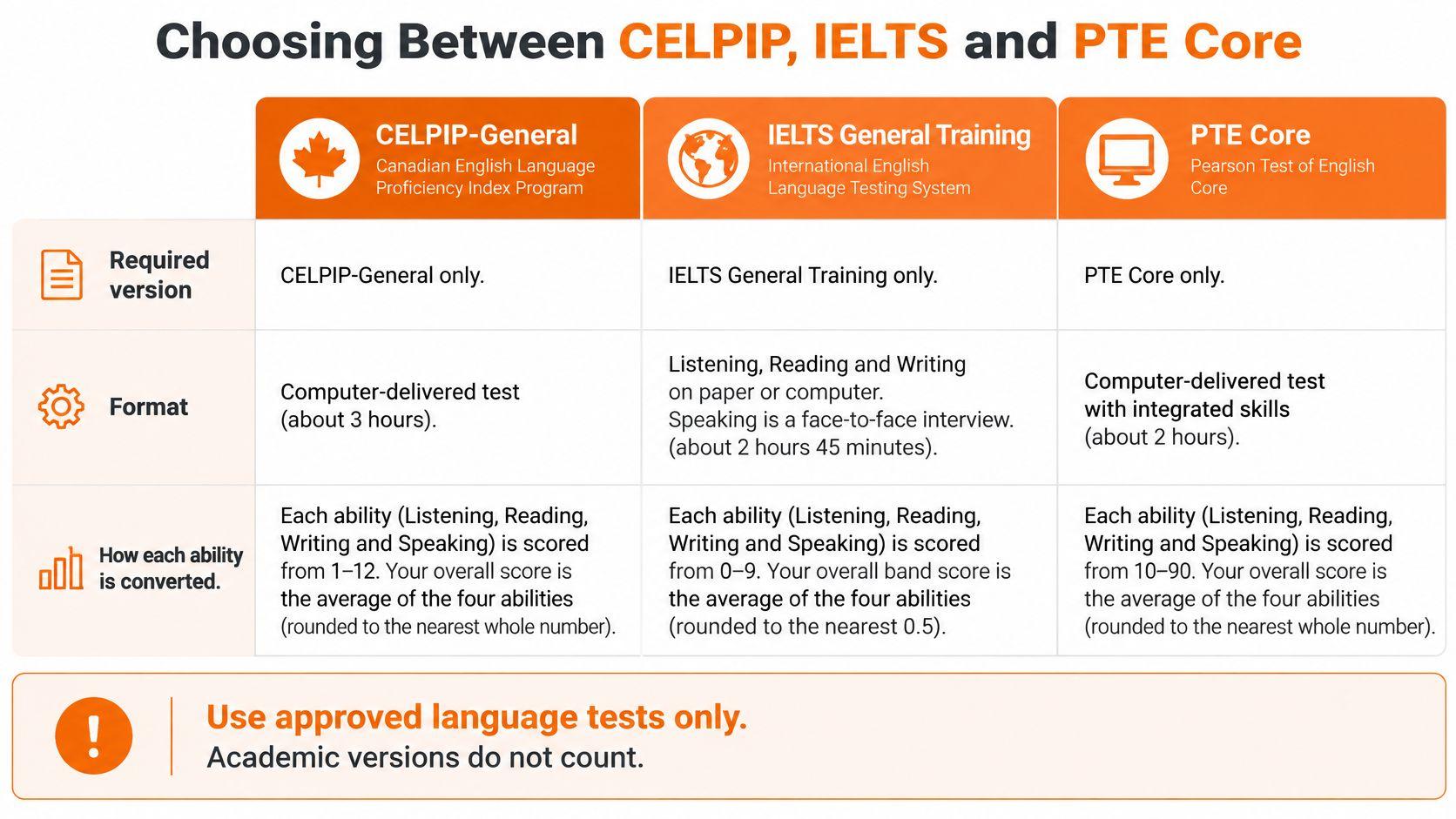
Results convert separately for reading, writing, listening, and speaking. For CLB 9, CELPIP-General requires 9 in each ability. IELTS General Training requires 7.0 in reading, 7.0 in writing, 8.0 in listening, and 7.0 in speaking. An overall average cannot make up for an ability below the required level.
| Test | Version Required | Format | How Results Convert |
|---|---|---|---|
| CELPIP-General | CELPIP-General only | Computer-based, one sitting, recorded speaking | Each ability maps to one CLB level. CELPIP 9 equals CLB 9. |
| IELTS General Training | General Training only | Paper or computer, speaking with an examiner | Each ability has its own band. CLB 9 requires 8.0 listening, 7.0 reading, 7.0 writing, and 7.0 speaking. |
| PTE Core | PTE Core only | Computer-based, speaking and writing scored by AI | Each ability converts to its own CLB, not one total score. |
What to consider before booking
Applicants often weigh whether they can complete the test in one sitting, whether speaking is recorded or examiner-led, and how familiar the accents and situations feel. These practical details can help you choose a format to practise consistently. They do not change the score required for your target.
Celprep is an independent practice resource. CELPIP is a registered trademark of Paragon Testing Enterprises.
Choose a format you can rehearse under timed conditions, then confirm the exact test version before booking. Results must be valid both when you create your Express Entry profile and when you submit your permanent residence application.
When French Changes Your Points Strategy
English is only one part of your language strategy. Express Entry can consider eligible results in both official languages.
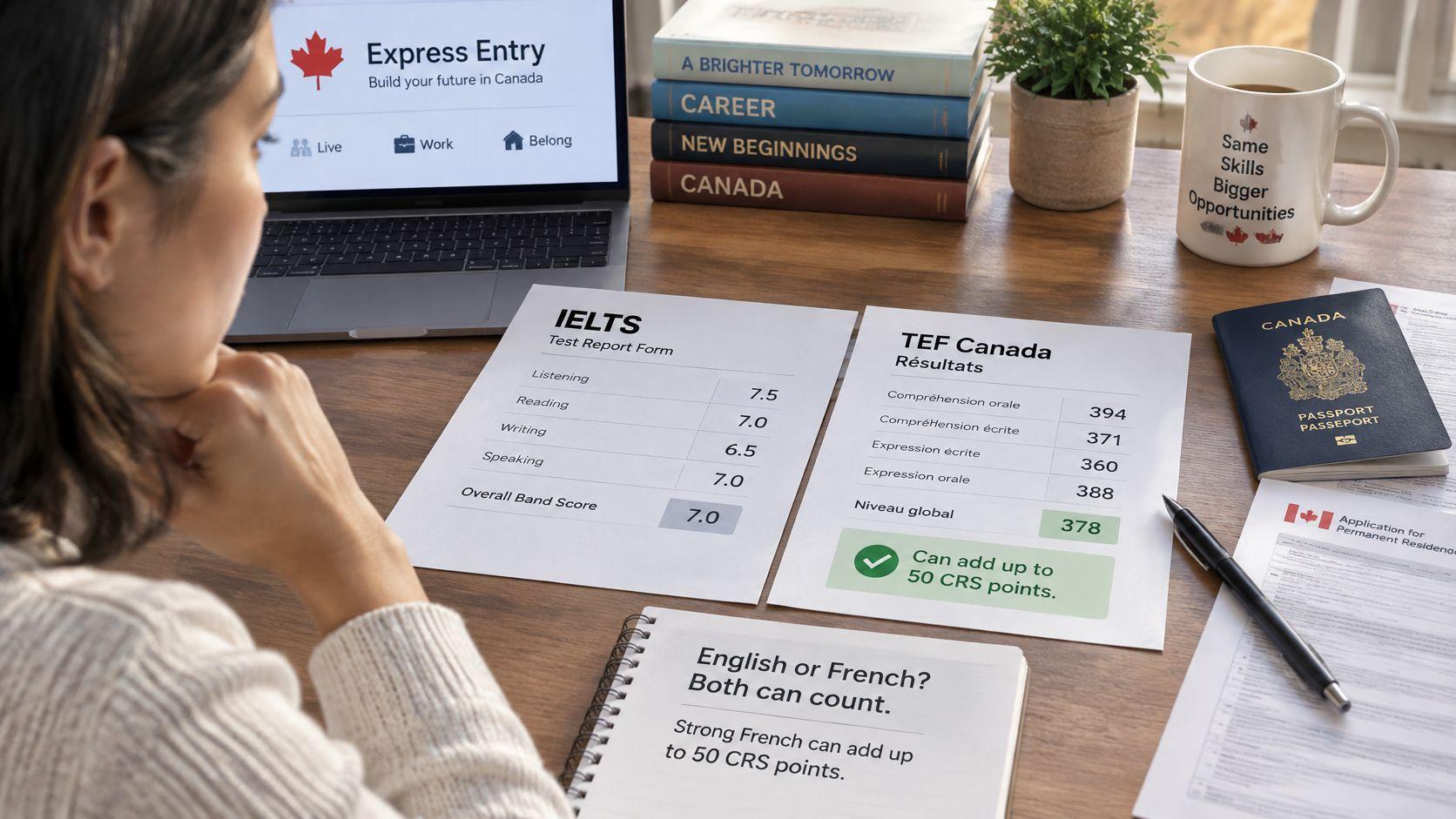
IRCC's Express Entry guidance for French-speaking candidates explains how French results can affect your options. Strong French may add up to 50 additional CRS points, even when French is your second official language. To qualify for the relevant points or selection options, you need to meet the required benchmark in reading, writing, listening, and speaking. Your English results can also affect the size of the French-language bonus.
French-language category selection has used a minimum of NCLC 7 in all four abilities. Each ability is a separate gate: a result below the required level in even one can keep you from qualifying for that category.
Two ways to spend the next study block
Raise English further. This may make sense if an English ability is below CLB 9 and improving it would change your CRS calculation. The goal is to address the specific gap, rather than raise a score that does not affect your plan.
Certify French. Consider this route if your English is already strong and another English score increase would not change your points or eligibility. French may affect both your CRS points and your eligibility for a category-based draw, provided all four French abilities meet the required level.
Compare the two routes against your own scores, timeline, and results in each ability. A strong overall impression of your language skills is not enough if one component falls short.
The linked IRCC guidance explains how French-language selection fits within Express Entry.
Before choosing a test date, check your current English results, your French level in all four abilities, how much preparation time you have, and which component could block your points or eligibility.
How to Prepare for Your Weakest Ability
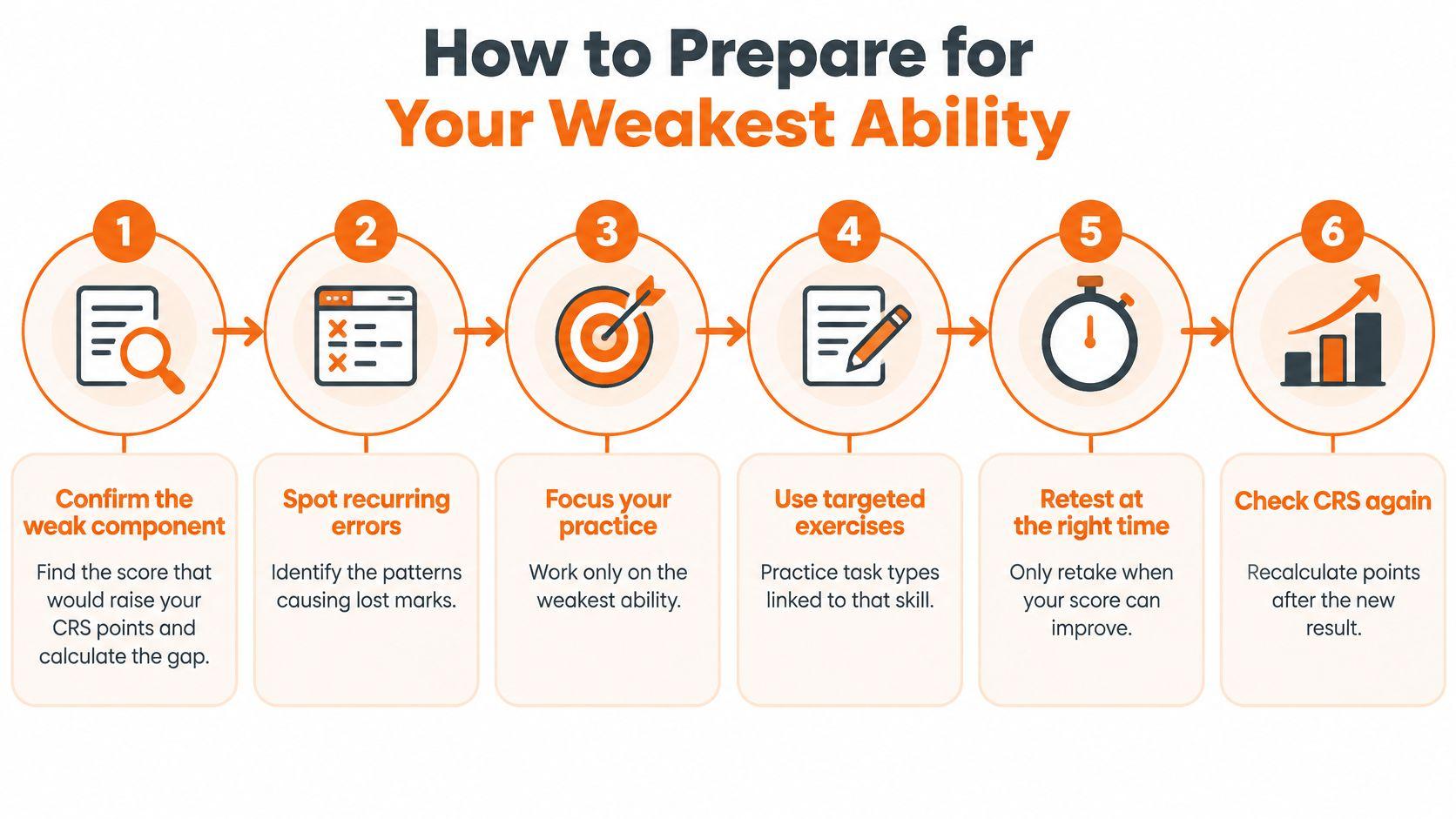
Once you know the ability under the line, general "more English" practice wastes the weeks you have. Work that one component until it can clear the row.
-
Confirm the component and the score that would raise your CRS points. Calculate the gap between your last result and that target. Without the gap, you'll practise skills that don't change the application.
-
Name the recurring weakness from your last timed practice. It might be speaking structure, reading speed, or the same grammar error. A label you can see is more useful than "speaking feels hard."
-
Practise that task under exam timing. For a short speaking turn, stay inside the 60-second window and plan at least two clear suggestions so you never offer only one. Untimed answers train a version of the test you won't sit.
-
Review a concrete correction for each error type. Put your answer next to a band-9 model and mark one change, not a full rewrite of your personality. The study methods guide is a useful checklist for how to log those corrections so you don't repeat the same miss.
-
Apply the correction to a fresh question. Rereading the prompt you already understand feels like progress and isn't. A new question shows whether the fix travels.
-
Check readiness against official practice materials, plus any AI feedback that uses CELPIP scoring criteria such as coherence, vocabulary range, grammar accuracy, and task completion. If the feedback only praises you, it isn't ready to trust.
The usual slip is practising with the clock off, or reviewing answers you already know by heart. Both inflate confidence the night before a retest.
A ready speaking answer has a clear structure, relevant detail, and an ending that lands before the timer. You can hear that on a recording. If you're still talking when the time cuts you off, the structure isn't ready, no matter how good the ideas were.
Test Validity Dates and Retest Planning
A high score doesn't protect you after it ages out. IRCC treats validity as two checkpoints, not one sticker on the score report. Results have to be valid when you create the Express Entry profile and again when you submit the permanent residence application.
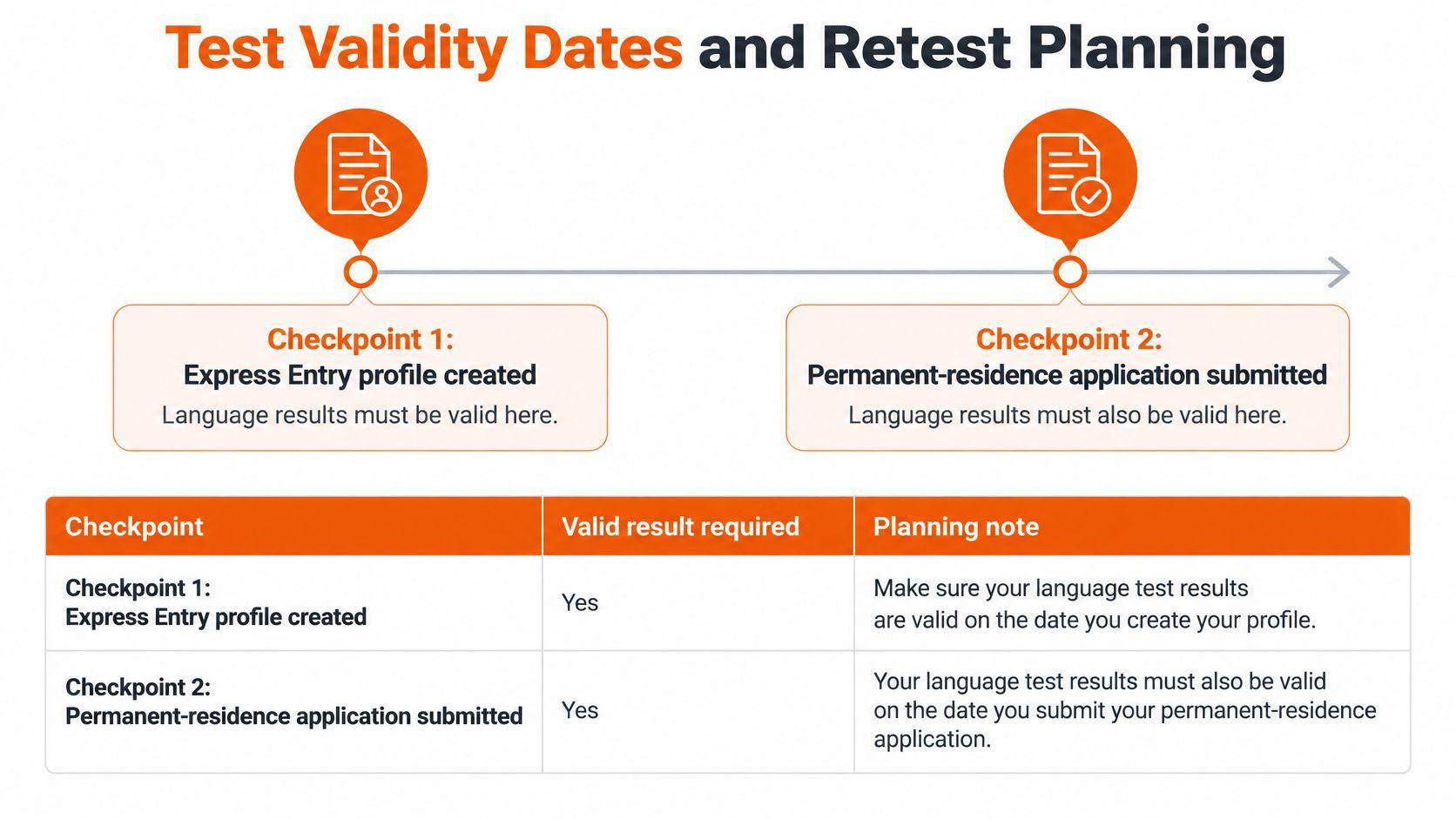
The language test page warns that an expired result at application time can lead to refusal. Candidates who stay in the pool may need to retest, apply before expiry, or decline an invitation and re-enter. Once results are two years old, you can lose eligibility or the CRS language points tied to that test.
| Checkpoint | Result Must Be Valid | If It Has Expired |
|---|---|---|
| Creating the Express Entry profile | Valid on the day the profile is created | The result cannot support the profile |
| Submitting the permanent-residence application | Valid on the day the application is submitted | Refusal risk |
| Between invitation and submission | Confirm validity before the deadline | Apply before expiry, retest, or decline and re-enter the pool |
A date model you can actually use
Start from the expiry date on the score report. Subtract the time you expect to wait for an invitation, then subtract the time you'll need to file the application. The date that remains is your latest sensible retest, and you should pull it forward by a buffer for booking delays and a bad day on the retest.
If an invitation lands close to expiry, you have three moves. File before the result expires if the documents are ready. Retest if they aren't and a new score can be in hand in time. Or decline the invitation and re-enter the pool with a fresh result rather than file a file IRCC can't accept.
People most exposed are candidates chasing competitive CRS totals, workers with long notice periods, and anyone whose invitation is likely to arrive near the two-year mark.
Track the expiry date in the same place you track the score. A CLB 9 you can't submit is not a CLB 9 on the application.
Confirm Your Target Score Before You Book
Before paying for a test, check four things: the CLB level required for your Express Entry plan, the accepted test version, your result's validity, and which of the four abilities needs the most work. A strong overall result cannot make up for a component that falls below the required threshold.
Start with a diagnostic for your weakest ability. Celprep's free plan includes one exercise per task type, three starter templates, one vocabulary bundle per section, and three submissions per day. Paid plans include personalized feedback on each attempt and a My Progress tool that tracks improvement and shows what to work on next.
Through a partnership with ApplyBoard, eligible users can get up to 10% off CELPIP registration in Canada and a discounted registration for CELPIP India, subject to the stated conditions.
Use the CELPIP score calculator to check how a practice result maps to CLB and language points. Then set your retest date against your result's expiry and practise the ability that is holding you back.
Celprep offers timed, exam-style practice and response-specific feedback for writing, reading, speaking, and listening. A focused practice set can help you work on the weaker component before booking another test. Start with a diagnostic on Celprep.