You've downloaded a CELPIP writing PDF, read the model answers, and written an email that sounds polished. Then you try a timed prompt. You spend too long explaining the situation, rush the final request, and finish without checking whether you answered everything.
If you're searching for test expert writing practice for CELPIP PDF resources, look beyond the sample answers. A useful PDF should help you rehearse the task, manage the clock, and diagnose why a grammatically accurate response still falls short.
Writing Timings and Word Limits at a Glance
Long, untimed essays can give you confidence without showing whether you're ready for the writing test. You might develop an interesting introduction at home, then discover during a timed attempt that you haven't left enough room for the actual requests.
The official CELPIP-General overview states that the test takes less than three hours in one sitting, with 53 minutes for Writing, covering an email and a survey response. Your practice needs to reproduce those demands, not just give you a topic to discuss.
Keep the task limits beside your draft
The official CELPIP preparation specifications allocate 27 minutes to Task 1 and 26 minutes to Task 2, with approximately 150–200 words for each response. They distinguish an email addressing requested points from a survey response that chooses between options and explains the choice.
CELPIP-General writing task limits
| Task | Time | Length | What it asks |
|---|---|---|---|
| Task 1: email | 27 minutes | 150–200 words | Address about three requested points in one email |
| Task 2: survey response | 26 minutes | 150–200 words | Choose one of two options and justify the choice |
| Full writing section | 53 minutes | Both tasks | Completed in one sitting |
Treat this table as a practice boundary. Don't extend the timer because you've thought of a better example, and don't keep writing because your introduction took more space than expected.
The tasks require different decisions. In an email, you must communicate with a particular recipient and complete the requested actions. In a survey response, you must make your preference clear and develop a convincing justification, without adding an email greeting or sign-off.
Find out where your time goes
Your first timed attempt is a diagnostic, not a verdict on your English. Notice whether you stall while choosing ideas, translating sentences, or repeatedly correcting the opening paragraph.
Practical rule: Record where you stopped, not just whether you finished. An unfinished request and an unfinished spelling check need different fixes.
Start with a Task 1 email using the task timer. Count the words when it ends, mark any incomplete request, and note the moment you began rushing. That gives you a concrete starting point for choosing what to practise next.
What a Strong CELPIP Writing Practice PDF Contains
A strong practice PDF gives you something to do, not just something to read. Before downloading another collection, check whether it helps you plan, draft, compare, and record a result.
Use this checklist to assess its contents.
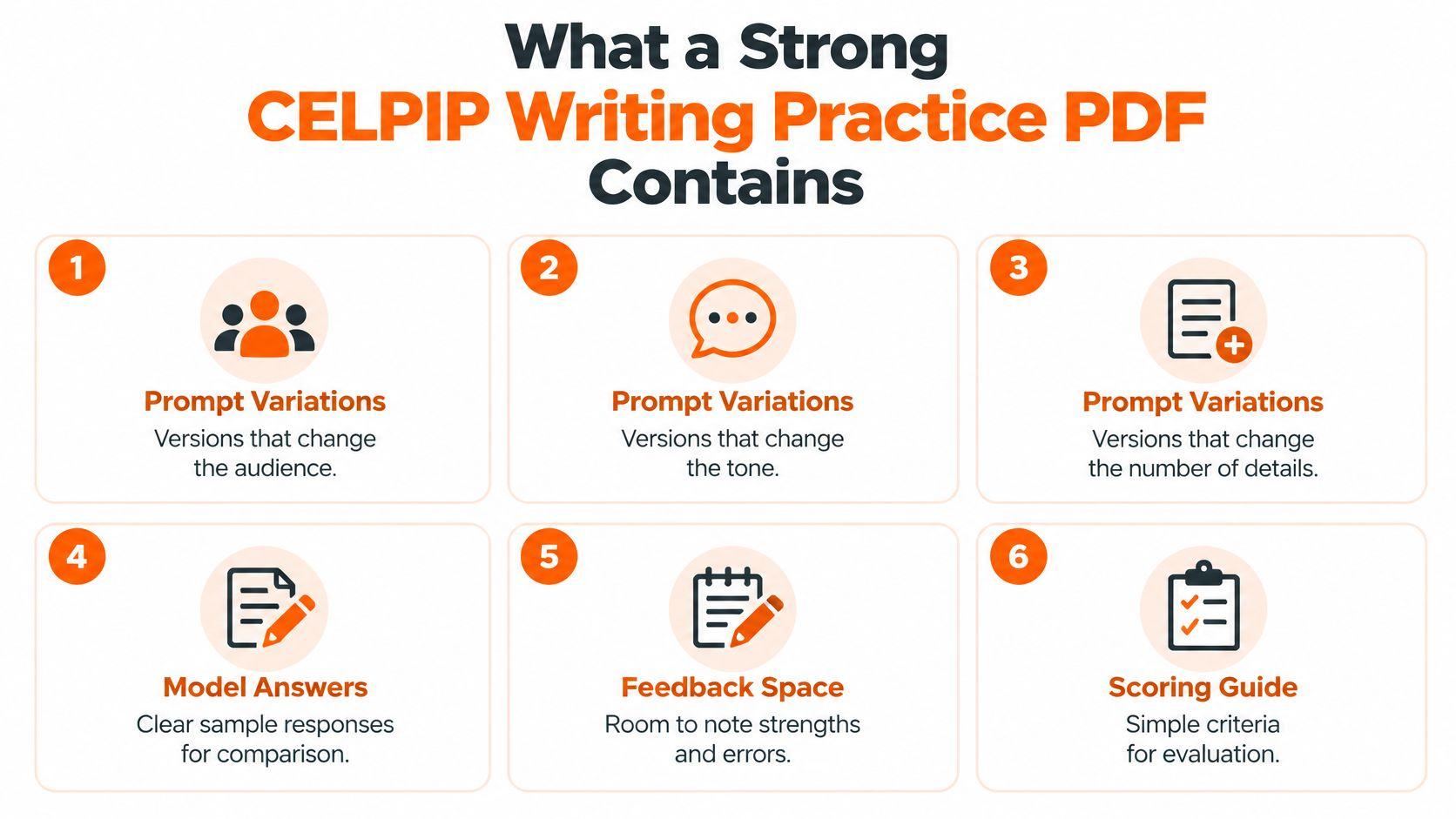
Look for prompts that change the decision
Prompt variations should change the audience, tone, or requested details. Say you're reporting a maintenance problem: writing to your landlord requires a different relationship and request from writing to a colleague who shares the workspace.
The official CELPIP participant package describes everyday email tasks and advises against an excessively formal or overly casual tone. Practise adapting your language rather than pasting the same opening into every response.
A useful PDF should include:
- An obligation checklist. Separate the greeting, each requested action, and the closing before drafting. This prevents a polished introduction from hiding an unanswered request.
- A word-budget grid. In a hypothetical email with three equally important points, allow roughly 50–60 words per point, then leave room for a brief greeting and closing. Adjust the allocation when one request needs more explanation.
- Audience-and-tone contrasts. Compare Could you arrange a repair? with Can you take a look when you're free? Decide which fits the relationship rather than assuming formal language is always better.
- A blank simulation page. Include the prompt, a planning area, a response space, and fields for elapsed time and final word count.
Leave room for evidence
Your error log should have fields for omitted points, weak support, missing transitions, and minutes spent revising. Add a space for the exact sentence you'll change, so the next practice decision doesn't depend on memory.
Model answers still have a role. Use CELPIP Writing Task 1 samples after your own attempt to compare how the writer introduces the purpose, covers requests, and closes the message.
Don't copy an answer just because it sounds polished. Identify a transferable choice, such as placing the proposed solution immediately after explaining the problem.
The simplest test for any PDF is practical: Does it give you a prompt, a time limit, and a place to log the result? If it only supplies completed answers, you'll need to add the rehearsal tools yourself.
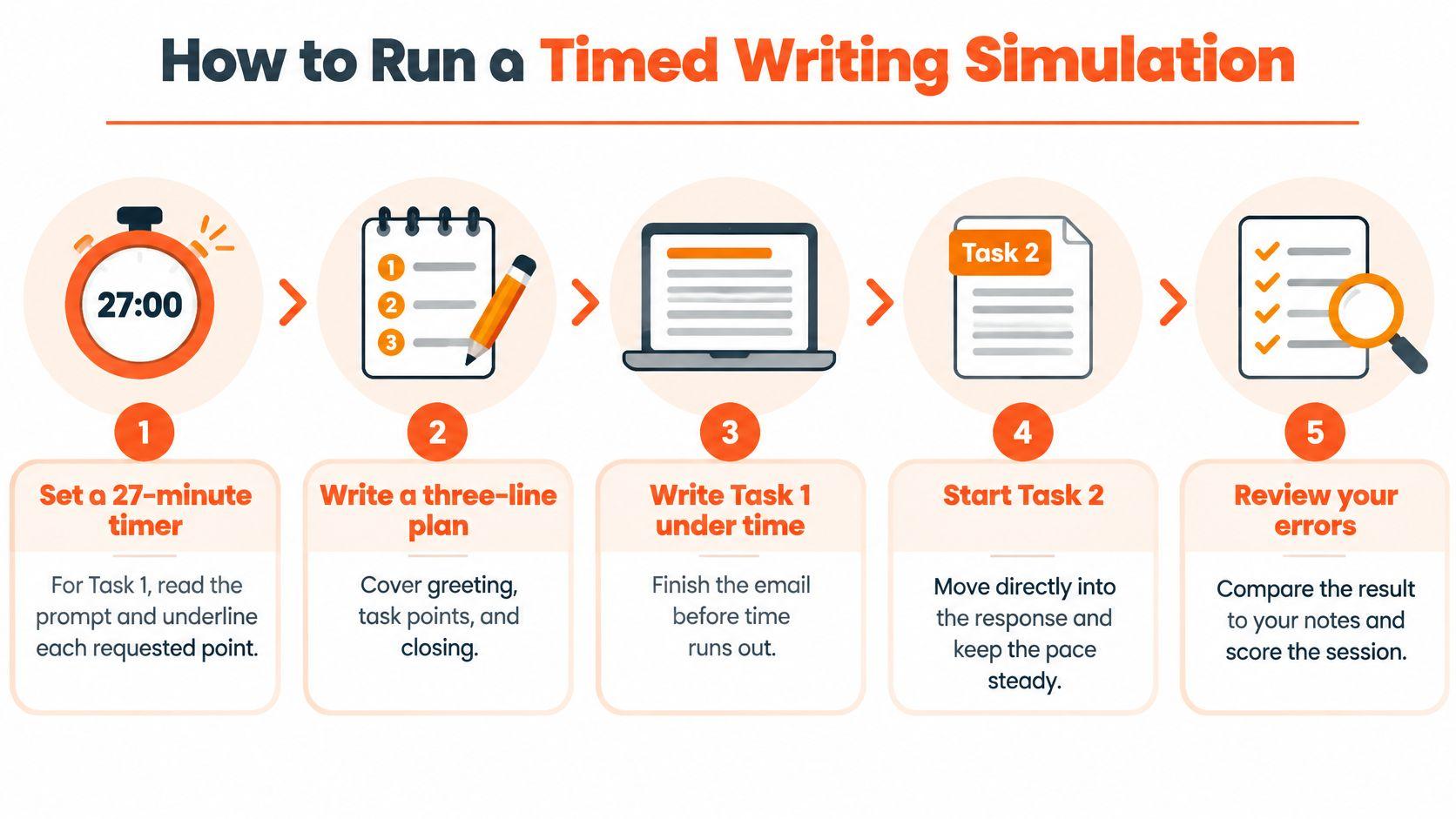
How to Run a Timed Writing Simulation
Use an unfamiliar prompt and keep the model answer out of sight. Type your response in a document with a word counter, and keep a separate timer visible so you can record when you move from planning to drafting.
The official CELPIP-General study pack specifies 27 minutes and 150–200 words for Task 1. The rehearsal schedule below is a suggested way to divide that time, not an additional test rule.
Follow a complete rehearsal cycle
Keep the overall sequence visible while you work.
-
Start the Task 1 timer and read for obligations. For this rehearsal, spend about two minutes underlining the recipient, purpose, and requested points. The common slip is reading the situation carefully but overlooking an instruction at the end.
-
Make a compact plan. Allow about three minutes to sketch three lines covering the greeting and purpose, the requested points, and the closing action. Use keywords, because drafting complete sentences here duplicates work.
-
Allocate the available words. Give the most demanding request the largest share, rather than dividing the space automatically. Include the opening and closing in your budget so they don't become unplanned additions.
-
Draft in one pass. In this suggested schedule, use about fifteen minutes to turn the plan into complete paragraphs. Fix an error immediately if it blocks meaning, but don't repeatedly polish a sentence while a requested point remains unwritten.
-
Check length and coverage. Use the remaining short window before the final edit to count words and compare the draft with your checklist. Cut repeated background before cutting a required detail, or develop a thin explanation rather than adding filler.
-
Protect the final editing period. Reserve about five minutes in this rehearsal for transitions, tone, spelling, and punctuation. Read the greeting and closing together, then inspect whether the paragraphs follow a sensible order.
-
Mark omissions without extending the attempt. At the timer, stop writing and record any missing request or unfinished support. During a combined simulation, keep this note brief so you can move directly to the next task.
-
Reset for Task 2 and adapt the routine. State your chosen option in the first sentence, then develop two reasons, each with a concrete example and a consequence. Use the survey task's allotted time, check that the justification fits its required word range, and leave out email formatting.
Compare process, not just finished answers
For a hypothetical survey about extending library hours, It would help workers is only a starting point. Explain that someone finishing work late could collect reserved books afterward, then connect that access to a practical benefit.
After each run, record omitted points and weak support before beginning another session. Across three practice sessions, compare the time spent reading, planning, drafting, and revising.
A faster draft isn't automatically a better draft. Look for completed requests and developed reasons, not speed alone.
If planning expands each time, simplify the outline. If editing disappears, practise drafting a complete, plain response before attempting more ambitious phrasing.
Scoring Your Own Response on Four Criteria
Don't finish a practice response by writing Good grammar, needs better vocabulary. That impression is too broad to guide revision. You need a note that identifies what the reader can find, understand, or act on.
The official CELPIP teacher guide evaluates writing through four dimensions: Content/Coherence, Vocabulary, Readability, and Task Fulfillment. Treat them as separate inspection lenses rather than assuming a strength in one cancels a weakness in another.
Turn each dimension into a visible check
Self-scoring checks for each writing dimension
| Dimension | What raters check | Self-check question |
|---|---|---|
| Content/Coherence | Number and quality of ideas, organization, examples and supporting details | Does each paragraph hold one idea with a concrete example? |
| Vocabulary | Word choice, range, suitability, precision and accuracy | Did I replace one vague word with a precise one? |
| Readability | Paragraphing, transitions, grammar, sentence structure, spelling and punctuation | Is every paragraph linked to the next by a transition? |
| Task Fulfillment | Relevance, completeness, tone and word count | Did I answer every requested point in the right tone and length? |
For Content/Coherence, underline the sentence that supports your main recommendation. If you recommend evening classes because they're convenient, show who needs them and what scheduling problem they solve.
For Vocabulary, identify a vague expression and test a more precise alternative. The service was bad might become The delivery arrived damaged, if that matches the scenario. Don't replace familiar words with impressive ones unless the meaning stays accurate.
For Readability, mark the connection between paragraphs and inspect sentence boundaries. The table's transition question is a diagnostic, not a command to begin every paragraph with Furthermore. A clear reference to the previous idea can link paragraphs naturally.
For Task Fulfillment, match each prompt obligation to an identifiable answer. Mentioning a repair isn't the same as requesting a repair date, and describing inconvenience isn't the same as proposing a solution.
Write evidence instead of awarding yourself a level
An effective note names the location and problem: The final paragraph asks for a refund but doesn't explain the requested replacement. That gives you a revision target you can verify.
If you use automated comments, AI essay feedback can help you consider what useful response-specific analysis should identify. Ask whether a comment points to your wording, explains the problem, and suggests a change that preserves your intended meaning.
Keep the distinction clear: This self-check is a learning tool, not an official CELPIP score.
Record which dimension needs the most attention across attempts. Choose the next focus from the weakest repeated evidence, not from whichever correction feels easiest.
If incomplete requests recur, work on coverage before collecting more vocabulary. If the requests are complete but reasons remain general, practise developing support.
Why Accurate Grammar Still Loses Marks
A sentence can be correct without doing the job the prompt assigns. I've enjoyed living in this building may be grammatical and relevant background, but it doesn't tell the landlord what needs fixing or when access is possible.
The official CELPIP score descriptors distinguish Level 9, effective proficiency, from Level 10, highly effective proficiency, with both aligned to CEFR C1. Aiming at these levels means demonstrating effective communication in demanding contexts, not merely avoiding sentence errors.
Diagnose the symptom before choosing a drill
A static PDF can show a well-developed answer. It can't inspect your own draft and identify that you explained the noise problem but forgot the requested suggestion.
Use the following table as a troubleshooting guide, not as a prediction of an official score.
Writing symptoms, causes and fixes
| Symptom | Likely cause | Fix before the next timed run |
|---|---|---|
| Grammar is clean but the score stays low | An omitted request or weak supporting detail | Build the prewriting checklist from each prompt point before drafting |
| Task 2 ideas feel thin | A justification with no concrete example | Add one example and one consequence to each reason |
| Tone is marked down | The email reads too casually or stiffly for the named recipient | Rewrite the greeting and closing for that recipient |
| Length misses 150–200 words | Time spent on ideas with no word budget | Allocate words per point before writing and check at the midpoint |
| Paragraphs feel disconnected | Missing connectors between points | Mark every transition during the edit pass |
Start with the first symptom that describes your response. Then check the cause against the actual draft, because the same symptom can come from different problems.
For example, a short survey response might reflect weak idea development, but it might also result from spending too long rewriting the opening. The remedy depends on what happened during the attempt.
Separate process failures from language gaps
Process failures include skipping a request, overplanning, and leaving no editing time. Correct them by changing the sequence of work: extract obligations, budget space, and stop polishing unfinished drafts.
Language gaps need targeted language practice. If you can explain the intended meaning aloud but can't write a precise request, practise request forms and useful combinations such as arrange an inspection, confirm availability, or provide a replacement.
Tone deserves the same precision. Rewriting the greeting and closing is a starting point, but inspect the body for abrupt commands or inflated courtesy that doesn't fit the recipient.
Rerun the same prompt after applying a single fix. Compare the error logs to see whether the problem disappeared, remained, or shifted elsewhere.
Choose a Writing Practice Routine You Will Repeat
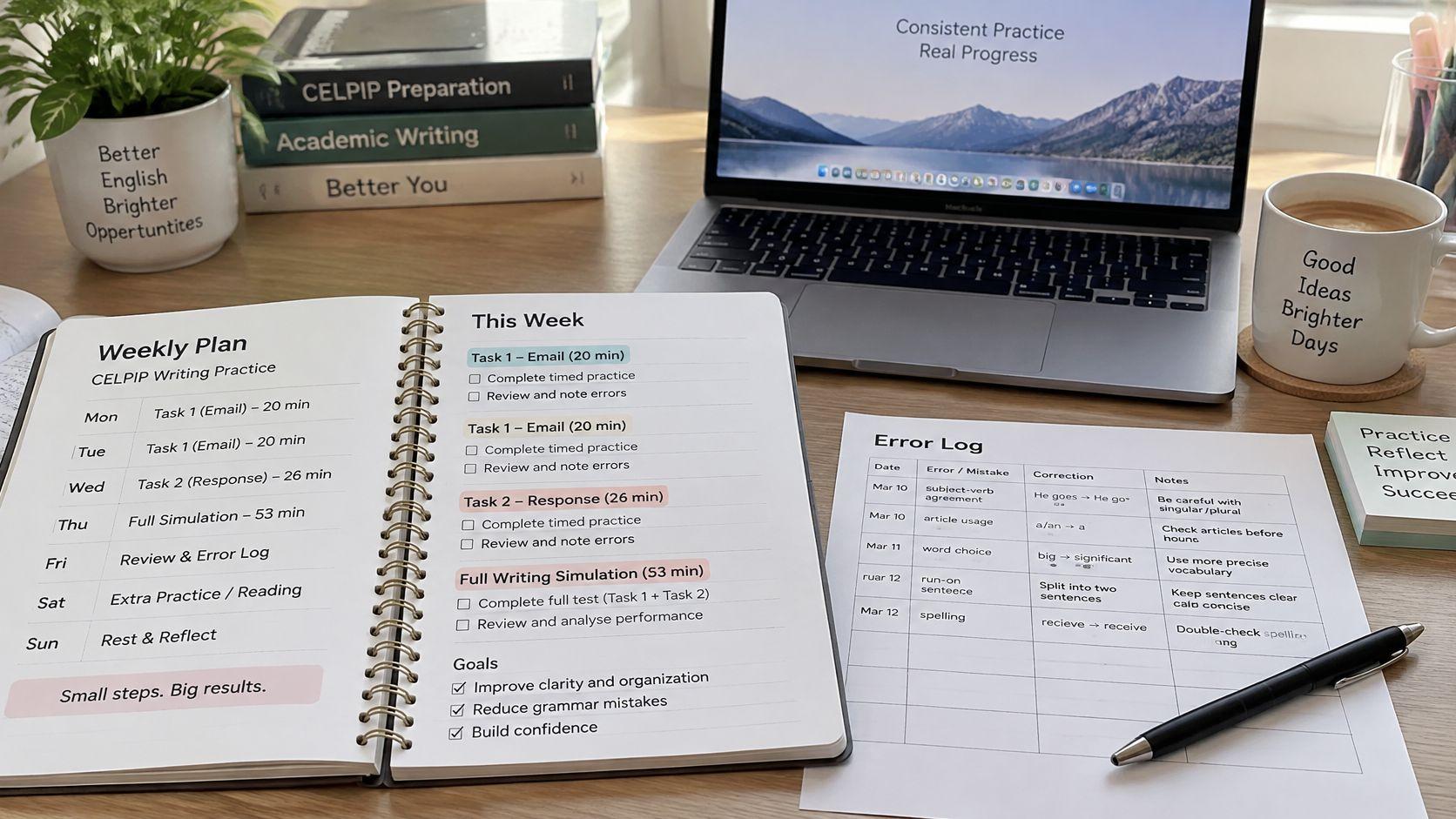
A repeatable routine is more useful than an ambitious schedule you abandon after a difficult workday. Keep your prompts, drafts, and error log together so you can begin without spending the session searching for materials.
Set up a workspace where the timer and planning sheet are easy to see.
Build a manageable practice week
Try this suggested weekly routine, adjusting the days around your commitments:
- Early in the week: Complete two timed Task 1 emails on separate days, changing the audience or purpose.
- Midweek: Write one timed Task 2 response, concentrating on supported reasons rather than a long introduction.
- At the weekend: Complete a full combined writing simulation without opening sample answers.
- After every attempt: Complete the error log and the four-dimension self-check before filing the draft.
After three weeks of this proposed routine, identify the dimension and error type that recur most often. Make that combination the following week's focus, such as Task Fulfillment plus omitted requests, or Content/Coherence plus unsupported claims.
You can use structured English writing practice to keep exercises focused on producing and revising responses. Save both versions when you rewrite, because the difference between them shows what you changed.
Test feedback against your own diagnosis
Response-specific feedback is useful when it identifies something you can locate in the draft. Compare its comments with your notes: did it catch the missing request, explain an unclear sentence, or identify an unsupported reason?
We give immediate, personalized feedback on each specific response in Celprep, with feedback on every attempt and a My Progress tool that tracks improvement and shows what to work on next. All paid plans include 3,000+ real exam-style questions, full mock exams under real test timing, and templates and vocabulary suited to each CELPIP task.
Test the free tier before deciding whether you need paid access. Judge the usefulness of the feedback, not just the amount: a specific correction with a clear reason is more actionable than a page of general encouragement.
For another study format, you can use this video alongside your written practice.
Don't let watching replace writing. Keep the next prompt ready, choose the routine you'll follow this week, and start the first simulation.
After three runs, compare the logs and select a single change for the next attempt. That decision turns a downloaded PDF into a practical rehearsal tool.
Celprep combines timed CELPIP writing practice with personalized feedback on your own responses, so you can work on the gaps a static PDF can't identify. Visit Celprep, complete a writing attempt, and compare the feedback with your task checklist before revising.