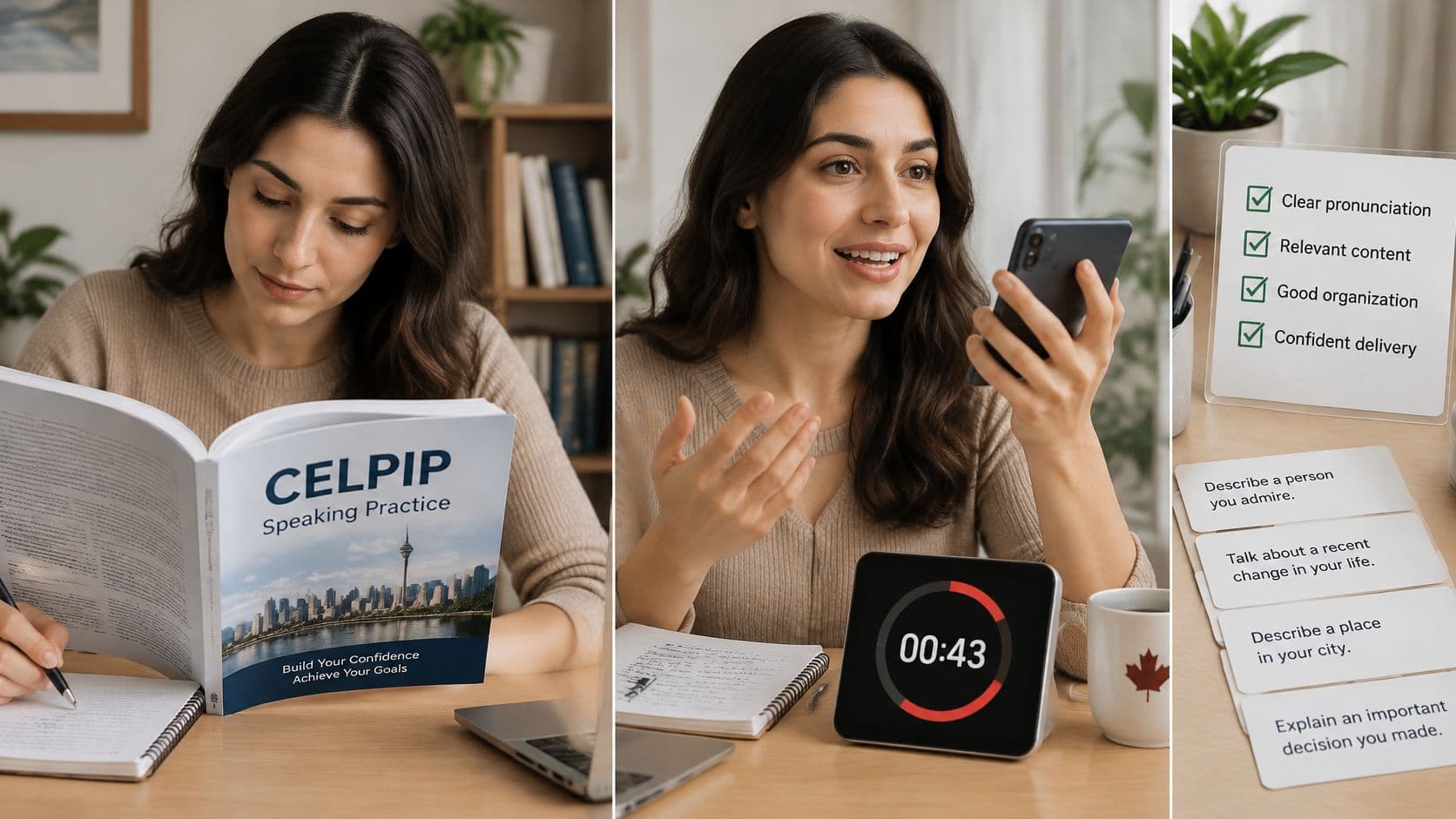
You're checking your eligibility late at night, calculator open, trying to work out whether your English is finally good enough to submit. You use English at work every day. You write emails, join meetings, and explain problems to clients without much trouble. Then you see the rule that changes everything. Your program doesn't ask for one overall score. It checks listening, reading, writing, and speaking separately, and one low result can block the whole application.
That's the point many applicants miss when they start looking for an English test for immigration. The question isn't only, "How good is my English?" It's also, "Which test does my exact route accept, and what minimum does it set for each skill?" Get those answers first, and your preparation has a clear target. Guess them, and you can study hard for the wrong test version or the wrong score.
Why One English Score Does Not Fit Every Application
Say a software engineer applies for Canadian permanent residence. His workplace English is solid. He leads calls, reads technical documents quickly, and rarely struggles to be understood. His test results look strong too, except for one problem. He scores 6 in writing, while his program needs 7 in every skill. His higher listening and speaking scores don't rescue the writing result, so the application stalls over one component.
Think of each immigration program as a different lock. A test score is a key, but it only opens doors that accept that test, that version, and that level. A key that fits one lock may not fit another, even if your actual English hasn't changed at all.
Every applicant has to make three decisions in order:
- Country and program: Are you applying through Canadian Express Entry, a Canadian pilot, Canadian citizenship, US naturalization, or an Australian skilled visa?
- Accepted test: Which exact test and version does that route accept?
- Minimum per skill: What level do you need in listening, reading, writing, and speaking, checked one by one?
Those three answers explain why the same person can qualify for one route and miss another. A citizenship route may only check listening and speaking, while an economic immigration route checks all four skills at a higher level.
You'll find a table of accepted tests and minimums first, then a plain explanation of CLB levels and how CELPIP compares with IELTS. After that comes a diagnosis for weak components, a step by step preparation routine, and a checklist for choosing your test date without letting a valid score expire.
Accepted Tests and Minimum Scores by Pathway
A Canadian Language Benchmark, or CLB, level is the per skill target that a test score converts into for Canadian programs. You'll see how that conversion works in detail shortly. For now, use the table to find your pathway, then confirm the test version and the minimum for every skill.
| Pathway | Accepted tests | Minimum per skill | Watch for |
|---|---|---|---|
| Express Entry (Federal Skilled Worker) | CELPIP-General or IELTS General Training | CLB 7 in all four skills | IELTS One Skill Retake generally not accepted |
| Rural Community Immigration Pilot, TEER 0 or 1 | CELPIP-General | CLB 6 in all four skills | Minimum depends on the job's TEER category |
| Rural Community Immigration Pilot, TEER 2 or 3 | CELPIP-General | CLB 5 in all four skills | Confirm the job's TEER code before testing |
| Rural Community Immigration Pilot, TEER 4 or 5 | CELPIP-General | CLB 4 in all four skills | Lowest threshold, still checked per skill |
| Canadian citizenship (ages 18 to 54) | CELPIP-General or CELPIP-General Listening and Speaking | CLB 4 in listening and speaking | Reading and writing not used for this proof |
| US naturalization | USCIS English test (understanding, speaking, reading, writing) | Ordinary English usage | Taken with the civics test, not a third-party score |
| Australian skilled visas | Approved tests, including CELPIP-General | Competent English, set minimum in each component (CELPIP 7 in each) | Approved-test list changed on 7 August 2025 |
How to Read Your Row
For Express Entry through the Federal Skilled Worker Program, you need CLB 7 in all four skills from CELPIP-General or IELTS General Training. Don't plan around fixing one weak IELTS skill later through a retake product, because IELTS One Skill Retake is generally not accepted for this route. Treat all four results as a single sitting problem.
The Rural Community Immigration Pilot works differently because the job category sets the bar. The IRCC Rural Community Immigration Pilot language page specifies CELPIP-General and sets CLB 6 for TEER 0 or 1 jobs, CLB 5 for TEER 2 or 3 jobs, and CLB 4 for TEER 4 or 5 jobs. You still need that level across reading, writing, listening, and speaking, not as a combined score. Before you book, check the National Occupational Classification TEER category for the actual job, not the job title you use at work.
Canadian citizenship is narrower. Applicants aged 18 to 54 need CLB 4 in speaking and listening only, using CELPIP-General or CELPIP-General Listening and Speaking. That route doesn't use reading and writing scores for this proof, so preparation can focus on the two skills that count.
Practical rule: Find your row first. Every later decision, from practice materials to test date, follows from that row.
The Two Rows That Work Differently
US naturalization doesn't give you a third party minimum score to chase. USCIS runs its own English test covering understanding, speaking, reading, and writing in ordinary English usage, alongside a civics test. Read that row as a process you prepare for, not a score report you order.
Australian skilled visas use approved tests and a competent English standard with a minimum in each component, with CELPIP-General 7 in each skill as the common benchmark. Check the current approved list before booking, because the Australian approved test list changed on 7 August 2025 and validity rules can differ by visa subclass. If you're still unsure how the Canadian benchmark itself works, the guide to the CLB language test explains the per skill target before you compare test options.
CLB Levels and How CELPIP Compares With IELTS
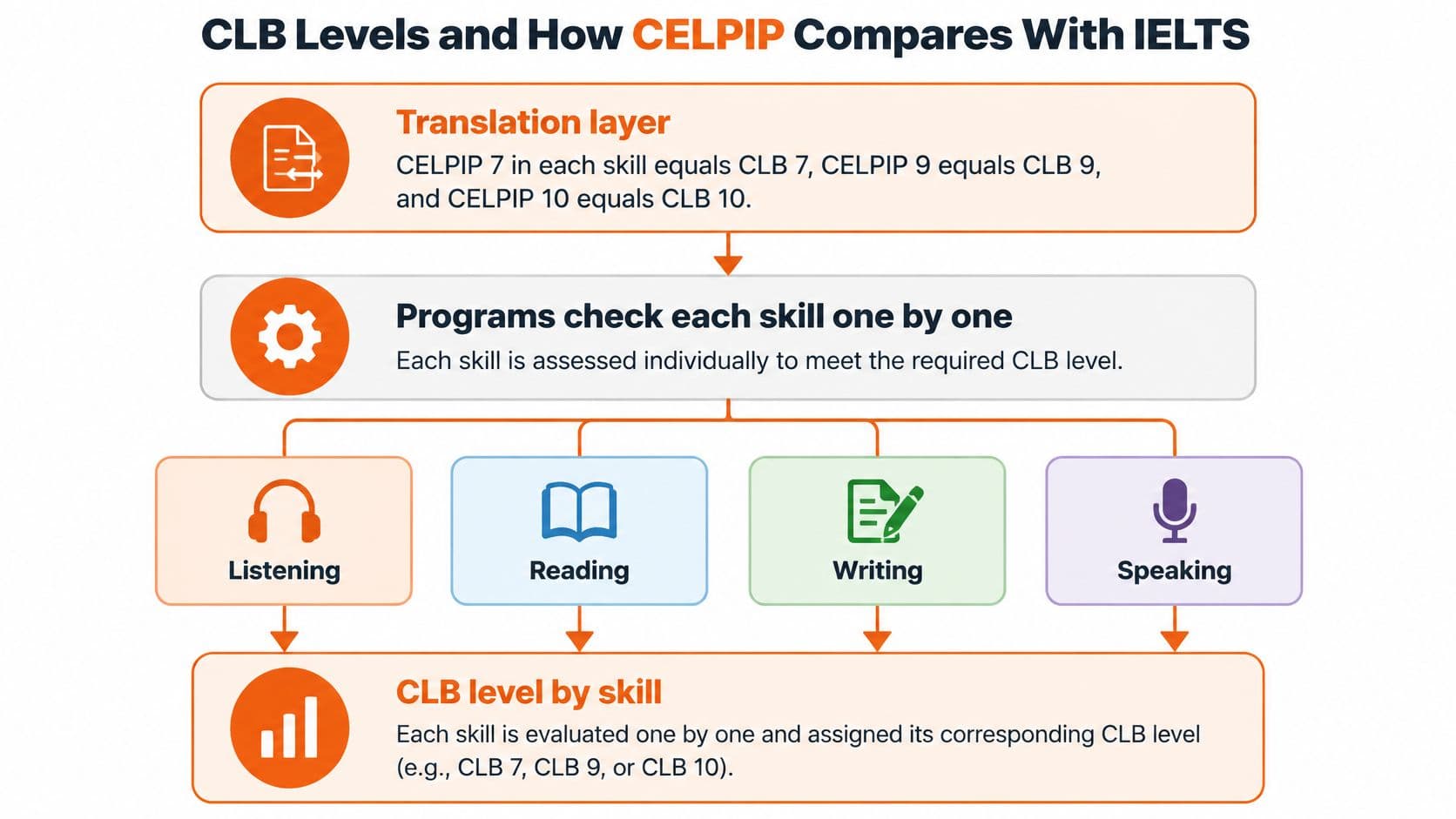
Canada doesn't judge your CELPIP or IELTS result as one overall number. It translates each skill into a CLB level, then checks those four levels against the program rule. The IRCC language requirements manual maps CELPIP scores directly, so CELPIP 7 in each skill equals CLB 7, CELPIP 9 equals CLB 9, and CELPIP 10 equals CLB 10.
Picture the structure in three layers. At the base sit your four skill scores. In the middle, each score becomes a CLB level for that skill alone. At the top, the program compares each CLB level with its minimum, one by one, with no averaging across skills.
Why Higher CLB Levels Matter for Express Entry Points
Meeting the minimum makes you eligible. Scoring above it can also improve your position. In Express Entry, each first language ability contributes 4 points at CLB 7, 5 points at CLB 8, and 6 points at CLB 9 or higher. If all four skills move from CLB 7 to CLB 9, the first language subtotal rises from 16 to 24 points before other factors are counted.
That jump explains why many applicants don't stop at the minimum. A candidate who is safely above the line in three skills but stuck at CLB 7 in writing may gain points by lifting that one skill. The weakest component often controls both eligibility and the next points increase.
The CELPIP test format and scoring page confirms that a score of 9 in reading, writing, listening, and speaking equals CLB 9 in each skill, and a score of 10 in each equals CLB 10. It also states that CELPIP results are valid for two years from the date the score report is issued, so check that expiry date before you submit.
The Rule That Catches Uneven Scores
Here's the example to remember. A candidate scores 10 in listening, reading, and speaking but 6 in writing. That profile doesn't meet a program requiring CLB 7 in every ability. The three strong scores don't pull the writing score up, and a higher reading score can't offset a lower speaking score in the same way.
The weakest skill sets the level.
That's why an average can mislead you. Four results of 9, 9, 9, and 6 may look close to strong overall, but the program sees three skills at CLB 9 and one at CLB 6. Your preparation plan should track four separate score lines and put the lowest one first.
CELPIP and IELTS Side by Side
Both tests can work for Canadian economic immigration, but their score scales don't line up in a simple one to one way. Use the component table for the CLB level you need, not a rough overall conversion you find in a forum post.
| CLB level | CELPIP-General (Reading, Writing, Listening, Speaking) | IELTS General Training (Reading, Writing, Listening, Speaking) |
|---|---|---|
| CLB 7 | 7 in each skill | 6.0 in each skill |
| CLB 9 | 9 in each skill | Reading 7.0, Writing 7.0, Listening 8.0, Speaking 7.0 |
At CLB 7, CELPIP needs 7 in each skill and IELTS General Training needs 6.0 in each skill. At CLB 9, CELPIP needs 9 in each skill, while IELTS needs Reading 7.0, Writing 7.0, Listening 8.0, and Speaking 7.0. That makes IELTS listening the hardest single target in the CLB 9 row, even though the other three IELTS targets sit lower.
Follow three rules when you choose between them:
- Take the right IELTS version: Use IELTS General Training, not Academic, for Canadian immigration. For CELPIP, immigration routes that check four skills need CELPIP-General, while the Listening and Speaking version belongs to citizenship proof.
- Compare your weakest skill, not your best: Take practice scores in all four skills under each format if you can. Choose the test where your lowest skill has the most room above its required line.
- Use the official component table: Don't convert an overall CELPIP impression into an overall IELTS band and assume you're safe. Programs convert skill by skill, so your decision should too.
If you want a fuller side by side breakdown before you commit, read the CELPIP vs IELTS comparison and match each format against your own four practice scores. Neither test is easier in the abstract. The better test is the one where your weakest skill clears its line with the least risk.
Why Strong Speakers Still Miss the Threshold
A low component score doesn't automatically mean your grammar or vocabulary is weak. That's the assumption to challenge first. Plenty of applicants handle real conversations well, then lose marks on a timed task that asks for a very specific kind of answer. The test measures performance under its own conditions, not your general ability to get through a workday.
Three different causes can produce the same disappointing number:
- A genuine language gap: Your answers lack range or accuracy. Sentences stay simple, word choices repeat, or errors make the meaning hard to follow.
- A strategy failure under time pressure: Your English is adequate, but the answer is incomplete. A speaking response gives only one reason, or a writing email misses one required point from the prompt.
- Unfamiliarity with the format: The accent, interaction style, or structured prompt feels foreign. You hesitate, restart, or run out of planning time, so a fluent speaker sounds unsure on the recording.
Workplace English hides these problems because real life gives you help the test removes. In a meeting, you can ask someone to repeat a question, check a detail, or rephrase your point after you see a confused face. A test prompt doesn't negotiate with you. It gives fixed time, fixed instructions, and one chance to produce the expected response.
Migration language research has also recorded concerns about accent familiarity and whether scores always reflect workplace communication. Don't assume every low score is entirely your fault. Do treat it as a problem you still have to solve, because the program will use the score either way.
Diagnose before you buy a big course. Complete several comparable tasks in the weak skill, mark each response against the same criteria, and look for the error that repeats. If you miss required points in task after task, you have a strategy problem. If your ideas are complete but the language keeps breaking down, you have a language problem.
That diagnosis decides your next move. A broad gap across all four skills may justify a full general English course. One repeated bottleneck usually calls for a narrow repair plan focused on that task type, that timing, and that scoring weakness. Spending months raising skills that already pass won't fix the one score that's blocking you.
How to Prepare Each Skill Step by Step
Preparation works best as a loop. You find the target, measure yourself against it, repair the lowest skill, then prove the result under full test timing. Skipping the measurement step is how busy applicants spend weeks practising what they already do well.
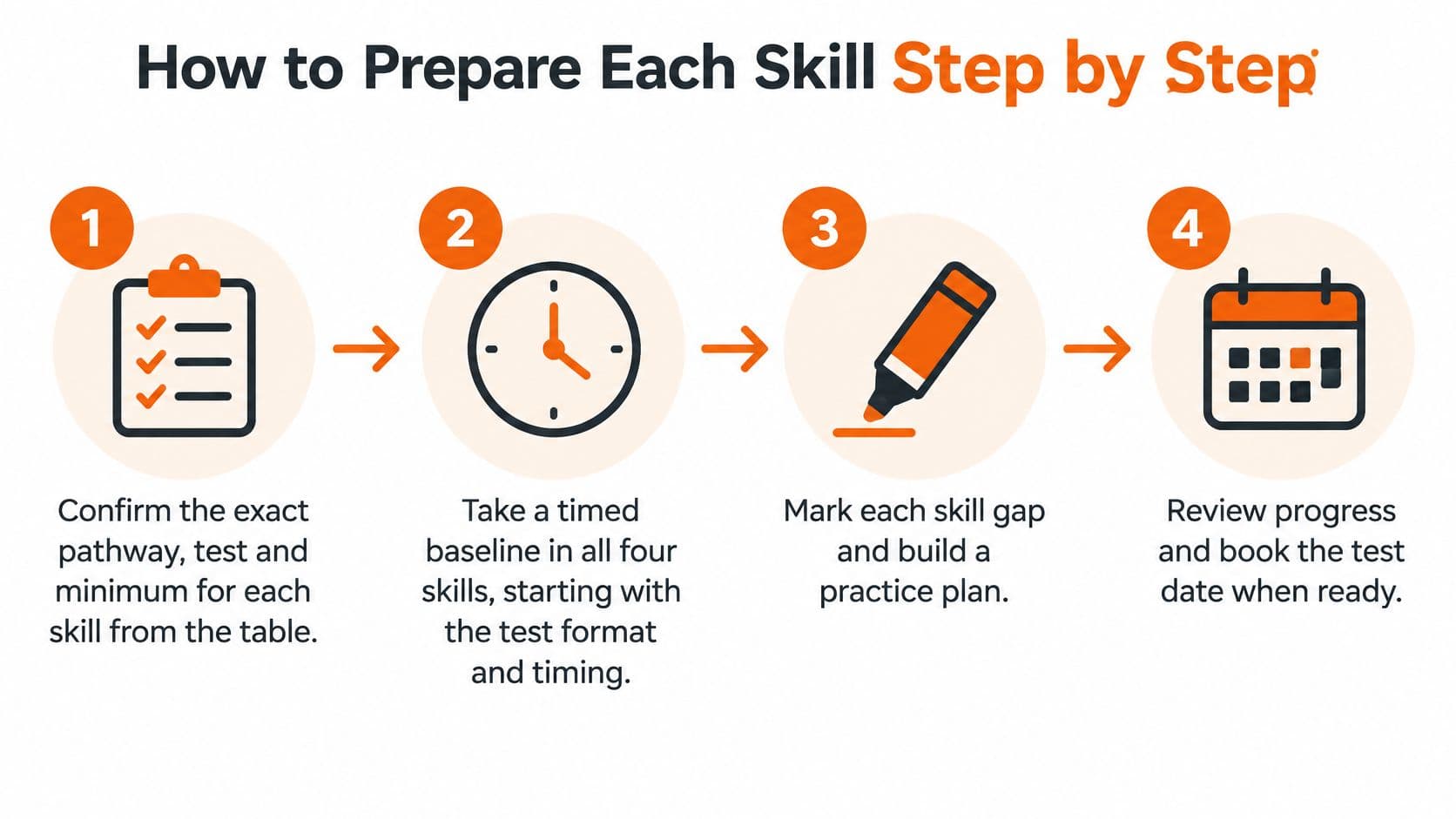
- Confirm your exact target. Write down your pathway, accepted test, and minimum for each skill in one place. This prevents the most expensive slip, preparing for a test version or score level your route doesn't accept.
- Take a timed baseline in all four skills. Use the correct format and timing from the start, even if the first attempt feels rough. An untimed score can flatter you, while a timed baseline shows whether you finish, organize, and answer every part of the prompt.
- Rank the gaps against the target. Mark each skill against its CLB or component minimum and order them from lowest to highest. The lowest skill gets the most practice time, because it carries the highest application risk.
- Practise the weakest task type in the correct format. For writing, produce a 150 to 200 word email in 27 minutes and cover every point in the prompt. For speaking, use the planning time to line up two or three clear pieces of advice with reasons, rather than improvising one idea and hoping it fills the time.
- Compare every attempt with a model and a checklist. Record speaking answers or save written drafts, then check them against required points, organization, vocabulary, and accuracy. If you're working on spoken responses, an English speaking test online format lets you rehearse the recording step itself, not just read about it.
- Repeat until the same errors stop appearing. Don't jump to a new task type after one decent attempt. Repeat the same kind of task until missed points, weak openings, or timing problems disappear across several tries, then move to a full mock test under correct timing.
- Schedule with expiry in mind. Book only when practice shows you're ready, and make sure the score will still be valid when you submit. A ready score that expires before submission helps no one.
The Readiness Check
You're ready to book when you can meet every target in one full mock, with no skill falling below its line.
Notice what that check doesn't say. It doesn't ask whether your best skill improved again, or whether one strong writing attempt went well last Tuesday. It asks whether all four skills can hold their level on the same day, under the same pressure you'll face in the test.
Keep a simple record as you go. Write the date, task type, score or checklist result, and the one error you need to fix next. After a few weeks, that record tells you whether you're closing the gap or just staying busy. If the same weakness keeps appearing, change the drill, get feedback on your own answer, or narrow the practice further. Don't add more hours to a method that isn't moving the lowest score.
Choose Your Test and Book the Right Date
Start with the destination and program, not with the test centre calendar. Then work through this checklist in order:
- Accepted test list: Confirm the exact test and version for your route, on the program's current page.
- Minimum in each skill: Write the four numbers down separately. Don't rely on an overall target.
- Retake rules: Check whether single skill retakes are allowed. For Express Entry, IELTS One Skill Retake is generally not accepted, so plan to clear all four skills in an accepted result.
- Validity period: Confirm how long the score stays valid and count from the correct date.
- Professional rules: If a licensing body will also judge your English, check its rule separately. Passing an immigration minimum doesn't guarantee you meet a regulator's separate standard.

Work Backward From Submission
CELPIP results stay valid for two years from the score report date, so timing is a planning decision, not an afterthought. Start with your planned application date. Then find the latest test date that leaves time for results, a possible retake, and document preparation, while keeping the score valid at submission.
Booking too early creates one risk. Your score may expire before an invitation or submission date arrives, forcing you to test again. Booking too late creates the opposite risk. A weak result leaves no room to repair the lowest skill before a deadline.
The safer sequence is baseline first, booking second. Complete a timed baseline in all four skills, repair the weakest one, and book only after that skill sits at or above target in practice. That order costs a little patience at the start and saves a retake fee, a missed intake, or an expired result later.
If you want structured CELPIP practice, we built Celprep as an independent practice resource, not the official test provider. It offers more than 3,000 exam style exercises built to mirror the structure, timing, and question types of the actual exam, plus full length mock tests and instant AI feedback. The free plan includes one exercise per task type, three starter templates, one vocabulary bundle per section, and three submissions per day, so you can test your baseline before you pay for anything. You can also record a real speaking task and receive one weakness plus one change to make on the next attempt.
Whatever resource you use, keep the decision grounded in your four scores. Choose the test your pathway accepts, prove each skill under timing, and book a date that keeps the result valid. That's how strong English becomes an eligible application.
Find your weakest CELPIP skill before you book, then practise it with timed, exam style tasks and feedback on your own answers. Visit Celprep to try the free exercises, templates, and mock test practice, and book your real test date only when all four skills clear your target in practice.