Only 31% of U.S. fourth-grade students performed at or above the NAEP Proficient level in reading comprehension in 2024, according to the U.S. National Center for Education Statistics results. That figure reframes English reading comprehension practice. Reading the words isn't the same as proving what a text means. You'll improve faster when you treat each set as an evidence hunt, find the sentence that supports your answer, and learn most from the answers you get wrong.
The Question Types to Practice and What Each Tests
Basic comprehension is common. Advanced comprehension isn't. In the OECD's 2022 PISA study of approximately 690,000 15-year-old students in 81 countries and economies, about 74% of students reached Level 2 or higher, where learners can identify the main idea of a moderately long text and locate information using explicit but sometimes complex criteria. Only 7% reached the advanced Levels 5 or 6, where students can understand lengthy texts, infer relevant information, perform causal reasoning, and handle abstract or counterintuitive ideas.
That gap tells you what to practise. If you can already find stated facts, more easy detail questions won't move you much. You need deliberate work on inference, evaluation, and author purpose, the skills that separate a comfortable reader from one who stalls on a dense passage under a timer.
Five Question Types You Will Meet
| Question type | What it tests | Practice cue | Common trap |
|---|---|---|---|
| Main idea | Gist of the whole passage | Ask what the passage is mostly about | Choosing a true detail instead of the big picture |
| Detail retrieval | Locating a stated fact | Find the keyword in the question and scan for synonyms | Matching a sentence that shares a word but not the meaning |
| Inference | Meaning the author implies | Ask what must be true based on the text | Picking an answer that is plausible but not supported |
| Vocabulary in context | Meaning of a word from its sentence | Replace the word with a guess and reread the sentence | Using the dictionary meaning that does not fit |
| Author purpose and tone | Why the text was written and the writer's attitude | Ask why the writer included this detail | Confusing the topic with the purpose |
Notice how each trap works. A main idea distractor is often completely true, it's just too small. It describes one paragraph, not the passage. An inference distractor sounds sensible in real life, but the author never gave you the evidence for it. A vocabulary in context distractor uses the meaning you memorised from a word list, while the sentence needs a second, less familiar meaning.
Detail and purpose questions have quieter traps. Detail options copy a word from the passage to feel familiar, then change who did what, when, or why. Purpose options name the topic, such as public transport or office policy, instead of the writer's reason for writing, such as persuading, warning, or explaining a change.
Practical rule: Before you look at the options, say in one short phrase what kind of answer the question wants. Gist, fact, implied meaning, word meaning, or purpose. That label stops a true detail from stealing a main idea question.
Run one short set today and log every answer by type, not just right or wrong. Circle the type you miss most. That weakest question type becomes your target for timed sessions, vocabulary work, and review, so you're practising a diagnosed weakness instead of working through questions at random.
How to Run a Timed Reading Session
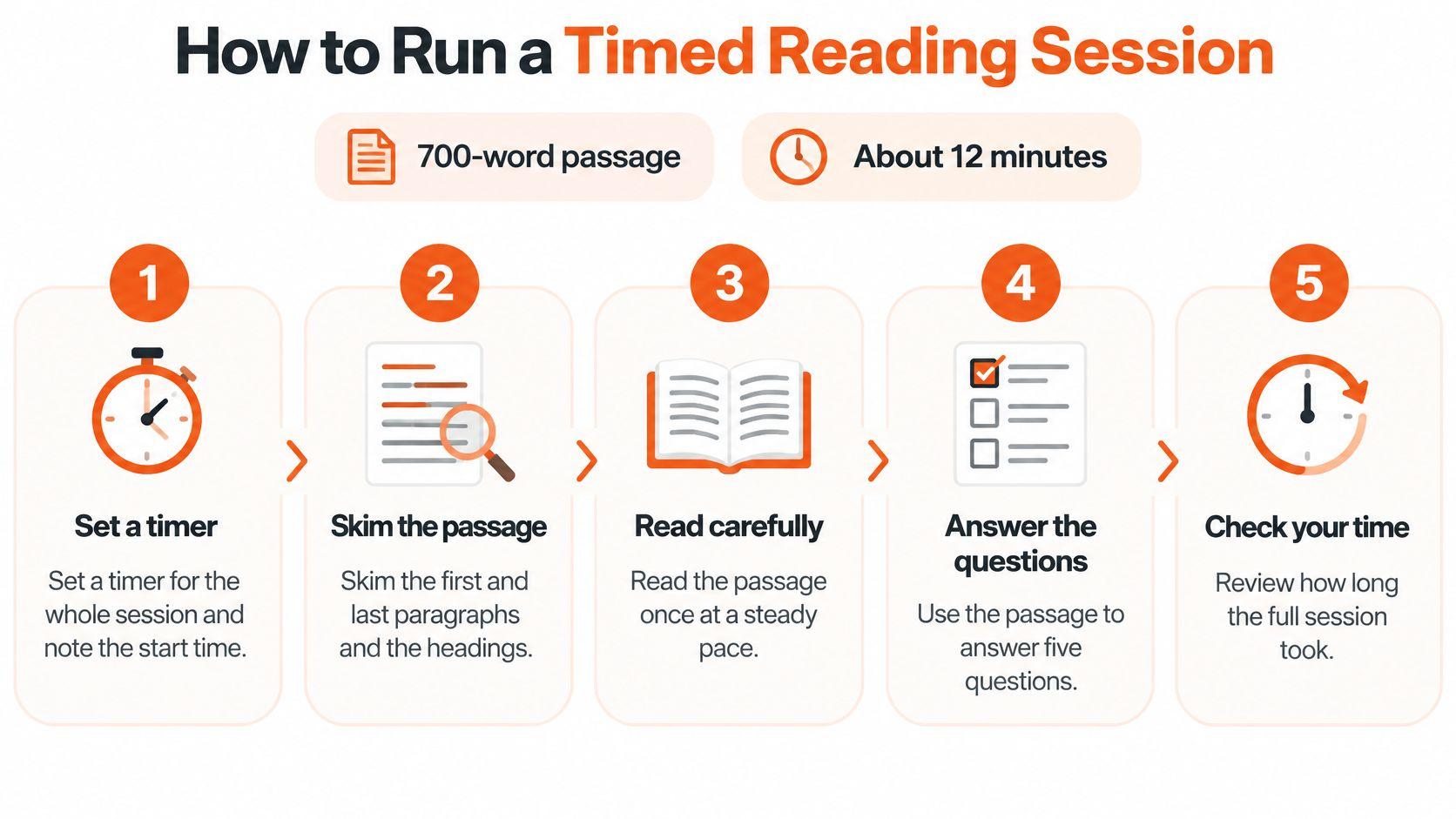
Use a repeatable session you can finish on a busy day. For example, take a 700-word passage with five questions in about 12 minutes. The point isn't speed for its own sake. It's learning where your time goes and whether you can still find evidence when the clock is moving.
The visual below shows the basic shape of the session before you add the evidence steps.
Seven Steps for One Set
-
Set a timer for the whole session. Note the start time where you'll see it. One timer for the full set teaches pacing, while resetting after each question hides the habit of spending too long early.
-
Skim for gist in about 60 seconds. Read the first and last paragraphs and the topic sentence of each middle paragraph. You're building a map of the passage, not understanding every line yet.
-
Read the questions before a full read. Underline the keyword in each detail question. Mark M beside main idea questions and I beside inference questions, so you know which answers need the whole text and which need one proof sentence.
-
Read the passage more slowly. As you read, write a paragraph number beside each question where its answer seems to sit. This keeps evidence in the text instead of in your memory, where details blur together.
-
Answer every question. Don't leave blanks, even when you're unsure. Circle a confidence mark, sure or unsure, beside each answer. Unsure correct answers still need review later, because a lucky guess isn't a reliable skill.
-
Check the timer halfway. If you've used more than half the time on fewer than half the questions, move on and return later. One stubborn inference question shouldn't take the time you need for two detail questions you can prove.
-
Stop when the timer ends. Score the set exactly as it stands, even if one question is unfinished. An honest unfinished set gives you better pacing information than a set you extended by five minutes.
What a Healthy First Session Looks Like
Don't worry if your first log is uneven. Many learners miss more inference items than detail items at the start, because inference asks you to connect evidence rather than copy it. Look for a steady time per question and a clear pattern in your errors. That pattern is more useful than the raw score.
Mix your text types as the weeks pass. The official CELPIP-General format lists 38 Reading questions in approximately 43 to 56 minutes, across Reading Correspondence, Reading to Apply a Diagram, Reading for Information, and Reading for Viewpoints. Practise switching between letters, informational texts, diagrams, and opinion passages instead of using only one familiar format.
Answer difficult items with the same effort as easy ones. The CELPIP test taker guidebook explains that unscored content can appear anywhere in the Reading test, uses the same format as scored content, and cannot be identified while taking the exam. You can't safely skip an odd question by assuming it's experimental.
Question Strategies That Hold Up Under Time Pressure
Time pressure makes familiar words feel like evidence. They aren't. Three habits protect you when you're tempted to choose the option that sounds right and move on.
Follow the Evidence Trail
For every answer you pick, copy or underline the sentence that proves it. If you can't point to a sentence, you're guessing. That's sometimes necessary at the end of a timed set, but label it as a guess in your log so you review it later.
The evidence trail changes how options look. Say a passage describes a city that added bus lanes and then saw ridership rise. Officials say they support keeping the lanes. The question asks why officials support them.
- Supported option: Officials support the lanes because ridership rose after the lanes were added.
- Unsupported distractor: Officials support the lanes because they cut the city's fuel costs.
The second option could be true in another city. It might even sound like a sensible transport policy. But the passage never mentions fuel costs, so it fails the not-stated check. For detail questions especially, reject any option the text doesn't support, even if it's true elsewhere.
The same pattern appears everywhere. Say a passage explains that a company introduced flexible Fridays and staff reported fewer sick days. A question asks why managers kept the policy. The proof sentence points to fewer sick days. A distractor claiming the policy lowered office rent may be plausible, but if rent never appears in the text, it's not evidence.
Compare Claim Strength When Two Options Remain
Test writers often build distractors by overstating what the passage says. Between two close options, be suspicious of absolute words such as always, only, never, or proves, unless the passage itself uses that strong language. A cautious option using words like "may", "some", or "suggests" often matches a cautious author.
Don't treat this as a shortcut that replaces reading. Use it after you've checked the evidence. First cross out options with no proof sentence. Then, if two options still compete, ask which one claims exactly what the text claims, no more and no less.
If an option is stronger than the passage, it needs stronger evidence than the passage gave you. When that evidence isn't there, cross it out.
Use a Fixed Rule for Guesses
Guessing shouldn't feel random. Eliminate two options first, using the not-stated check and claim strength. Then choose between the final two by asking which one has a sentence you can quote. Never leave a blank, because a blank teaches you nothing about how close your reasoning was.
Finish with a 30-second drill. Take one answered question from your last set, find its proof sentence, and rewrite that sentence in your own words without looking at the options. If your version matches your chosen answer, your reasoning is solid. If it doesn't, you've found exactly where your understanding drifted.
Handling Unfamiliar Words and Dense Passages
Most unknown words don't need to be known. That's the rule that saves the most time. Replace the word with a plausible guess from its sentence, reread the sentence with your guess in place, and move on if the meaning still fits. You can note the word for later, but don't stop the whole passage for it.
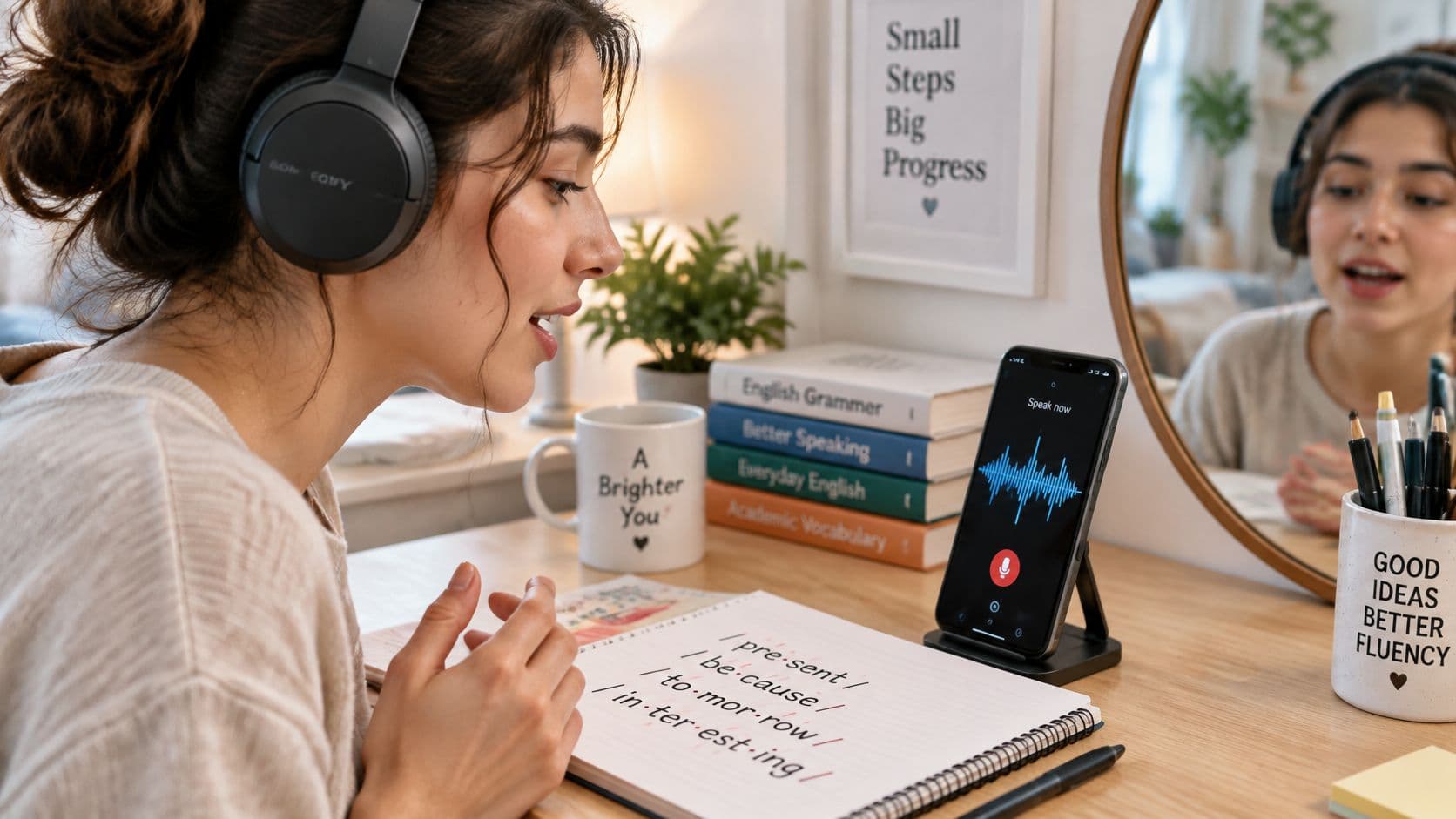
This short study scene reflects the habit you're building, reading actively and noting only what you'll revisit.

Let Signal Words Show the Direction
Connectors often reveal a sentence's direction faster than its vocabulary does. If you know a contrast is coming, you can predict the shape of the next idea even when a noun or adjective is unfamiliar. Keep this table open during practice until the predictions become automatic. For extra word work alongside passages, our CELPIP vocabulary resources can support the words you collect from your own reading.
| Signal words | Relationship signalled | What to predict next |
|---|---|---|
| however, although, but | Contrast | The second idea reverses or limits the first |
| so, therefore, as a result | Cause and effect | The next sentence gives the outcome |
| for example, such as | Illustration | An example supports a general claim made just before |
| in addition, furthermore | Addition | More detail in the same direction |
| on the other hand, in contrast | Reversal | The answer will be the opposing view |
Watch this short video for another walk-through of working through a passage when the language feels dense.
Recover When a Whole Passage Feels Unfamiliar
Sometimes the topic itself is the problem. You may know the individual words but not the subject, so every paragraph feels heavy. Read the first sentence of each paragraph, name the topic in plain words, and mark the single sentence you don't understand instead of rereading the whole paragraph.
Many learners lose minutes rereading from the top, hoping the meaning will settle. It rarely does on the third pass. Skimming forward once gives you context from later sentences, and that context often opens up the marked line when you return to it.
Close each week with a small vocabulary habit. Keep a list of ten words a week from passages you've read. Use each word while summarising a different passage during the same week. Meaning built from varied contexts sticks better in timed reading than a definition you memorised once from a flashcard.
Answer Review That Turns Mistakes Into Progress
Checking only your score wastes the most useful part of practice. A Harvard Graduate School of Education summary of a review of 66 observational studies of K-12 reading instruction found that comprehension received only 23% of instructional time, and that repeated vocabulary exposure, background-knowledge development, text-based discussion, and both literal and inferential questioning were underused. For self-study, the lesson is clear. More questions alone won't teach you why an answer works.
After each set, open every wrong answer, and every unsure correct answer, and write three things. Write the question type, the sentence that proves the right answer, and the reason you chose the wrong one. Our guide to effective study methods fits well with this kind of active review.
| Error type | Sign in your log | Fix |
|---|---|---|
| Misread question | You chose a true statement that answers a different question | Underline the key term in the question before reading the options |
| Missed inference | Answer was too strong or too literal | Ask what the text proves, not what is merely possible |
| Vocabulary guess | You picked an option built around a familiar word | Reread the sentence with the guessed meaning and check it fits |
| Time overrun | Set finished after the timer ran out | Set a checkpoint at the halfway mark and move on |
| Lost evidence | You could not find a sentence to support your answer | Reread the sentence containing the signal word |
Say you miss four inference questions in one set and each wrong option was possible but unsupported. Your fix isn't another full set tomorrow. It's asking what the text proves before reading the options, then rechecking those same four items three days later. Spend ten minutes every Sunday counting error types in your log, and carry the most frequent one into the next week's drills.
Start Your First Timed Reading Set This Week
Tomorrow morning, use what you already have. Choose one passage you trust: a library book, a quality newspaper article, or an exam-style exercise. Set a kitchen timer for the length you practiced in earlier sessions, answer every question, then score the set. Before you close the book, fill in the error log. Treat the timer as a rehearsal, and treat each wrong answer as the part of the rehearsal worth studying.
Do that once a day for four weeks, or four times a week if daily reading is unrealistic. Each week, add one harder text: a longer opinion piece, a passage on an unfamiliar topic, or a set with denser vocabulary. Keep the same review habit. If inference questions stay at the top of your log, add short inference drills. If detail errors appear when the clock speeds up, slow your scanning and check synonyms before you choose.
When you want timed, exam-style practice with feedback, our Reading coach builds comprehension with correspondence, diagrams, and viewpoint analysis exercises that match the exam. Feedback arrives as one response, one specific weakness, and one achievable correction, so the next attempt has a clear target. You can also test your pacing with CELPIP mock test practice before committing to a longer routine. The free plan includes 1 exercise per task type, 3 starter templates, one vocabulary bundle per section, and 3 submissions per day.
After four weeks, take a fresh passage under the timer and compare its error log with week one. Read the change by question type, not just by raw percentage. The official CELPIP score comparison information maps CELPIP 9 to CLB 9 and CELPIP 10 to CLB 10. Use that mapping as a reference point; your own log shows which reading habits still need work.
Run your first timed set this week, review every wrong answer, and carry one correction into the next attempt. Visit Celprep to try a Reading exercise and see the specific weakness that should shape your next session.